Eric D. Sun, Olivia Y. Zhou, Max Hauptschein, Nimrod Rappoport, Lucy Xu, Paloma Navarro Negredo, Ling Liu, Thomas A. Rando, James Zou, Anne Brunet
{"title":"Spatial transcriptomic clocks reveal cell proximity effects in brain ageing","authors":"Eric D. Sun, Olivia Y. Zhou, Max Hauptschein, Nimrod Rappoport, Lucy Xu, Paloma Navarro Negredo, Ling Liu, Thomas A. Rando, James Zou, Anne Brunet","doi":"10.1038/s41586-024-08334-8","DOIUrl":null,"url":null,"abstract":"Old age is associated with a decline in cognitive function and an increase in neurodegenerative disease risk1. Brain ageing is complex and is accompanied by many cellular changes2. Furthermore, the influence that aged cells have on neighbouring cells and how this contributes to tissue decline is unknown. More generally, the tools to systematically address this question in ageing tissues have not yet been developed. Here we generate a spatially resolved single-cell transcriptomics brain atlas of 4.2 million cells from 20 distinct ages across the adult lifespan and across two rejuvenating interventions—exercise and partial reprogramming. We build spatial ageing clocks, machine learning models trained on this spatial transcriptomics atlas, to identify spatial and cell-type-specific transcriptomic fingerprints of ageing, rejuvenation and disease, including for rare cell types. Using spatial ageing clocks and deep learning, we find that T cells, which increasingly infiltrate the brain with age, have a marked pro-ageing proximity effect on neighbouring cells. Surprisingly, neural stem cells have a strong pro-rejuvenating proximity effect on neighbouring cells. We also identify potential mediators of the pro-ageing effect of T cells and the pro-rejuvenating effect of neural stem cells on their neighbours. These results suggest that rare cell types can have a potent influence on their neighbours and could be targeted to counter tissue ageing. Spatial ageing clocks represent a useful tool for studying cell–cell interactions in spatial contexts and should allow scalable assessment of the efficacy of interventions for ageing and disease. A spatially resolved single-cell transcriptomics map of the mouse brain at different ages reveals signatures of ageing, rejuvenation and disease, including ageing effects associated with T cells and rejuvenation associated with neural stem cells.","PeriodicalId":18787,"journal":{"name":"Nature","volume":"638 8049","pages":"160-171"},"PeriodicalIF":48.5000,"publicationDate":"2024-12-18","publicationTypes":"Journal Article","fieldsOfStudy":null,"isOpenAccess":false,"openAccessPdf":"https://www.nature.com/articles/s41586-024-08334-8.pdf","citationCount":"0","resultStr":null,"platform":"Semanticscholar","paperid":null,"PeriodicalName":"Nature","FirstCategoryId":"103","ListUrlMain":"https://www.nature.com/articles/s41586-024-08334-8","RegionNum":1,"RegionCategory":"综合性期刊","ArticlePicture":[],"TitleCN":null,"AbstractTextCN":null,"PMCID":null,"EPubDate":"","PubModel":"","JCR":"Q1","JCRName":"MULTIDISCIPLINARY SCIENCES","Score":null,"Total":0}
引用次数: 0
Abstract
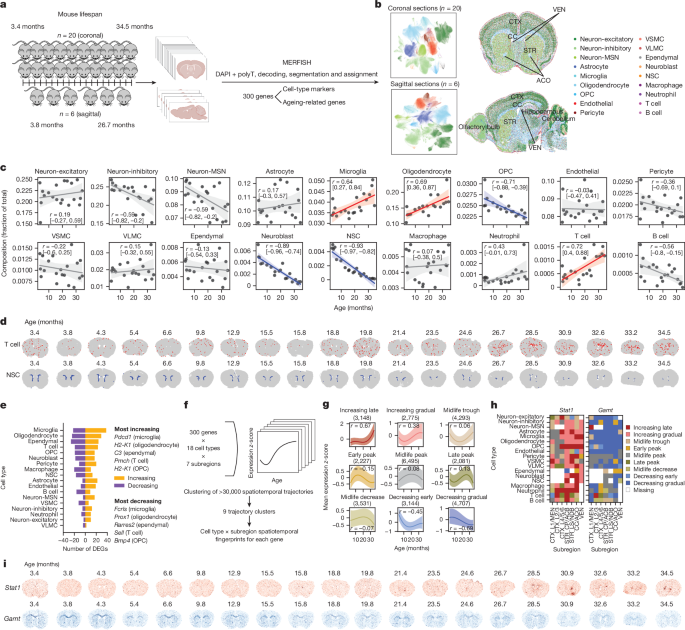
Old age is associated with a decline in cognitive function and an increase in neurodegenerative disease risk1. Brain ageing is complex and is accompanied by many cellular changes2. Furthermore, the influence that aged cells have on neighbouring cells and how this contributes to tissue decline is unknown. More generally, the tools to systematically address this question in ageing tissues have not yet been developed. Here we generate a spatially resolved single-cell transcriptomics brain atlas of 4.2 million cells from 20 distinct ages across the adult lifespan and across two rejuvenating interventions—exercise and partial reprogramming. We build spatial ageing clocks, machine learning models trained on this spatial transcriptomics atlas, to identify spatial and cell-type-specific transcriptomic fingerprints of ageing, rejuvenation and disease, including for rare cell types. Using spatial ageing clocks and deep learning, we find that T cells, which increasingly infiltrate the brain with age, have a marked pro-ageing proximity effect on neighbouring cells. Surprisingly, neural stem cells have a strong pro-rejuvenating proximity effect on neighbouring cells. We also identify potential mediators of the pro-ageing effect of T cells and the pro-rejuvenating effect of neural stem cells on their neighbours. These results suggest that rare cell types can have a potent influence on their neighbours and could be targeted to counter tissue ageing. Spatial ageing clocks represent a useful tool for studying cell–cell interactions in spatial contexts and should allow scalable assessment of the efficacy of interventions for ageing and disease. A spatially resolved single-cell transcriptomics map of the mouse brain at different ages reveals signatures of ageing, rejuvenation and disease, including ageing effects associated with T cells and rejuvenation associated with neural stem cells.
期刊介绍:
Nature is a prestigious international journal that publishes peer-reviewed research in various scientific and technological fields. The selection of articles is based on criteria such as originality, importance, interdisciplinary relevance, timeliness, accessibility, elegance, and surprising conclusions. In addition to showcasing significant scientific advances, Nature delivers rapid, authoritative, insightful news, and interpretation of current and upcoming trends impacting science, scientists, and the broader public. The journal serves a dual purpose: firstly, to promptly share noteworthy scientific advances and foster discussions among scientists, and secondly, to ensure the swift dissemination of scientific results globally, emphasizing their significance for knowledge, culture, and daily life.




 京公网安备 11010802042870号
京ICP备2023020795号-1
京公网安备 11010802042870号
京ICP备2023020795号-1

 分享
分享
 求助内容:
求助内容: 应助结果提醒方式:
 扫码关注我们
