Xiaojing Wang, Yiming Xu, Siyuan Xiang, Shengyang Tao, Wendong Liu
{"title":"Hydrogel-Assisted Robust Supraparticles Evolved from Droplet Evaporation","authors":"Xiaojing Wang, Yiming Xu, Siyuan Xiang, Shengyang Tao, Wendong Liu","doi":"10.1021/acsnano.4c15025","DOIUrl":null,"url":null,"abstract":"Supraparticles, formed through the self-assembly of nanoparticles, are promising contenders in catalysis, sensing, and drug delivery due to their exceptional specific surface area and porosity. However, their mechanical resilience, especially in dimensions spanning micrometers and beyond, is challenged by the inherently weak interactions among their constituent building blocks, significantly constraining their broad applicability. Here, we have exploited a robust supraparticle fabrication strategy by integrating hydrogel components into the assembly system and evaporating on the superamphiphobic surface. The resultant SiO<sub>2</sub>/SA (sodium alginate) supraparticles, achieved by evaporating a 15% volume fraction dispersion of SiO<sub>2</sub> nanoparticles containing 18.46 mg/mL of sodium alginate and subsequently cross-linking with Ca<sup>2+</sup>, demonstrate mechanical robustness with a fracture force of 6.04 N, representing a mechanical strength enhancement of 60 times higher than that prior to the incorporation of the hydrogel component. The supraparticles maintain their original morphology after 30 min of ultrasonic treatment (200 W), demonstrating mechanical stability. This method exhibits generalizability, enabling the customization of supraparticles with various building blocks and hydrogel backbone materials. Based on such a methodology, we have synthesized enzyme-carrying supraparticles, further expanding the potential applications in intricate cascade reactions. The encapsulated glucose oxidase and horseradish peroxidase maintained their inherent reactivity, and such hydrogel-assisted robust supraparticles exhibited exceptional performance in accurate glucose assays, indicating great practical application in biocatalysis.","PeriodicalId":21,"journal":{"name":"ACS Nano","volume":"186 1","pages":""},"PeriodicalIF":16.0000,"publicationDate":"2024-12-19","publicationTypes":"Journal Article","fieldsOfStudy":null,"isOpenAccess":false,"openAccessPdf":"","citationCount":"0","resultStr":null,"platform":"Semanticscholar","paperid":null,"PeriodicalName":"ACS Nano","FirstCategoryId":"88","ListUrlMain":"https://doi.org/10.1021/acsnano.4c15025","RegionNum":1,"RegionCategory":"材料科学","ArticlePicture":[],"TitleCN":null,"AbstractTextCN":null,"PMCID":null,"EPubDate":"","PubModel":"","JCR":"Q1","JCRName":"CHEMISTRY, MULTIDISCIPLINARY","Score":null,"Total":0}
引用次数: 0
Abstract
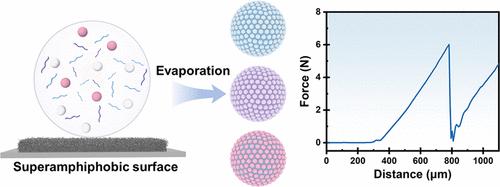
Supraparticles, formed through the self-assembly of nanoparticles, are promising contenders in catalysis, sensing, and drug delivery due to their exceptional specific surface area and porosity. However, their mechanical resilience, especially in dimensions spanning micrometers and beyond, is challenged by the inherently weak interactions among their constituent building blocks, significantly constraining their broad applicability. Here, we have exploited a robust supraparticle fabrication strategy by integrating hydrogel components into the assembly system and evaporating on the superamphiphobic surface. The resultant SiO2/SA (sodium alginate) supraparticles, achieved by evaporating a 15% volume fraction dispersion of SiO2 nanoparticles containing 18.46 mg/mL of sodium alginate and subsequently cross-linking with Ca2+, demonstrate mechanical robustness with a fracture force of 6.04 N, representing a mechanical strength enhancement of 60 times higher than that prior to the incorporation of the hydrogel component. The supraparticles maintain their original morphology after 30 min of ultrasonic treatment (200 W), demonstrating mechanical stability. This method exhibits generalizability, enabling the customization of supraparticles with various building blocks and hydrogel backbone materials. Based on such a methodology, we have synthesized enzyme-carrying supraparticles, further expanding the potential applications in intricate cascade reactions. The encapsulated glucose oxidase and horseradish peroxidase maintained their inherent reactivity, and such hydrogel-assisted robust supraparticles exhibited exceptional performance in accurate glucose assays, indicating great practical application in biocatalysis.
期刊介绍:
ACS Nano, published monthly, serves as an international forum for comprehensive articles on nanoscience and nanotechnology research at the intersections of chemistry, biology, materials science, physics, and engineering. The journal fosters communication among scientists in these communities, facilitating collaboration, new research opportunities, and advancements through discoveries. ACS Nano covers synthesis, assembly, characterization, theory, and simulation of nanostructures, nanobiotechnology, nanofabrication, methods and tools for nanoscience and nanotechnology, and self- and directed-assembly. Alongside original research articles, it offers thorough reviews, perspectives on cutting-edge research, and discussions envisioning the future of nanoscience and nanotechnology.



 京公网安备 11010802042870号
京ICP备2023020795号-1
京公网安备 11010802042870号
京ICP备2023020795号-1

 分享
分享
 求助内容:
求助内容: 应助结果提醒方式:
 扫码关注我们
