{"title":"Why Mixed Halides in 2D Chiral Perovskites Weaken Chirality-Induced Spin Selectivity","authors":"Soirik Dan, Subham Paramanik, Amlan J. Pal","doi":"10.1021/acsnano.4c14328","DOIUrl":null,"url":null,"abstract":"2D Ruddlesden–Popper (RP) perovskites, upon inclusion of a chiral amine, exhibit chirality-induced spin selectivity (CISS). Although alloying at the halogen site in MBA-based RPs (MBA: methylbenzylammonium) is one of the suitable routes to tune the CISS effect, the mixed-halide RP perovskites exhibited complete suppression of chirality when probed through circular dichroism (CD). Here, we present the CISS effect in a series of mixed-halide RP perovskites. We show that photoinduced halide segregation is the origin for the apparent chirality suppression. The spin-dependent charge transport was evidenced through magnetic-conducting atomic force microscopy (mc-AFM) studies and magnetoresistance (MR) measurements. The mc-AFM results show that in (<i>R</i>/<i>S</i>-MBA)<sub>2</sub>PbI<sub>4(1–<i>x</i>)</sub>Br<sub>4<i>x</i></sub>, the CISS effect decreases with bromide inclusion, nonmonotonically; the microstrain developed in the lattice and the spin-polarized charge transport are found to be correlated. Such a behavior has been explained through an inhomogeneity in the strength of the hydrogen bond between the organic moieties and halogens in the inorganic framework of the compounds. Our results further inferred that the hydrogen-bond-induced coupling transfers the chirality from the amine to the inorganic sublattice. The work explains the weakened CISS effect in mixed-halide chiral RP perovskites and provides a strategy to tune the spin-polarized charge transport as well.","PeriodicalId":21,"journal":{"name":"ACS Nano","volume":"10 1","pages":""},"PeriodicalIF":16.0000,"publicationDate":"2024-12-18","publicationTypes":"Journal Article","fieldsOfStudy":null,"isOpenAccess":false,"openAccessPdf":"","citationCount":"0","resultStr":null,"platform":"Semanticscholar","paperid":null,"PeriodicalName":"ACS Nano","FirstCategoryId":"88","ListUrlMain":"https://doi.org/10.1021/acsnano.4c14328","RegionNum":1,"RegionCategory":"材料科学","ArticlePicture":[],"TitleCN":null,"AbstractTextCN":null,"PMCID":null,"EPubDate":"","PubModel":"","JCR":"Q1","JCRName":"CHEMISTRY, MULTIDISCIPLINARY","Score":null,"Total":0}
引用次数: 0
Abstract
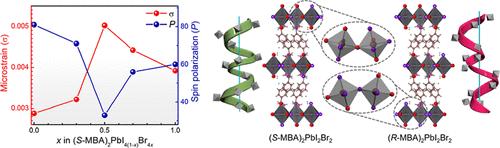
2D Ruddlesden–Popper (RP) perovskites, upon inclusion of a chiral amine, exhibit chirality-induced spin selectivity (CISS). Although alloying at the halogen site in MBA-based RPs (MBA: methylbenzylammonium) is one of the suitable routes to tune the CISS effect, the mixed-halide RP perovskites exhibited complete suppression of chirality when probed through circular dichroism (CD). Here, we present the CISS effect in a series of mixed-halide RP perovskites. We show that photoinduced halide segregation is the origin for the apparent chirality suppression. The spin-dependent charge transport was evidenced through magnetic-conducting atomic force microscopy (mc-AFM) studies and magnetoresistance (MR) measurements. The mc-AFM results show that in (R/S-MBA)2PbI4(1–x)Br4x, the CISS effect decreases with bromide inclusion, nonmonotonically; the microstrain developed in the lattice and the spin-polarized charge transport are found to be correlated. Such a behavior has been explained through an inhomogeneity in the strength of the hydrogen bond between the organic moieties and halogens in the inorganic framework of the compounds. Our results further inferred that the hydrogen-bond-induced coupling transfers the chirality from the amine to the inorganic sublattice. The work explains the weakened CISS effect in mixed-halide chiral RP perovskites and provides a strategy to tune the spin-polarized charge transport as well.
期刊介绍:
ACS Nano, published monthly, serves as an international forum for comprehensive articles on nanoscience and nanotechnology research at the intersections of chemistry, biology, materials science, physics, and engineering. The journal fosters communication among scientists in these communities, facilitating collaboration, new research opportunities, and advancements through discoveries. ACS Nano covers synthesis, assembly, characterization, theory, and simulation of nanostructures, nanobiotechnology, nanofabrication, methods and tools for nanoscience and nanotechnology, and self- and directed-assembly. Alongside original research articles, it offers thorough reviews, perspectives on cutting-edge research, and discussions envisioning the future of nanoscience and nanotechnology.



 京公网安备 11010802042870号
京ICP备2023020795号-1
京公网安备 11010802042870号
京ICP备2023020795号-1

 分享
分享
 求助内容:
求助内容: 应助结果提醒方式:
 扫码关注我们
