{"title":"Transferrin Protein Corona-Targeted Codelivery of Tirapazamine and IR820 Facilitates Efficient PDT-Induced Hypoxic Chemotherapy on 4T1 Breast Cancer","authors":"Mingji Jin, Hao Wu, Wenyu Jin, Bowen Zeng, Yanhong Liu, Nuoya Wang, Shuangqing Wang, Liqing Chen, Zhonggao Gao, Wei Huang","doi":"10.1021/acsami.4c15045","DOIUrl":null,"url":null,"abstract":"Protein corona (PC) formation confers novel biological properties to the original nanomaterial, impeding its uptake and targeting efficacy in cells and tissues. Although many studies discussing PC formation have focused on inert proteins that may inhibit the function of nanomaterials, some functional plasma proteins with intrinsic targeting capabilities can also be adsorbed to the surface of nanomaterials, with active ligand properties to improve the targeting ability. In this approach, nanomaterials are surface-engineered to promote the adsorption of specific functional plasma proteins that are directly targeted to transport nanomaterials to the target site. In this study, T<sub>10</sub> peptide-modified liposomes were employed to construct an <i>in situ</i> transferrin (Tf) PC-mediated liposome carrying a hypoxia-sensitive chemotherapy drug (tirapazamine, TPZ) and a photosensitizer (indocyanine green, IR820). The water-soluble drug TPZ was encapsulated in mesoporous silica nanoparticles (MSNs) and coated with IR820 (IR)-loaded liposome. Lipid-coated MSNs can inhibit aggregation in the body and significantly reduce the rapid release of water-soluble drugs, resulting in improved system stability and sustained release. Upon entering the <i>in vivo</i> circulation, T<sub>10</sub> bound specifically to Tf in plasma to form an <i>in situ</i> Tf liposome–PC complex with enhanced targeting efficacy compared to traditional ligand-modified active-targeting strategies. However, large-sized PC particles faced challenges in penetrating deep into tumor tissues. IR could kill tumors through photodynamic therapy (PDT) and elicit complementary antitumor effects with the hypoxia-sensitive drug TPZ. This study demonstrates the novel design of <i>in situ</i> PC-mediated multifunctional liposomes for hypoxia-activated chemotherapy combined with PDT, a promising approach to cancer therapy.","PeriodicalId":5,"journal":{"name":"ACS Applied Materials & Interfaces","volume":"87 1","pages":""},"PeriodicalIF":8.2000,"publicationDate":"2024-12-19","publicationTypes":"Journal Article","fieldsOfStudy":null,"isOpenAccess":false,"openAccessPdf":"","citationCount":"0","resultStr":null,"platform":"Semanticscholar","paperid":null,"PeriodicalName":"ACS Applied Materials & Interfaces","FirstCategoryId":"88","ListUrlMain":"https://doi.org/10.1021/acsami.4c15045","RegionNum":2,"RegionCategory":"材料科学","ArticlePicture":[],"TitleCN":null,"AbstractTextCN":null,"PMCID":null,"EPubDate":"","PubModel":"","JCR":"Q1","JCRName":"MATERIALS SCIENCE, MULTIDISCIPLINARY","Score":null,"Total":0}
引用次数: 0
Abstract
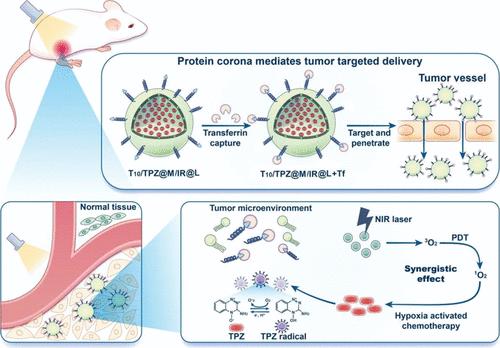
Protein corona (PC) formation confers novel biological properties to the original nanomaterial, impeding its uptake and targeting efficacy in cells and tissues. Although many studies discussing PC formation have focused on inert proteins that may inhibit the function of nanomaterials, some functional plasma proteins with intrinsic targeting capabilities can also be adsorbed to the surface of nanomaterials, with active ligand properties to improve the targeting ability. In this approach, nanomaterials are surface-engineered to promote the adsorption of specific functional plasma proteins that are directly targeted to transport nanomaterials to the target site. In this study, T10 peptide-modified liposomes were employed to construct an in situ transferrin (Tf) PC-mediated liposome carrying a hypoxia-sensitive chemotherapy drug (tirapazamine, TPZ) and a photosensitizer (indocyanine green, IR820). The water-soluble drug TPZ was encapsulated in mesoporous silica nanoparticles (MSNs) and coated with IR820 (IR)-loaded liposome. Lipid-coated MSNs can inhibit aggregation in the body and significantly reduce the rapid release of water-soluble drugs, resulting in improved system stability and sustained release. Upon entering the in vivo circulation, T10 bound specifically to Tf in plasma to form an in situ Tf liposome–PC complex with enhanced targeting efficacy compared to traditional ligand-modified active-targeting strategies. However, large-sized PC particles faced challenges in penetrating deep into tumor tissues. IR could kill tumors through photodynamic therapy (PDT) and elicit complementary antitumor effects with the hypoxia-sensitive drug TPZ. This study demonstrates the novel design of in situ PC-mediated multifunctional liposomes for hypoxia-activated chemotherapy combined with PDT, a promising approach to cancer therapy.
期刊介绍:
ACS Applied Materials & Interfaces is a leading interdisciplinary journal that brings together chemists, engineers, physicists, and biologists to explore the development and utilization of newly-discovered materials and interfacial processes for specific applications. Our journal has experienced remarkable growth since its establishment in 2009, both in terms of the number of articles published and the impact of the research showcased. We are proud to foster a truly global community, with the majority of published articles originating from outside the United States, reflecting the rapid growth of applied research worldwide.



 京公网安备 11010802042870号
京ICP备2023020795号-1
京公网安备 11010802042870号
京ICP备2023020795号-1

 分享
分享
 求助内容:
求助内容: 应助结果提醒方式:
 扫码关注我们
