{"title":"Engineering a Binding Peptide for Oriented Immobilization and Efficient Bioelectrocatalytic Oxygen Reduction of Multicopper Oxidases","authors":"Meng Zhang, Xiufeng Wang, Weisong Liu, Xinyu Cui, Yuanming Wang, Lin Fan, Huijuan Cui, Yanbing Shen, Haiyang Cui, Lingling Zhang","doi":"10.1021/acsami.4c12970","DOIUrl":null,"url":null,"abstract":"Enzymatic fuel cells (EFCs) are emerging as promising technologies in renewable energy and biomedical applications, utilizing enzyme catalysts to convert the chemical energy of renewable biomass into electrical energy, known for their high energy conversion efficiency and excellent biocompatibility. Currently, EFCs face challenges of poor stability and catalytic efficiency at the cathodes, necessitating solutions to enhance the oriented immobilization of multicopper oxidases for improved heterogeneous electron transfer efficiency. This study successfully identified a surface-binding peptide (SBP, 13 amino acids) derived from a methionine-rich fragment (MetRich, 53 amino acids) in <i>E. coli</i> CueO through semirational design. The first phase of engineering focused on the structural characteristics of MetRich, pinpointing fragment N394-H406 (SBP 1.0, corresponding to variant CueO-M12) as the key region dominating the binding. Subsequent site-saturation mutagenesis, combined with electrochemical screening, yielded three variants, and among them, the variant CueO-M12-1 (CueO-M12 H398I) exhibited a more uniform favorable orientation with a 1.38-fold increase in current density. Further electrocatalytic kinetics analysis revealed a significant 21.2-fold improvement in kinetics current density (<i>J</i><sub><i>k</i></sub>) compared with that of CueO-WT, leading to the development of SBP 2.0. When SBPs were fused to laccase from <i>Bacillus pumilus</i> (<i>Bp</i>L) and fungal bilirubin oxidase from <i>Myrothecium verrucaria</i> (<i>Mv</i>BOD), respectively, they transformed a sluggish adsorption process into a rapid and oriented one. In addition, compared with SBP 1.0, SBP 2.0 endows <i>Bp</i>L and <i>Mv</i>BOD with enhanced electrocatalytic capabilities for oxygen reduction and glucose/O<sub>2</sub> EFC performance. The engineered SBPs are promising for serving as a versatile “glue” to enable the immobilization of oxidoreductases in an oriented manner, which leads to a breakthrough in bioelectrocatalysis and thereby overcoming the current bottleneck of EFCs.","PeriodicalId":5,"journal":{"name":"ACS Applied Materials & Interfaces","volume":"62 1","pages":""},"PeriodicalIF":8.2000,"publicationDate":"2024-12-18","publicationTypes":"Journal Article","fieldsOfStudy":null,"isOpenAccess":false,"openAccessPdf":"","citationCount":"0","resultStr":null,"platform":"Semanticscholar","paperid":null,"PeriodicalName":"ACS Applied Materials & Interfaces","FirstCategoryId":"88","ListUrlMain":"https://doi.org/10.1021/acsami.4c12970","RegionNum":2,"RegionCategory":"材料科学","ArticlePicture":[],"TitleCN":null,"AbstractTextCN":null,"PMCID":null,"EPubDate":"","PubModel":"","JCR":"Q1","JCRName":"MATERIALS SCIENCE, MULTIDISCIPLINARY","Score":null,"Total":0}
引用次数: 0
Abstract
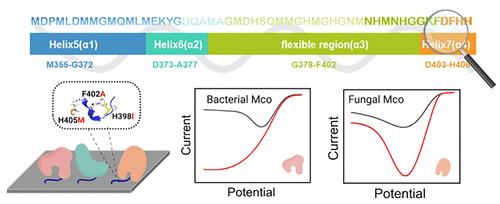
Enzymatic fuel cells (EFCs) are emerging as promising technologies in renewable energy and biomedical applications, utilizing enzyme catalysts to convert the chemical energy of renewable biomass into electrical energy, known for their high energy conversion efficiency and excellent biocompatibility. Currently, EFCs face challenges of poor stability and catalytic efficiency at the cathodes, necessitating solutions to enhance the oriented immobilization of multicopper oxidases for improved heterogeneous electron transfer efficiency. This study successfully identified a surface-binding peptide (SBP, 13 amino acids) derived from a methionine-rich fragment (MetRich, 53 amino acids) in E. coli CueO through semirational design. The first phase of engineering focused on the structural characteristics of MetRich, pinpointing fragment N394-H406 (SBP 1.0, corresponding to variant CueO-M12) as the key region dominating the binding. Subsequent site-saturation mutagenesis, combined with electrochemical screening, yielded three variants, and among them, the variant CueO-M12-1 (CueO-M12 H398I) exhibited a more uniform favorable orientation with a 1.38-fold increase in current density. Further electrocatalytic kinetics analysis revealed a significant 21.2-fold improvement in kinetics current density (Jk) compared with that of CueO-WT, leading to the development of SBP 2.0. When SBPs were fused to laccase from Bacillus pumilus (BpL) and fungal bilirubin oxidase from Myrothecium verrucaria (MvBOD), respectively, they transformed a sluggish adsorption process into a rapid and oriented one. In addition, compared with SBP 1.0, SBP 2.0 endows BpL and MvBOD with enhanced electrocatalytic capabilities for oxygen reduction and glucose/O2 EFC performance. The engineered SBPs are promising for serving as a versatile “glue” to enable the immobilization of oxidoreductases in an oriented manner, which leads to a breakthrough in bioelectrocatalysis and thereby overcoming the current bottleneck of EFCs.
期刊介绍:
ACS Applied Materials & Interfaces is a leading interdisciplinary journal that brings together chemists, engineers, physicists, and biologists to explore the development and utilization of newly-discovered materials and interfacial processes for specific applications. Our journal has experienced remarkable growth since its establishment in 2009, both in terms of the number of articles published and the impact of the research showcased. We are proud to foster a truly global community, with the majority of published articles originating from outside the United States, reflecting the rapid growth of applied research worldwide.



 京公网安备 11010802042870号
京ICP备2023020795号-1
京公网安备 11010802042870号
京ICP备2023020795号-1

 分享
分享
 求助内容:
求助内容: 应助结果提醒方式:
 扫码关注我们
