Jianye Gao, Jun Zhao, Zerong Xing, Minghui Guo, Haijiao Xie, Wangjing Ma, Jing Liu
{"title":"Microwave-Powered Liquid Metal Degradation of Polyolefins","authors":"Jianye Gao, Jun Zhao, Zerong Xing, Minghui Guo, Haijiao Xie, Wangjing Ma, Jing Liu","doi":"10.1002/adma.202412539","DOIUrl":null,"url":null,"abstract":"<p>Upcycling waste plastics is highly promising to tackle global white pollution while achieving sustainable development. However, prevailing approaches often encounter challenges in scalable engineering practices due to either insufficient plastic upcycling capability or arduousness in the separation, recovery, and purification of catalysts, which inevitably augments the cost of plastic upcycling. Here, the microwave-powered liquid metal synergetic depolymerization is presented to facilitate low-cost plastic upcycling. By leveraging the fluidity of liquid metals and their exceptional chemical-bond activation ability under microwave field, this method efficiently converts various polyolefins into narrowband hydrocarbon oil (Oil yield: 81 wt.% for polypropylene (PP), 85.9 wt.% for polyethylene (PE)) and high-value olefin monomers (C<sub>2-4</sub><sup></sup> selectivity: 50% for PE, 65.3% for PP) over 30 successive cycles, resulting in a high turnover frequency of 2.83 kg<sub>Plastic</sub> mL<sub>Liquid metal</sub><sup>−1</sup>. These captivating advantages offered by electromagnetically-powered liquid metals are also supported by their self-separation features, thereby paving the way for large-scale engineering solutions in waste plastic upcycling.</p>","PeriodicalId":114,"journal":{"name":"Advanced Materials","volume":"37 6","pages":""},"PeriodicalIF":26.8000,"publicationDate":"2024-12-18","publicationTypes":"Journal Article","fieldsOfStudy":null,"isOpenAccess":false,"openAccessPdf":"","citationCount":"0","resultStr":null,"platform":"Semanticscholar","paperid":null,"PeriodicalName":"Advanced Materials","FirstCategoryId":"88","ListUrlMain":"https://advanced.onlinelibrary.wiley.com/doi/10.1002/adma.202412539","RegionNum":1,"RegionCategory":"材料科学","ArticlePicture":[],"TitleCN":null,"AbstractTextCN":null,"PMCID":null,"EPubDate":"","PubModel":"","JCR":"Q1","JCRName":"CHEMISTRY, MULTIDISCIPLINARY","Score":null,"Total":0}
引用次数: 0
Abstract
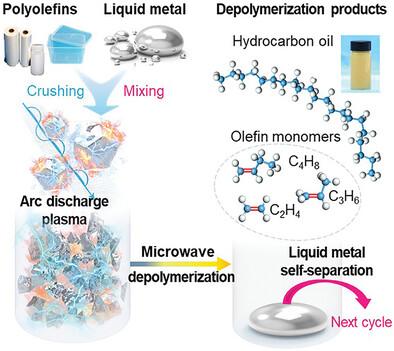
Upcycling waste plastics is highly promising to tackle global white pollution while achieving sustainable development. However, prevailing approaches often encounter challenges in scalable engineering practices due to either insufficient plastic upcycling capability or arduousness in the separation, recovery, and purification of catalysts, which inevitably augments the cost of plastic upcycling. Here, the microwave-powered liquid metal synergetic depolymerization is presented to facilitate low-cost plastic upcycling. By leveraging the fluidity of liquid metals and their exceptional chemical-bond activation ability under microwave field, this method efficiently converts various polyolefins into narrowband hydrocarbon oil (Oil yield: 81 wt.% for polypropylene (PP), 85.9 wt.% for polyethylene (PE)) and high-value olefin monomers (C2-4 selectivity: 50% for PE, 65.3% for PP) over 30 successive cycles, resulting in a high turnover frequency of 2.83 kgPlastic mLLiquid metal−1. These captivating advantages offered by electromagnetically-powered liquid metals are also supported by their self-separation features, thereby paving the way for large-scale engineering solutions in waste plastic upcycling.
期刊介绍:
Advanced Materials, one of the world's most prestigious journals and the foundation of the Advanced portfolio, is the home of choice for best-in-class materials science for more than 30 years. Following this fast-growing and interdisciplinary field, we are considering and publishing the most important discoveries on any and all materials from materials scientists, chemists, physicists, engineers as well as health and life scientists and bringing you the latest results and trends in modern materials-related research every week.





 京公网安备 11010802042870号
京ICP备2023020795号-1
京公网安备 11010802042870号
京ICP备2023020795号-1

 分享
分享
 求助内容:
求助内容: 应助结果提醒方式:
 扫码关注我们
