Muhammad Hikam, Putri P. P. Asri, Faiq H. Hamid, Ahmad Miftahul Anwar, Muhamad Nasir, Afriyanti Sumboja, Lia Amelia Tresna Wulan Asri
{"title":"Electrospun Poly(vinyl Alcohol)/Chitin Nanofiber Membrane as a Sustainable Lithium-Ion Battery Separator","authors":"Muhammad Hikam, Putri P. P. Asri, Faiq H. Hamid, Ahmad Miftahul Anwar, Muhamad Nasir, Afriyanti Sumboja, Lia Amelia Tresna Wulan Asri","doi":"10.1021/acs.langmuir.4c03369","DOIUrl":null,"url":null,"abstract":"Commercial battery separators are made of polyolefin polymers due to their desired mechanical strength and chemical stability. However, these materials are not biodegradable and are challenging to recycle. Considering the environmental issues from polyolefins, biodegradable polymers can be developed as separators to reduce the potential waste from polyolefin separators. In this work, we investigated the potential of poly(vinyl alcohol)/chitin nanofiber (PVA/CHNF) nanofiber as a sustainable lithium-ion battery separator, which was successfully fabricated via the electrospinning and cross-linking method. The PVA/CHNF separator is biodegradable and has an ionic conductivity (1.41 mS cm<sup>–1</sup>), desirable porosity (86%), good thermal stability (1.4% shrinkage upon heating at 90 °C for 1 h), as well as high electrolyte uptake (388%). The PVA/CHNF separator is also evaluated in the assembled Li//LiFePO<sub>4</sub> cells, showing an improved performance compared to the cell with the commercial separator. It shows a discharge capacity of 142 mAh g<sup>–1</sup>, which is stable throughout 120 charge–discharge cycles. Hence, according to these resulting properties, the PVA/CHNF separator shows promise as a sustainable and environmentally friendly lithium-ion battery separator, offering a high-value use of waste chitin materials.","PeriodicalId":50,"journal":{"name":"Langmuir","volume":"97 1","pages":""},"PeriodicalIF":3.9000,"publicationDate":"2024-12-20","publicationTypes":"Journal Article","fieldsOfStudy":null,"isOpenAccess":false,"openAccessPdf":"","citationCount":"0","resultStr":null,"platform":"Semanticscholar","paperid":null,"PeriodicalName":"Langmuir","FirstCategoryId":"92","ListUrlMain":"https://doi.org/10.1021/acs.langmuir.4c03369","RegionNum":2,"RegionCategory":"化学","ArticlePicture":[],"TitleCN":null,"AbstractTextCN":null,"PMCID":null,"EPubDate":"","PubModel":"","JCR":"Q2","JCRName":"CHEMISTRY, MULTIDISCIPLINARY","Score":null,"Total":0}
引用次数: 0
Abstract
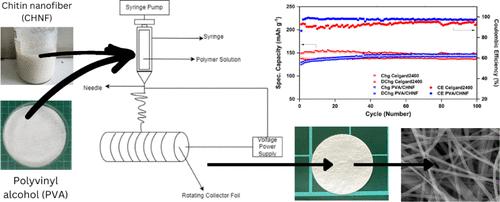
Commercial battery separators are made of polyolefin polymers due to their desired mechanical strength and chemical stability. However, these materials are not biodegradable and are challenging to recycle. Considering the environmental issues from polyolefins, biodegradable polymers can be developed as separators to reduce the potential waste from polyolefin separators. In this work, we investigated the potential of poly(vinyl alcohol)/chitin nanofiber (PVA/CHNF) nanofiber as a sustainable lithium-ion battery separator, which was successfully fabricated via the electrospinning and cross-linking method. The PVA/CHNF separator is biodegradable and has an ionic conductivity (1.41 mS cm–1), desirable porosity (86%), good thermal stability (1.4% shrinkage upon heating at 90 °C for 1 h), as well as high electrolyte uptake (388%). The PVA/CHNF separator is also evaluated in the assembled Li//LiFePO4 cells, showing an improved performance compared to the cell with the commercial separator. It shows a discharge capacity of 142 mAh g–1, which is stable throughout 120 charge–discharge cycles. Hence, according to these resulting properties, the PVA/CHNF separator shows promise as a sustainable and environmentally friendly lithium-ion battery separator, offering a high-value use of waste chitin materials.
商用电池分离器是由聚烯烃聚合物制成的,因为它们具有理想的机械强度和化学稳定性。然而,这些材料是不可生物降解的,很难回收利用。考虑到聚烯烃的环境问题,可以开发可生物降解聚合物作为聚烯烃分离器,以减少聚烯烃分离器的潜在浪费。本文研究了聚乙烯醇/几丁质纳米纤维(PVA/CHNF)作为可持续锂离子电池隔膜的潜力,并通过静电纺丝和交联法制备了PVA/CHNF纳米纤维。PVA/CHNF分离器是可生物降解的,具有离子电导率(1.41 mS cm-1),理想的孔隙率(86%),良好的热稳定性(在90°C加热1小时后收缩1.4%),以及高电解质吸收率(388%)。PVA/CHNF分离器还在组装的Li//LiFePO4电池中进行了评估,与商用分离器相比,PVA/CHNF分离器的性能有所提高。它的放电容量为142毫安时g-1,在120次充放电循环中保持稳定。因此,根据这些特性,PVA/CHNF分离器有望成为可持续和环保的锂离子电池分离器,为废弃甲壳素材料提供高价值的利用。
期刊介绍:
Langmuir is an interdisciplinary journal publishing articles in the following subject categories:
Colloids: surfactants and self-assembly, dispersions, emulsions, foams
Interfaces: adsorption, reactions, films, forces
Biological Interfaces: biocolloids, biomolecular and biomimetic materials
Materials: nano- and mesostructured materials, polymers, gels, liquid crystals
Electrochemistry: interfacial charge transfer, charge transport, electrocatalysis, electrokinetic phenomena, bioelectrochemistry
Devices and Applications: sensors, fluidics, patterning, catalysis, photonic crystals
However, when high-impact, original work is submitted that does not fit within the above categories, decisions to accept or decline such papers will be based on one criteria: What Would Irving Do?
Langmuir ranks #2 in citations out of 136 journals in the category of Physical Chemistry with 113,157 total citations. The journal received an Impact Factor of 4.384*.
This journal is also indexed in the categories of Materials Science (ranked #1) and Multidisciplinary Chemistry (ranked #5).



 京公网安备 11010802042870号
京ICP备2023020795号-1
京公网安备 11010802042870号
京ICP备2023020795号-1

 分享
分享
 求助内容:
求助内容: 应助结果提醒方式:
 扫码关注我们
