Sha Yang , Xinyu Zhan , Lijia Yuan , Marc Lamy de la Chapelle , Weiling Fu , Xiang Yang
{"title":"Entropy driven-based catalytic biosensors for bioanalysis: From construction to application-A review","authors":"Sha Yang , Xinyu Zhan , Lijia Yuan , Marc Lamy de la Chapelle , Weiling Fu , Xiang Yang","doi":"10.1016/j.aca.2024.343549","DOIUrl":null,"url":null,"abstract":"<div><div>The rapid advancement of precision medicine and the continuous emergence of novel pathogens have presented new challenges for biosensors, necessitating higher requirements. Target amplification technology serves as the core component in biosensor construction. Enzyme-based amplification methods are often sensitive and selective but involve relatively complex operational steps, whereas enzyme-free amplification methods offer simplicity but frequently fail to meet both sensitivity and selectivity simultaneously. Existing research has confirmed that entropy-driven catalyst (EDC) biosensors not only fulfills the demands for sensitivity and selectivity concurrently but also offers ease of operation and flexibility in construction. In this review, we summarize the key advantages of EDC, explore how to construct DNA nanomachines based on these advantages to achieve intracellular detection and simultaneous detection of multiple targets, as well as point-of-care testing (POCT) to address practical issues in clinical diagnosis and treatment. We also anticipate potential challenges, propose corresponding solutions, and outline future development directions for EDC-based biosensors in practical clinical applications. We firmly believe that EDC sensors will emerge as a crucial branch within the realm of biosensor development.</div></div>","PeriodicalId":240,"journal":{"name":"Analytica Chimica Acta","volume":"1338 ","pages":"Article 343549"},"PeriodicalIF":6.0000,"publicationDate":"2025-02-08","publicationTypes":"Journal Article","fieldsOfStudy":null,"isOpenAccess":false,"openAccessPdf":"","citationCount":"0","resultStr":null,"platform":"Semanticscholar","paperid":null,"PeriodicalName":"Analytica Chimica Acta","FirstCategoryId":"92","ListUrlMain":"https://www.sciencedirect.com/science/article/pii/S0003267024013503","RegionNum":2,"RegionCategory":"化学","ArticlePicture":[],"TitleCN":null,"AbstractTextCN":null,"PMCID":null,"EPubDate":"2024/12/20 0:00:00","PubModel":"Epub","JCR":"Q1","JCRName":"CHEMISTRY, ANALYTICAL","Score":null,"Total":0}
引用次数: 0
Abstract
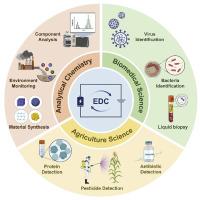
The rapid advancement of precision medicine and the continuous emergence of novel pathogens have presented new challenges for biosensors, necessitating higher requirements. Target amplification technology serves as the core component in biosensor construction. Enzyme-based amplification methods are often sensitive and selective but involve relatively complex operational steps, whereas enzyme-free amplification methods offer simplicity but frequently fail to meet both sensitivity and selectivity simultaneously. Existing research has confirmed that entropy-driven catalyst (EDC) biosensors not only fulfills the demands for sensitivity and selectivity concurrently but also offers ease of operation and flexibility in construction. In this review, we summarize the key advantages of EDC, explore how to construct DNA nanomachines based on these advantages to achieve intracellular detection and simultaneous detection of multiple targets, as well as point-of-care testing (POCT) to address practical issues in clinical diagnosis and treatment. We also anticipate potential challenges, propose corresponding solutions, and outline future development directions for EDC-based biosensors in practical clinical applications. We firmly believe that EDC sensors will emerge as a crucial branch within the realm of biosensor development.
期刊介绍:
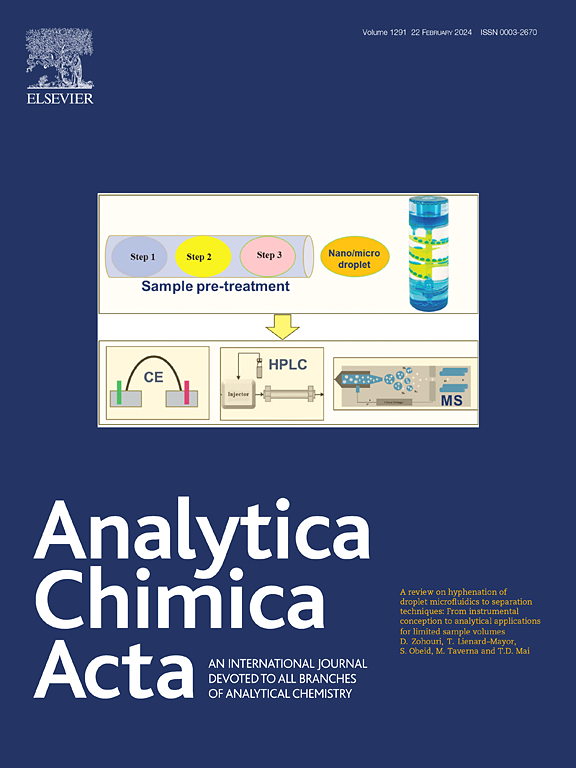
Analytica Chimica Acta has an open access mirror journal Analytica Chimica Acta: X, sharing the same aims and scope, editorial team, submission system and rigorous peer review.
Analytica Chimica Acta provides a forum for the rapid publication of original research, and critical, comprehensive reviews dealing with all aspects of fundamental and applied modern analytical chemistry. The journal welcomes the submission of research papers which report studies concerning the development of new and significant analytical methodologies. In determining the suitability of submitted articles for publication, particular scrutiny will be placed on the degree of novelty and impact of the research and the extent to which it adds to the existing body of knowledge in analytical chemistry.





 京公网安备 11010802042870号
京ICP备2023020795号-1
京公网安备 11010802042870号
京ICP备2023020795号-1

 分享
分享
 求助内容:
求助内容: 应助结果提醒方式:
 扫码关注我们
