Multiscale Modeling of Heat Conduction in a Hydroxyethyl Cellulose/Boron Nitride Composite Realizing Ultrahigh Thermal Conductivity via a “Moisture-Activated” Strategy
Chenggong Zhao, Chen Jiang, Bingheng Li, Yuanzheng Tang, Xinfeng Wu, Changqing Liu, Yan He, Wei Yu, Yifan Li
{"title":"Multiscale Modeling of Heat Conduction in a Hydroxyethyl Cellulose/Boron Nitride Composite Realizing Ultrahigh Thermal Conductivity via a “Moisture-Activated” Strategy","authors":"Chenggong Zhao, Chen Jiang, Bingheng Li, Yuanzheng Tang, Xinfeng Wu, Changqing Liu, Yan He, Wei Yu, Yifan Li","doi":"10.1021/acsami.4c20264","DOIUrl":null,"url":null,"abstract":"Polymer-based thermally conductive composites are widely used in microelectronics for heat dissipation and packaging, for which the filler arrangement and the filler/matrix interfacial thermal resistance (ITR) are key factors limiting superior thermal conduction realization. This work reveals the effects of filler modification and orientation on thermal duction in the boron nitride (BN)/hydroxyethyl cellulose (HEC) through multiscale simulation approaches. Nonequilibrium molecular dynamics (NEMD) identifies that the thermal conductivity of the BN molecule is not size-dependent and proves that thermal resistance is dramatically reduced after hydroxylation modification (BN<sub>OH</sub>). Finite element simulation (FEM) reveals that maintaining a proper tilt of BN may improve both the cross-plane and in-plane thermal conductivity of the composite. Experimentally, BN<sub>OH</sub>/HEC composites with high self-viscosity are prepared via a “moisture-activated” strategy, for which the introduction of BN<sub>OH</sub> and wet hot pressing contribute to the thermal resistance reduction and filler orientation, respectively. The in-plane thermal conductivity reaches 30.64 W/mK with a cross-plane thermal conductivity of 5.06 W/mK. The films show good adaptability to surface morphology with the thermal resistance decreasing to 1.42 K·cm<sup>2</sup>/W. Practical thermal management demonstrates that the incorporation of BN<sub>OH</sub>/HEC facilitates a 15.05 °C reduction of the LED Al substrate compared to the common composite film.","PeriodicalId":5,"journal":{"name":"ACS Applied Materials & Interfaces","volume":"30 1","pages":""},"PeriodicalIF":8.2000,"publicationDate":"2024-12-19","publicationTypes":"Journal Article","fieldsOfStudy":null,"isOpenAccess":false,"openAccessPdf":"","citationCount":"0","resultStr":null,"platform":"Semanticscholar","paperid":null,"PeriodicalName":"ACS Applied Materials & Interfaces","FirstCategoryId":"88","ListUrlMain":"https://doi.org/10.1021/acsami.4c20264","RegionNum":2,"RegionCategory":"材料科学","ArticlePicture":[],"TitleCN":null,"AbstractTextCN":null,"PMCID":null,"EPubDate":"","PubModel":"","JCR":"Q1","JCRName":"MATERIALS SCIENCE, MULTIDISCIPLINARY","Score":null,"Total":0}
引用次数: 0
Abstract
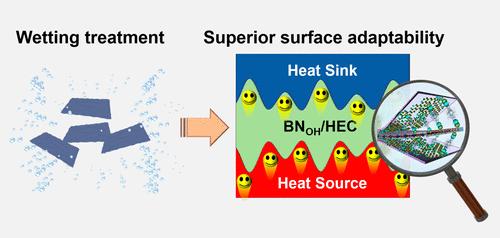
Polymer-based thermally conductive composites are widely used in microelectronics for heat dissipation and packaging, for which the filler arrangement and the filler/matrix interfacial thermal resistance (ITR) are key factors limiting superior thermal conduction realization. This work reveals the effects of filler modification and orientation on thermal duction in the boron nitride (BN)/hydroxyethyl cellulose (HEC) through multiscale simulation approaches. Nonequilibrium molecular dynamics (NEMD) identifies that the thermal conductivity of the BN molecule is not size-dependent and proves that thermal resistance is dramatically reduced after hydroxylation modification (BNOH). Finite element simulation (FEM) reveals that maintaining a proper tilt of BN may improve both the cross-plane and in-plane thermal conductivity of the composite. Experimentally, BNOH/HEC composites with high self-viscosity are prepared via a “moisture-activated” strategy, for which the introduction of BNOH and wet hot pressing contribute to the thermal resistance reduction and filler orientation, respectively. The in-plane thermal conductivity reaches 30.64 W/mK with a cross-plane thermal conductivity of 5.06 W/mK. The films show good adaptability to surface morphology with the thermal resistance decreasing to 1.42 K·cm2/W. Practical thermal management demonstrates that the incorporation of BNOH/HEC facilitates a 15.05 °C reduction of the LED Al substrate compared to the common composite film.
期刊介绍:
ACS Applied Materials & Interfaces is a leading interdisciplinary journal that brings together chemists, engineers, physicists, and biologists to explore the development and utilization of newly-discovered materials and interfacial processes for specific applications. Our journal has experienced remarkable growth since its establishment in 2009, both in terms of the number of articles published and the impact of the research showcased. We are proud to foster a truly global community, with the majority of published articles originating from outside the United States, reflecting the rapid growth of applied research worldwide.



 京公网安备 11010802042870号
京ICP备2023020795号-1
京公网安备 11010802042870号
京ICP备2023020795号-1

 分享
分享
 求助内容:
求助内容: 应助结果提醒方式:
 扫码关注我们
