Kexing Xin , Yining Wu , Aziz Ul Ikram , Yanping Jing, Shan Liu, Yawen Zhang, Jian Chen
{"title":"Salicylic acid cooperates with different small molecules to control biotic and abiotic stress responses","authors":"Kexing Xin , Yining Wu , Aziz Ul Ikram , Yanping Jing, Shan Liu, Yawen Zhang, Jian Chen","doi":"10.1016/j.jplph.2024.154406","DOIUrl":null,"url":null,"abstract":"<div><div>Salicylic acid (SA) is a phytohormone that plays a critical role in plant growth, development, and response to unfavorable conditions. Over the past three decades, researches on SA have deeply elucidated the mechanism of its function in plants tolerance to infection by biotrophic and hemibiotrophic pathogens. Recent studies have found that SA also plays an important role in regulating plants response to abiotic stress. It is emerging as a strong tool for alleviating adverse effects of biotic and abiotic stresses in crop plants. During SA-mediated stress responses, many small molecules participate in the SA modification or signaling, which play important regulatory roles. The cooperations of small molecules in SA pathway remain least discussed, especially in terms of SA-induced abiotic stress tolerance. This review provides an overview of the recent studies about SA and its relationship with different small molecules and highlights the critical functions of small molecules in SA-mediated plant stress responses.</div></div>","PeriodicalId":16808,"journal":{"name":"Journal of plant physiology","volume":"304 ","pages":"Article 154406"},"PeriodicalIF":4.1000,"publicationDate":"2025-01-01","publicationTypes":"Journal Article","fieldsOfStudy":null,"isOpenAccess":false,"openAccessPdf":"","citationCount":"0","resultStr":null,"platform":"Semanticscholar","paperid":null,"PeriodicalName":"Journal of plant physiology","FirstCategoryId":"99","ListUrlMain":"https://www.sciencedirect.com/science/article/pii/S0176161724002372","RegionNum":3,"RegionCategory":"生物学","ArticlePicture":[],"TitleCN":null,"AbstractTextCN":null,"PMCID":null,"EPubDate":"","PubModel":"","JCR":"Q1","JCRName":"PLANT SCIENCES","Score":null,"Total":0}
引用次数: 0
Abstract
Salicylic acid (SA) is a phytohormone that plays a critical role in plant growth, development, and response to unfavorable conditions. Over the past three decades, researches on SA have deeply elucidated the mechanism of its function in plants tolerance to infection by biotrophic and hemibiotrophic pathogens. Recent studies have found that SA also plays an important role in regulating plants response to abiotic stress. It is emerging as a strong tool for alleviating adverse effects of biotic and abiotic stresses in crop plants. During SA-mediated stress responses, many small molecules participate in the SA modification or signaling, which play important regulatory roles. The cooperations of small molecules in SA pathway remain least discussed, especially in terms of SA-induced abiotic stress tolerance. This review provides an overview of the recent studies about SA and its relationship with different small molecules and highlights the critical functions of small molecules in SA-mediated plant stress responses.
期刊介绍:
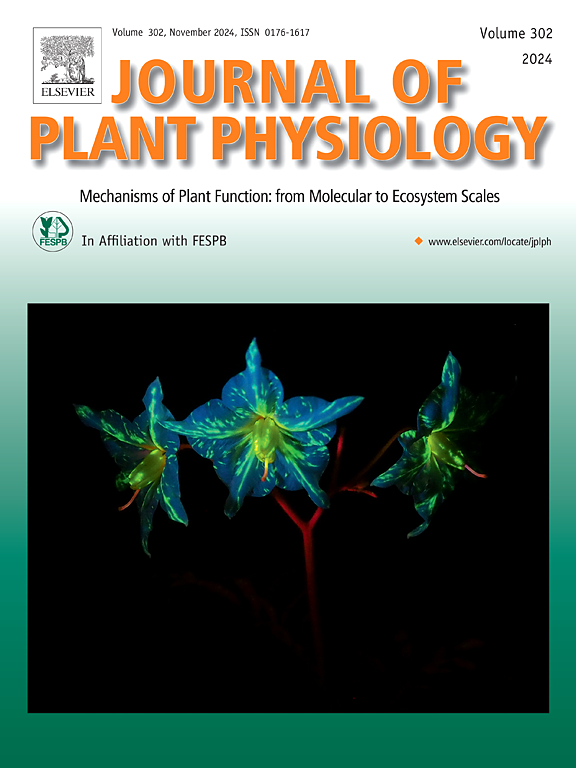
The Journal of Plant Physiology is a broad-spectrum journal that welcomes high-quality submissions in all major areas of plant physiology, including plant biochemistry, functional biotechnology, computational and synthetic plant biology, growth and development, photosynthesis and respiration, transport and translocation, plant-microbe interactions, biotic and abiotic stress. Studies are welcome at all levels of integration ranging from molecules and cells to organisms and their environments and are expected to use state-of-the-art methodologies. Pure gene expression studies are not within the focus of our journal. To be considered for publication, papers must significantly contribute to the mechanistic understanding of physiological processes, and not be merely descriptive, or confirmatory of previous results. We encourage the submission of papers that explore the physiology of non-model as well as accepted model species and those that bridge basic and applied research. For instance, studies on agricultural plants that show new physiological mechanisms to improve agricultural efficiency are welcome. Studies performed under uncontrolled situations (e.g. field conditions) not providing mechanistic insight will not be considered for publication.
The Journal of Plant Physiology publishes several types of articles: Original Research Articles, Reviews, Perspectives Articles, and Short Communications. Reviews and Perspectives will be solicited by the Editors; unsolicited reviews are also welcome but only from authors with a strong track record in the field of the review. Original research papers comprise the majority of published contributions.



 京公网安备 11010802042870号
京ICP备2023020795号-1
京公网安备 11010802042870号
京ICP备2023020795号-1

 分享
分享
 求助内容:
求助内容: 应助结果提醒方式:
 扫码关注我们
