Miao Chao, Dmitri Rozgonjuk, Jon D Elhai, Haibo Yang, Christian Montag
{"title":"Personality associations with online vs. offline social capital and well-being variables.","authors":"Miao Chao, Dmitri Rozgonjuk, Jon D Elhai, Haibo Yang, Christian Montag","doi":"10.1186/s40359-024-02265-9","DOIUrl":null,"url":null,"abstract":"<p><p>Social capital is an important construct in diverse scientific disciplines for understanding health promotion, entrepreneurship, and economic growth. In an increasingly digitalized world, social capital can be established and used in both online and offline contexts. Previous research suggests that personality might be relevant to an understanding of individual differences in social capital. For instance, the literature suggests that extraversion is associated with more social capital. Against this background, the present study aimed to revisit social capital research, but with a broader focus on studying all Big Five Personality traits (assessed with the BFI-45) and their association with bonding (similarity-based relationships), bridging (diversity-based relationships) social capital dimensions, and well-being. Insights in social capital variables in offline and online areas were obtained via the Internet Social Capital Scale and well-being was assessed with Diener's Satisfaction with Life scale. In particular, the study aimed to understand if personality-well-being associations would emerge with online/offline social capital being a mediator. The questionnaires were filled in by n = 289 German speaking participants (73 males and 216 females). The results revealed that offline social capital in the form of bridging and bonding played a significant role in mediating the relationship between both agreeableness and extraversion with life satisfaction. Online social capital was not associated with life satisfaction and was only very weakly linked to some Big Five Personality traits. In conclusion, the present study demonstrates that offline social capital is very relevant for well-being, while online social capital shows no association with self-reported well-being levels and seems to be negligible for an understanding of well-being.</p>","PeriodicalId":37867,"journal":{"name":"BMC Psychology","volume":"12 1","pages":"763"},"PeriodicalIF":3.0000,"publicationDate":"2024-12-19","publicationTypes":"Journal Article","fieldsOfStudy":null,"isOpenAccess":false,"openAccessPdf":"https://www.ncbi.nlm.nih.gov/pmc/articles/PMC11657760/pdf/","citationCount":"0","resultStr":null,"platform":"Semanticscholar","paperid":null,"PeriodicalName":"BMC Psychology","FirstCategoryId":"102","ListUrlMain":"https://doi.org/10.1186/s40359-024-02265-9","RegionNum":3,"RegionCategory":"心理学","ArticlePicture":[],"TitleCN":null,"AbstractTextCN":null,"PMCID":null,"EPubDate":"","PubModel":"","JCR":"Q1","JCRName":"PSYCHOLOGY, MULTIDISCIPLINARY","Score":null,"Total":0}
引用次数: 0
Abstract
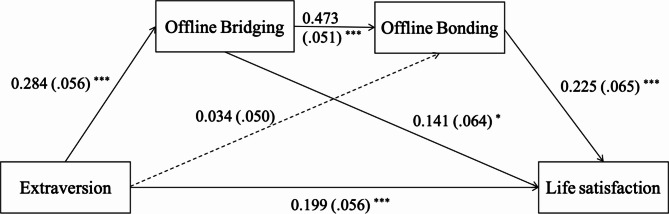
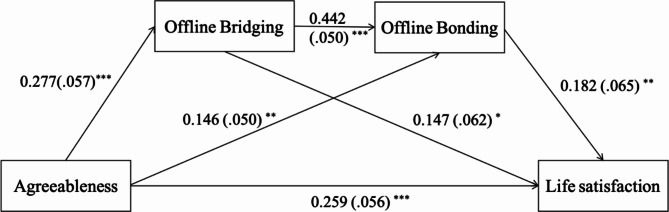
Social capital is an important construct in diverse scientific disciplines for understanding health promotion, entrepreneurship, and economic growth. In an increasingly digitalized world, social capital can be established and used in both online and offline contexts. Previous research suggests that personality might be relevant to an understanding of individual differences in social capital. For instance, the literature suggests that extraversion is associated with more social capital. Against this background, the present study aimed to revisit social capital research, but with a broader focus on studying all Big Five Personality traits (assessed with the BFI-45) and their association with bonding (similarity-based relationships), bridging (diversity-based relationships) social capital dimensions, and well-being. Insights in social capital variables in offline and online areas were obtained via the Internet Social Capital Scale and well-being was assessed with Diener's Satisfaction with Life scale. In particular, the study aimed to understand if personality-well-being associations would emerge with online/offline social capital being a mediator. The questionnaires were filled in by n = 289 German speaking participants (73 males and 216 females). The results revealed that offline social capital in the form of bridging and bonding played a significant role in mediating the relationship between both agreeableness and extraversion with life satisfaction. Online social capital was not associated with life satisfaction and was only very weakly linked to some Big Five Personality traits. In conclusion, the present study demonstrates that offline social capital is very relevant for well-being, while online social capital shows no association with self-reported well-being levels and seems to be negligible for an understanding of well-being.
期刊介绍:
BMC Psychology is an open access, peer-reviewed journal that considers manuscripts on all aspects of psychology, human behavior and the mind, including developmental, clinical, cognitive, experimental, health and social psychology, as well as personality and individual differences. The journal welcomes quantitative and qualitative research methods, including animal studies.



 京公网安备 11010802042870号
京ICP备2023020795号-1
京公网安备 11010802042870号
京ICP备2023020795号-1

 分享
分享
 求助内容:
求助内容: 应助结果提醒方式:
 扫码关注我们
