Montserrat Juvany , Alejandro Bravo-Salva , Jose Antonio Pereira-Rodríguez, Members of the Board of the AEC Abdominal Wall Section
{"title":"Abdominal wall closure: How do we do it in Spain? Survey of specialist general surgeons members of the AEC (Spanish Society of Surgeons)","authors":"Montserrat Juvany , Alejandro Bravo-Salva , Jose Antonio Pereira-Rodríguez, Members of the Board of the AEC Abdominal Wall Section","doi":"10.1016/j.cireng.2024.12.004","DOIUrl":null,"url":null,"abstract":"<div><h3>Objectives</h3><div>To evaluate the knowledge of abdominal wall closure in a cohort of specialist general surgeons who are members of the AEC and to see its adequacy with current recommendations. Sub-analysis in terms of years of specialization.</div></div><div><h3>Material and methods</h3><div>Individual questionnaire of 21 questions on abdominal wall closure in elective and urgent context.</div></div><div><h3>Results</h3><div>A total of 371 responses were received from specialist surgeons who are members of the AEC. Closure of the median laparotomy is performed with continuous suture in 99.7% and with slowly absorbable materials in 95.4%. 88.4% of surgeons report using the ratio equal to or greater than 4:1 between suture length and incision length (SL:IL) and short stitches. These results are equivalent in transverse and urgent elective laparotomy. 85.2% of the respondents systematically close trocars of 10 mm or more and 30.7% use prophylactic mesh in high-risk patients. Surgeons with less than 10 years of experience use the ratio ≥ 4:1 SL:SI and short stitches more than surgeons with more experience (93.4% vs 84.9%; <em>P</em> = .013).</div></div><div><h3>Conclusions</h3><div>Abdominal wall closure among general surgeons who are members of the ACS is adequate and adjusted to the recommendations with a tendency to improve among surgeons with less experience. There is an opportunity for improvement in the use of prophylactic mesh in high-risk patients.</div></div>","PeriodicalId":93935,"journal":{"name":"Cirugia espanola","volume":"103 2","pages":"Pages 84-90"},"PeriodicalIF":0.0000,"publicationDate":"2025-02-01","publicationTypes":"Journal Article","fieldsOfStudy":null,"isOpenAccess":false,"openAccessPdf":"","citationCount":"0","resultStr":null,"platform":"Semanticscholar","paperid":null,"PeriodicalName":"Cirugia espanola","FirstCategoryId":"1085","ListUrlMain":"https://www.sciencedirect.com/science/article/pii/S2173507724002813","RegionNum":0,"RegionCategory":null,"ArticlePicture":[],"TitleCN":null,"AbstractTextCN":null,"PMCID":null,"EPubDate":"","PubModel":"","JCR":"","JCRName":"","Score":null,"Total":0}
引用次数: 0
Abstract
Objectives
To evaluate the knowledge of abdominal wall closure in a cohort of specialist general surgeons who are members of the AEC and to see its adequacy with current recommendations. Sub-analysis in terms of years of specialization.
Material and methods
Individual questionnaire of 21 questions on abdominal wall closure in elective and urgent context.
Results
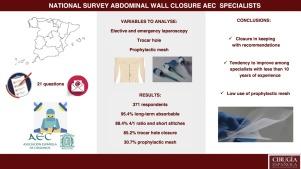
A total of 371 responses were received from specialist surgeons who are members of the AEC. Closure of the median laparotomy is performed with continuous suture in 99.7% and with slowly absorbable materials in 95.4%. 88.4% of surgeons report using the ratio equal to or greater than 4:1 between suture length and incision length (SL:IL) and short stitches. These results are equivalent in transverse and urgent elective laparotomy. 85.2% of the respondents systematically close trocars of 10 mm or more and 30.7% use prophylactic mesh in high-risk patients. Surgeons with less than 10 years of experience use the ratio ≥ 4:1 SL:SI and short stitches more than surgeons with more experience (93.4% vs 84.9%; P = .013).
Conclusions
Abdominal wall closure among general surgeons who are members of the ACS is adequate and adjusted to the recommendations with a tendency to improve among surgeons with less experience. There is an opportunity for improvement in the use of prophylactic mesh in high-risk patients.



 京公网安备 11010802042870号
京ICP备2023020795号-1
京公网安备 11010802042870号
京ICP备2023020795号-1

 分享
分享

 求助内容:
求助内容: 应助结果提醒方式:
 扫码关注我们
