Yang Zhou, Yiqi He, Simeng Qi, Sisi Zhao, Lulu Wang, Quan Xu
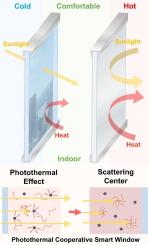
{"title":"Development and evaluation of the energy-saving effect of photothermal cooperative composite hydrogel smart window","authors":"Yang Zhou, Yiqi He, Simeng Qi, Sisi Zhao, Lulu Wang, Quan Xu","doi":"10.1016/j.cej.2024.158792","DOIUrl":null,"url":null,"abstract":"Thermal responsive hydrogel smart windows have attracted wide attention due to their design flexibility and excellent thermal responsive optical properties. Only relying on temperature control, sometimes the phase transition speed is not fast to meet the needs of rapid thermal response rate in practical applications. Here, a hydrogel with excellent photothermal response characteristics was prepared through combining the photothermal conversion efficiency of graphene nanoparticles and the thermal response effect of hydroxypropyl cellulose. The photothermal cooperative hydrogel (PCH) smart window has integrated high solar modulation ability (ΔT<sub>sol</sub> = 61.2 %), excellent infrared isolation ability (ΔT<sub>IR</sub> = 48.6 %) and fast response speed (within 2 min) successfully. In outdoor demonstrations, the PCH window can reduce 13.1 °C compared to the ordinary window, showing promising energy-saving performance in summer daytime. Simulations suggested that PCH window can cut off 13.1 % heating, ventilation, and air-conditioning (HVAC) energy consumption compared with the Low-E window in Singapore. The PCH window can dynamically adjust solar radiation through light and heat, which provides a new strategy for intelligently reducing the energy consumption of buildings","PeriodicalId":270,"journal":{"name":"Chemical Engineering Journal","volume":"24 1","pages":""},"PeriodicalIF":13.2000,"publicationDate":"2024-12-20","publicationTypes":"Journal Article","fieldsOfStudy":null,"isOpenAccess":false,"openAccessPdf":"","citationCount":"0","resultStr":null,"platform":"Semanticscholar","paperid":null,"PeriodicalName":"Chemical Engineering Journal","FirstCategoryId":"5","ListUrlMain":"https://doi.org/10.1016/j.cej.2024.158792","RegionNum":1,"RegionCategory":"工程技术","ArticlePicture":[],"TitleCN":null,"AbstractTextCN":null,"PMCID":null,"EPubDate":"","PubModel":"","JCR":"Q1","JCRName":"ENGINEERING, CHEMICAL","Score":null,"Total":0}
引用次数: 0
Abstract
Thermal responsive hydrogel smart windows have attracted wide attention due to their design flexibility and excellent thermal responsive optical properties. Only relying on temperature control, sometimes the phase transition speed is not fast to meet the needs of rapid thermal response rate in practical applications. Here, a hydrogel with excellent photothermal response characteristics was prepared through combining the photothermal conversion efficiency of graphene nanoparticles and the thermal response effect of hydroxypropyl cellulose. The photothermal cooperative hydrogel (PCH) smart window has integrated high solar modulation ability (ΔTsol = 61.2 %), excellent infrared isolation ability (ΔTIR = 48.6 %) and fast response speed (within 2 min) successfully. In outdoor demonstrations, the PCH window can reduce 13.1 °C compared to the ordinary window, showing promising energy-saving performance in summer daytime. Simulations suggested that PCH window can cut off 13.1 % heating, ventilation, and air-conditioning (HVAC) energy consumption compared with the Low-E window in Singapore. The PCH window can dynamically adjust solar radiation through light and heat, which provides a new strategy for intelligently reducing the energy consumption of buildings
期刊介绍:
The Chemical Engineering Journal is an international research journal that invites contributions of original and novel fundamental research. It aims to provide an international platform for presenting original fundamental research, interpretative reviews, and discussions on new developments in chemical engineering. The journal welcomes papers that describe novel theory and its practical application, as well as those that demonstrate the transfer of techniques from other disciplines. It also welcomes reports on carefully conducted experimental work that is soundly interpreted. The main focus of the journal is on original and rigorous research results that have broad significance. The Catalysis section within the Chemical Engineering Journal focuses specifically on Experimental and Theoretical studies in the fields of heterogeneous catalysis, molecular catalysis, and biocatalysis. These studies have industrial impact on various sectors such as chemicals, energy, materials, foods, healthcare, and environmental protection.



 京公网安备 11010802042870号
京ICP备2023020795号-1
京公网安备 11010802042870号
京ICP备2023020795号-1

 分享
分享
 求助内容:
求助内容: 应助结果提醒方式:
 扫码关注我们
