{"title":"The removal of high Se(IV) and Cd(II) concentrations in sulfur autotrophic reactor based on the “hibernation-like microbial survival strategy”","authors":"Ying Gao, Tingting Guo, Haibo Li, Wenli Liu, Xiaoping Wang, Yanan Hou, Zhi Chen, Jianbo Guo","doi":"10.1016/j.jhazmat.2024.136944","DOIUrl":null,"url":null,"abstract":"The removal of selenite (Se(IV)) and cadmium (Cd(II)) from low-carbon wastewater presents significant challenges. However, the addition of external organic carbon sources is limited in application due to the high cost and potential for secondary pollution. This study introduced a “hibernation-like microbial survival strategy”, enabling efficient removal of Se(IV) and Cd(II) in sulfur autotrophic reactor, with S<sup>0</sup> acting as the electron donor. The removal efficiencies of 5–120 mg/L Se(IV) and 50 mg/L Cd(II) were higher than 99 % in phase I–IV, and the nanoparticles formed in sulfur autotrophic reactor were available for recycling. The analysis of X-ray photoelectron spectroscopy confirmed that the removal pathways of Se(IV) and Cd(II) were biological reduction, adsorption, and biosynthesis. The decreased ratio of actual to theoretical sulfate concentrations indicated the weakened sulfur disproportionation trend in sulfur autotrophic reactor. The formation of autotrophic-heterotrophic symbiont was beneficial for promoting electron transfer, material exchange, and information flow. Microorganisms strategically decreased metabolic activity to reduce extra energy consumption under Se(IV) and Cd(II) stress, which was manifested in the decreased extracellular DNA, extracellular polymeric substances, and electron transfer system activity. Furthermore, microorganisms reduced the secretion of nicotinamide adenine dinucleotide, cytochrome <em>c</em>, and cyt-<em>c</em> oxidase on the premise of ensuring the required electron flux. The “hibernation-like microbial survival strategy” was proposed to explain the removal of Se(IV) and Cd(II) in sulfur autotrophic reactor, expanding the potential application of sulfur autotrophy in environmental engineering.","PeriodicalId":361,"journal":{"name":"Journal of Hazardous Materials","volume":"31 1","pages":""},"PeriodicalIF":11.3000,"publicationDate":"2024-12-20","publicationTypes":"Journal Article","fieldsOfStudy":null,"isOpenAccess":false,"openAccessPdf":"","citationCount":"0","resultStr":null,"platform":"Semanticscholar","paperid":null,"PeriodicalName":"Journal of Hazardous Materials","FirstCategoryId":"93","ListUrlMain":"https://doi.org/10.1016/j.jhazmat.2024.136944","RegionNum":1,"RegionCategory":"环境科学与生态学","ArticlePicture":[],"TitleCN":null,"AbstractTextCN":null,"PMCID":null,"EPubDate":"","PubModel":"","JCR":"Q1","JCRName":"ENGINEERING, ENVIRONMENTAL","Score":null,"Total":0}
引用次数: 0
Abstract
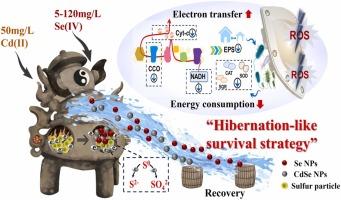
The removal of selenite (Se(IV)) and cadmium (Cd(II)) from low-carbon wastewater presents significant challenges. However, the addition of external organic carbon sources is limited in application due to the high cost and potential for secondary pollution. This study introduced a “hibernation-like microbial survival strategy”, enabling efficient removal of Se(IV) and Cd(II) in sulfur autotrophic reactor, with S0 acting as the electron donor. The removal efficiencies of 5–120 mg/L Se(IV) and 50 mg/L Cd(II) were higher than 99 % in phase I–IV, and the nanoparticles formed in sulfur autotrophic reactor were available for recycling. The analysis of X-ray photoelectron spectroscopy confirmed that the removal pathways of Se(IV) and Cd(II) were biological reduction, adsorption, and biosynthesis. The decreased ratio of actual to theoretical sulfate concentrations indicated the weakened sulfur disproportionation trend in sulfur autotrophic reactor. The formation of autotrophic-heterotrophic symbiont was beneficial for promoting electron transfer, material exchange, and information flow. Microorganisms strategically decreased metabolic activity to reduce extra energy consumption under Se(IV) and Cd(II) stress, which was manifested in the decreased extracellular DNA, extracellular polymeric substances, and electron transfer system activity. Furthermore, microorganisms reduced the secretion of nicotinamide adenine dinucleotide, cytochrome c, and cyt-c oxidase on the premise of ensuring the required electron flux. The “hibernation-like microbial survival strategy” was proposed to explain the removal of Se(IV) and Cd(II) in sulfur autotrophic reactor, expanding the potential application of sulfur autotrophy in environmental engineering.
期刊介绍:
The Journal of Hazardous Materials serves as a global platform for promoting cutting-edge research in the field of Environmental Science and Engineering. Our publication features a wide range of articles, including full-length research papers, review articles, and perspectives, with the aim of enhancing our understanding of the dangers and risks associated with various materials concerning public health and the environment. It is important to note that the term "environmental contaminants" refers specifically to substances that pose hazardous effects through contamination, while excluding those that do not have such impacts on the environment or human health. Moreover, we emphasize the distinction between wastes and hazardous materials in order to provide further clarity on the scope of the journal. We have a keen interest in exploring specific compounds and microbial agents that have adverse effects on the environment.



 京公网安备 11010802042870号
京ICP备2023020795号-1
京公网安备 11010802042870号
京ICP备2023020795号-1

 分享
分享
 求助内容:
求助内容: 应助结果提醒方式:
 扫码关注我们
