Yanfang Tao , Sujuan Zhang , Jinfeng Zhang , Zhongliao Wang , Gaoli Chen , Xiuzhen Zheng , Shifu Chen
{"title":"Efficient visible-light-driven alcohol oxidation coupled hydrogen production on 0D/0D “n-NiWO4/p-CdS” S-scheme heterojunction","authors":"Yanfang Tao , Sujuan Zhang , Jinfeng Zhang , Zhongliao Wang , Gaoli Chen , Xiuzhen Zheng , Shifu Chen","doi":"10.1016/j.jmat.2024.100997","DOIUrl":null,"url":null,"abstract":"<div><div>The theory of S-scheme transfer mechanism have significant implications for exploring the mechanism of photocatalytic carrier migration and its intrinsic dynamics. Modeled NiWO<sub>4</sub>/CdS heterojunction photocatalyst (referred to as NWO/CS) was synthesized using a simple hydrothermal method and applied for alcohol oxidation coupled with H<sub>2</sub> production. Systematically investigates the factors contributing to its enhanced performance and the internal charge transfer mechanisms. The 28% NWO/CS composite exhibited the highest activity, with a H<sub>2</sub> production and the aldehyde generation rates of 16.08 mmol⋅g<sup>−1</sup>⋅h<sup>−1</sup> and 16.88 mmol⋅g<sup>−1</sup>⋅h<sup>−1</sup>, which are about 320 times higher than those of NiWO<sub>4</sub> (0.05 mmol⋅g<sup>−1</sup>⋅h<sup>−1</sup> and 0.06 mmol⋅g<sup>−1</sup>⋅h<sup>−1</sup>) and 16 times higher than that of CdS (1.09 mmol⋅g<sup>−1</sup>⋅h<sup>−1</sup> and 1.12 mmol⋅g<sup>−1</sup>⋅h<sup>−1</sup>). Based on the <em>in-situ</em> XPS, transient surface photovoltage, theoretical calculations, and other physicochemical characterization results, we have confirmed that the built-in electric field formed at the interface and the transfer of photogenerated charges follows the S-scheme mechanism between relative “n-NiWO<sub>4</sub>” and relative “p-CdS” are the key factors that promote efficient charge separation and significantly enhance the subsequent reaction activity. This work provides a theoretical basis for improving photocatalytic performance and understanding photocatalytic mechanisms.</div></div>","PeriodicalId":16173,"journal":{"name":"Journal of Materiomics","volume":"11 4","pages":"Article 100997"},"PeriodicalIF":9.6000,"publicationDate":"2025-07-01","publicationTypes":"Journal Article","fieldsOfStudy":null,"isOpenAccess":false,"openAccessPdf":"","citationCount":"0","resultStr":null,"platform":"Semanticscholar","paperid":null,"PeriodicalName":"Journal of Materiomics","FirstCategoryId":"88","ListUrlMain":"https://www.sciencedirect.com/science/article/pii/S2352847824002363","RegionNum":1,"RegionCategory":"材料科学","ArticlePicture":[],"TitleCN":null,"AbstractTextCN":null,"PMCID":null,"EPubDate":"2024/12/22 0:00:00","PubModel":"Epub","JCR":"Q1","JCRName":"CHEMISTRY, PHYSICAL","Score":null,"Total":0}
引用次数: 0
Abstract
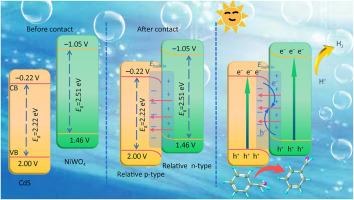
The theory of S-scheme transfer mechanism have significant implications for exploring the mechanism of photocatalytic carrier migration and its intrinsic dynamics. Modeled NiWO4/CdS heterojunction photocatalyst (referred to as NWO/CS) was synthesized using a simple hydrothermal method and applied for alcohol oxidation coupled with H2 production. Systematically investigates the factors contributing to its enhanced performance and the internal charge transfer mechanisms. The 28% NWO/CS composite exhibited the highest activity, with a H2 production and the aldehyde generation rates of 16.08 mmol⋅g−1⋅h−1 and 16.88 mmol⋅g−1⋅h−1, which are about 320 times higher than those of NiWO4 (0.05 mmol⋅g−1⋅h−1 and 0.06 mmol⋅g−1⋅h−1) and 16 times higher than that of CdS (1.09 mmol⋅g−1⋅h−1 and 1.12 mmol⋅g−1⋅h−1). Based on the in-situ XPS, transient surface photovoltage, theoretical calculations, and other physicochemical characterization results, we have confirmed that the built-in electric field formed at the interface and the transfer of photogenerated charges follows the S-scheme mechanism between relative “n-NiWO4” and relative “p-CdS” are the key factors that promote efficient charge separation and significantly enhance the subsequent reaction activity. This work provides a theoretical basis for improving photocatalytic performance and understanding photocatalytic mechanisms.
期刊介绍:
The Journal of Materiomics is a peer-reviewed open-access journal that aims to serve as a forum for the continuous dissemination of research within the field of materials science. It particularly emphasizes systematic studies on the relationships between composition, processing, structure, property, and performance of advanced materials. The journal is supported by the Chinese Ceramic Society and is indexed in SCIE and Scopus. It is commonly referred to as J Materiomics.





 京公网安备 11010802042870号
京ICP备2023020795号-1
京公网安备 11010802042870号
京ICP备2023020795号-1

 分享
分享
 求助内容:
求助内容: 应助结果提醒方式:
 扫码关注我们
