{"title":"Leaching and recovery of rare earth elements, copper, nickel, silver and gold from used smartphone circuit boards","authors":"Salmata Diallo , Lan-Huong Tran , Dominic Larivière , Jean-François Blais","doi":"10.1016/j.mineng.2024.109157","DOIUrl":null,"url":null,"abstract":"<div><div>Printed circuit board (PCB) assemblies constitute a concentrated source of valuable metals. This study evaluates the performance of a complete hydrometallurgical process for extracting and recovering rare earth elements (REE), Cu, Ni, Ag and Au from leachates produced from PCB found in smartphones via four selective leaching steps. In a REE leachate ([Dy] = 43 mg/L, [Gd] = 5 mg/L, [Nd] = 266 mg/L, [Sm] = 35 mg/L, [Tb] = 8 mg/L, [Ho] = 2 mg/L), 92 % of REE was precipitated at room temperature with H<sub>2</sub>C<sub>2</sub>O<sub>4</sub>/REE molar ratio of 2/1. Calcination of the REE-oxalate precipitates at 800 °C resulted in a mixture of rare earth oxides (REO) with a 91 % purity. From the base metal leachate ([Cu] = 19,376 mg/L and [Ni] = 1,264 mg/L), Cu was electrodeposited during 120 min (pH = 3, current 270 A/m<sup>2</sup>) while Ni was precipitated by addition of oxalic acid (H<sub>2</sub>C<sub>2</sub>O<sub>4</sub>/Ni molar ratio of 2/1, pH 4.4, T = 60 °C, t = 60 min), followed by calcination at 600 °C for 4 h to form NiO (93 % purity). Three oxidative leaching steps (10 % w/v solids, T = 80 °C, t = 180 min, 1.0 M H<sub>2</sub>SO<sub>4</sub>, 67 g H<sub>2</sub>O<sub>2</sub>/L, T = 80 °C, t = 180 min) solubilized 97 % of Ag. Subsequently, with the addition of Cu (Cu/Ag mass ratio of 2), at room temperature and 120 min, Ag was precipitated 99.4 % in the first leachate ([Ag] = 488 mg/L). A Zn/Au mass ratio of 30 precipitated 99.1 % of gold at the room-temperature from the gold leachate ([Au] = 107 mg/L).</div></div>","PeriodicalId":18594,"journal":{"name":"Minerals Engineering","volume":"222 ","pages":"Article 109157"},"PeriodicalIF":5.0000,"publicationDate":"2025-03-01","publicationTypes":"Journal Article","fieldsOfStudy":null,"isOpenAccess":false,"openAccessPdf":"","citationCount":"0","resultStr":null,"platform":"Semanticscholar","paperid":null,"PeriodicalName":"Minerals Engineering","FirstCategoryId":"5","ListUrlMain":"https://www.sciencedirect.com/science/article/pii/S0892687524005867","RegionNum":2,"RegionCategory":"工程技术","ArticlePicture":[],"TitleCN":null,"AbstractTextCN":null,"PMCID":null,"EPubDate":"2024/12/18 0:00:00","PubModel":"Epub","JCR":"Q1","JCRName":"ENGINEERING, CHEMICAL","Score":null,"Total":0}
引用次数: 0
Abstract
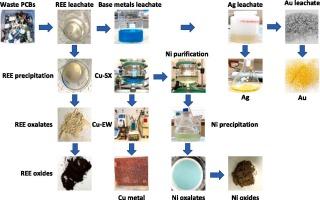
Printed circuit board (PCB) assemblies constitute a concentrated source of valuable metals. This study evaluates the performance of a complete hydrometallurgical process for extracting and recovering rare earth elements (REE), Cu, Ni, Ag and Au from leachates produced from PCB found in smartphones via four selective leaching steps. In a REE leachate ([Dy] = 43 mg/L, [Gd] = 5 mg/L, [Nd] = 266 mg/L, [Sm] = 35 mg/L, [Tb] = 8 mg/L, [Ho] = 2 mg/L), 92 % of REE was precipitated at room temperature with H2C2O4/REE molar ratio of 2/1. Calcination of the REE-oxalate precipitates at 800 °C resulted in a mixture of rare earth oxides (REO) with a 91 % purity. From the base metal leachate ([Cu] = 19,376 mg/L and [Ni] = 1,264 mg/L), Cu was electrodeposited during 120 min (pH = 3, current 270 A/m2) while Ni was precipitated by addition of oxalic acid (H2C2O4/Ni molar ratio of 2/1, pH 4.4, T = 60 °C, t = 60 min), followed by calcination at 600 °C for 4 h to form NiO (93 % purity). Three oxidative leaching steps (10 % w/v solids, T = 80 °C, t = 180 min, 1.0 M H2SO4, 67 g H2O2/L, T = 80 °C, t = 180 min) solubilized 97 % of Ag. Subsequently, with the addition of Cu (Cu/Ag mass ratio of 2), at room temperature and 120 min, Ag was precipitated 99.4 % in the first leachate ([Ag] = 488 mg/L). A Zn/Au mass ratio of 30 precipitated 99.1 % of gold at the room-temperature from the gold leachate ([Au] = 107 mg/L).
期刊介绍:
The purpose of the journal is to provide for the rapid publication of topical papers featuring the latest developments in the allied fields of mineral processing and extractive metallurgy. Its wide ranging coverage of research and practical (operating) topics includes physical separation methods, such as comminution, flotation concentration and dewatering, chemical methods such as bio-, hydro-, and electro-metallurgy, analytical techniques, process control, simulation and instrumentation, and mineralogical aspects of processing. Environmental issues, particularly those pertaining to sustainable development, will also be strongly covered.



 京公网安备 11010802042870号
京ICP备2023020795号-1
京公网安备 11010802042870号
京ICP备2023020795号-1

 分享
分享
 求助内容:
求助内容: 应助结果提醒方式:
 扫码关注我们
