Taotao Sun , Mian M. Ahson Aslam , Guangquan Chen , Changsheng Peng
{"title":"Low-temperature biomass pyrolytic reduction and recovery of iron oxides from red mud","authors":"Taotao Sun , Mian M. Ahson Aslam , Guangquan Chen , Changsheng Peng","doi":"10.1016/j.mineng.2024.109155","DOIUrl":null,"url":null,"abstract":"<div><div>In this study, the pyrolytic reduction of iron oxides contained in red mud using biomass-derived reductive gases was explored. Wheat straw and rice husk were evaluated together with activated carbon and graphite for their effectiveness in converting iron oxides to magnetite. Thermodynamic analyses using thermogravimetric-mass spectrometry (TG-MS) demonstrated that CO, H<sub>2</sub>, CH<sub>4</sub>, and biochar could effectively reduce iron oxides, with CO being particularly effective at lower temperatures. Optimal parameters for iron recovery were identified through an orthogonal experimental design, highlighting wheat straw as the superior biomass feedstock due to its high yield of reducing gases and fast reduction kinetics. Single-factor optimization emphasized the importance of temperature and red mud-to-biomass ratio. Optimization of pyrolytic reduction conditions revealed that wheat straw achieved the highest iron recovery rate of 75 % and a concentrate grade of 42 % at 550 °C, with a red mud-to-wheat straw ratio of 1:2, a heating rate of 12 °C/min, and a reduction time of 40 min. Mechanistic studies using X-ray diffraction, X-ray fluorescence, and scanning electron microscopy showed hematite in red mud transforming into magnetite, with some aluminum atoms substituting for iron to form iron-aluminum spinel, impacting the concentrate grade. This is a promising method for recycling iron from red mud, mitigating environmental impact, and conserving resources.</div></div>","PeriodicalId":18594,"journal":{"name":"Minerals Engineering","volume":"222 ","pages":"Article 109155"},"PeriodicalIF":5.0000,"publicationDate":"2024-12-18","publicationTypes":"Journal Article","fieldsOfStudy":null,"isOpenAccess":false,"openAccessPdf":"","citationCount":"0","resultStr":null,"platform":"Semanticscholar","paperid":null,"PeriodicalName":"Minerals Engineering","FirstCategoryId":"5","ListUrlMain":"https://www.sciencedirect.com/science/article/pii/S0892687524005843","RegionNum":2,"RegionCategory":"工程技术","ArticlePicture":[],"TitleCN":null,"AbstractTextCN":null,"PMCID":null,"EPubDate":"","PubModel":"","JCR":"Q1","JCRName":"ENGINEERING, CHEMICAL","Score":null,"Total":0}
引用次数: 0
Abstract
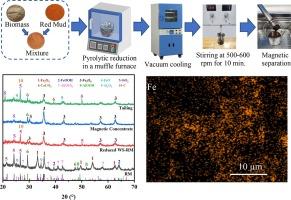
In this study, the pyrolytic reduction of iron oxides contained in red mud using biomass-derived reductive gases was explored. Wheat straw and rice husk were evaluated together with activated carbon and graphite for their effectiveness in converting iron oxides to magnetite. Thermodynamic analyses using thermogravimetric-mass spectrometry (TG-MS) demonstrated that CO, H2, CH4, and biochar could effectively reduce iron oxides, with CO being particularly effective at lower temperatures. Optimal parameters for iron recovery were identified through an orthogonal experimental design, highlighting wheat straw as the superior biomass feedstock due to its high yield of reducing gases and fast reduction kinetics. Single-factor optimization emphasized the importance of temperature and red mud-to-biomass ratio. Optimization of pyrolytic reduction conditions revealed that wheat straw achieved the highest iron recovery rate of 75 % and a concentrate grade of 42 % at 550 °C, with a red mud-to-wheat straw ratio of 1:2, a heating rate of 12 °C/min, and a reduction time of 40 min. Mechanistic studies using X-ray diffraction, X-ray fluorescence, and scanning electron microscopy showed hematite in red mud transforming into magnetite, with some aluminum atoms substituting for iron to form iron-aluminum spinel, impacting the concentrate grade. This is a promising method for recycling iron from red mud, mitigating environmental impact, and conserving resources.
期刊介绍:
The purpose of the journal is to provide for the rapid publication of topical papers featuring the latest developments in the allied fields of mineral processing and extractive metallurgy. Its wide ranging coverage of research and practical (operating) topics includes physical separation methods, such as comminution, flotation concentration and dewatering, chemical methods such as bio-, hydro-, and electro-metallurgy, analytical techniques, process control, simulation and instrumentation, and mineralogical aspects of processing. Environmental issues, particularly those pertaining to sustainable development, will also be strongly covered.



 京公网安备 11010802042870号
京ICP备2023020795号-1
京公网安备 11010802042870号
京ICP备2023020795号-1

 分享
分享
 求助内容:
求助内容: 应助结果提醒方式:
 扫码关注我们
