{"title":"Wide-ranging cellular functions of ion channels and lipid scramblases in the structurally related TMC, TMEM16 and TMEM63 families","authors":"Lily Yeh Jan, Yuh Nung Jan","doi":"10.1038/s41594-024-01444-x","DOIUrl":null,"url":null,"abstract":"Calcium (Ca2+)-activated ion channels and lipid scramblases in the transmembrane protein 16 (TMEM16) family are structurally related to mechanosensitive ion channels in the TMEM63 and transmembrane channel-like (TMC) families. Members of this structurally related superfamily share similarities in gating transitions and serve a wide range of physiological functions, which is evident from their disease associations. The TMEM16, TMEM63 and TMC families include members with important functions in the cell membrane and/or intracellular organelles such as the endoplasmic reticulum, membrane contact sites, endosomes and lysosomes. Moreover, some members of the TMEM16 family and the TMC family perform dual functions of ion channel and lipid scramblase, leading to intriguing physiological implications. In addition to their physiological functions such as mediating phosphatidylserine exposure and facilitation of extracellular vesicle generation and cell fusion, scramblases are involved in the entry and replication of enveloped viruses. Comparisons of structurally diverse scramblases may uncover features in the lipid-scrambling mechanisms that are likely shared by scramblases. In this Review, the authors discuss the physiological and biophysical functions of structurally related TMC, TMEM16 and TMEM63 families, with an aim to elucidate the mechanisms that control ion channel gating and mechanisms for scrambling lipids in the lipid membranes.","PeriodicalId":49141,"journal":{"name":"Nature Structural & Molecular Biology","volume":"32 2","pages":"222-236"},"PeriodicalIF":10.1000,"publicationDate":"2024-12-23","publicationTypes":"Journal Article","fieldsOfStudy":null,"isOpenAccess":false,"openAccessPdf":"","citationCount":"0","resultStr":null,"platform":"Semanticscholar","paperid":null,"PeriodicalName":"Nature Structural & Molecular Biology","FirstCategoryId":"99","ListUrlMain":"https://www.nature.com/articles/s41594-024-01444-x","RegionNum":1,"RegionCategory":"生物学","ArticlePicture":[],"TitleCN":null,"AbstractTextCN":null,"PMCID":null,"EPubDate":"","PubModel":"","JCR":"Q1","JCRName":"BIOCHEMISTRY & MOLECULAR BIOLOGY","Score":null,"Total":0}
引用次数: 0
Abstract
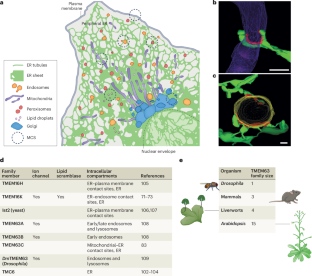
Calcium (Ca2+)-activated ion channels and lipid scramblases in the transmembrane protein 16 (TMEM16) family are structurally related to mechanosensitive ion channels in the TMEM63 and transmembrane channel-like (TMC) families. Members of this structurally related superfamily share similarities in gating transitions and serve a wide range of physiological functions, which is evident from their disease associations. The TMEM16, TMEM63 and TMC families include members with important functions in the cell membrane and/or intracellular organelles such as the endoplasmic reticulum, membrane contact sites, endosomes and lysosomes. Moreover, some members of the TMEM16 family and the TMC family perform dual functions of ion channel and lipid scramblase, leading to intriguing physiological implications. In addition to their physiological functions such as mediating phosphatidylserine exposure and facilitation of extracellular vesicle generation and cell fusion, scramblases are involved in the entry and replication of enveloped viruses. Comparisons of structurally diverse scramblases may uncover features in the lipid-scrambling mechanisms that are likely shared by scramblases. In this Review, the authors discuss the physiological and biophysical functions of structurally related TMC, TMEM16 and TMEM63 families, with an aim to elucidate the mechanisms that control ion channel gating and mechanisms for scrambling lipids in the lipid membranes.
期刊介绍:
Nature Structural & Molecular Biology is a comprehensive platform that combines structural and molecular research. Our journal focuses on exploring the functional and mechanistic aspects of biological processes, emphasizing how molecular components collaborate to achieve a particular function. While structural data can shed light on these insights, our publication does not require them as a prerequisite.




 京公网安备 11010802042870号
京ICP备2023020795号-1
京公网安备 11010802042870号
京ICP备2023020795号-1

 分享
分享
 求助内容:
求助内容: 应助结果提醒方式:
 扫码关注我们
