Dr. Tao Deng, Dr. Changhong Wang, Dr. Hongli Wan, Dr. Ai-Min Li, Dr. Xinzi He, Dr. Zeyi Wang, Dr. Longsheng Cao, Dr. Xiulin Fan, Prof. Chunsheng Wang
{"title":"A Universal Design of Lithium Anode via Dynamic Stability Strategy for Practical All-Solid-State Batteries","authors":"Dr. Tao Deng, Dr. Changhong Wang, Dr. Hongli Wan, Dr. Ai-Min Li, Dr. Xinzi He, Dr. Zeyi Wang, Dr. Longsheng Cao, Dr. Xiulin Fan, Prof. Chunsheng Wang","doi":"10.1002/anie.202418811","DOIUrl":null,"url":null,"abstract":"<p>All-solid-state Li-metal battery (ASSLB) chemistry with thin solid-state electrolyte (SSE) membranes features high energy density and intrinsic safety but suffers from severe dendrite formation and poor interface contact during cycling, which hampers the practical application of rechargeable ASSLB. Here, we propose a universal design of thin Li-metal anode (LMA) via a dynamic stability strategy to address these issues. The ultra-thin LMA (20 μm) is in situ constructed with uniform highly Li-ion conductive solid-electrolyte interphase and composite-polymer interphase (CPI) via electroplating process. As a result, the passivation layer with poor Li-ion conduction on Li anode can be dissolved and small surface resistance can be achieved due to the good compatibility of CPI to SSEs. The cycling of Li symmetric cell with Li<sub>6</sub>PS<sub>5</sub>Cl thin film electrolyte (<100 μm) shows a high critical current density of >2.0 mA cm<sup>−2</sup> with excellent cycling stability at 1.0 mA cm<sup>−2</sup>. The ASSLBs paring with Ni-rich LiNi<sub>0.6</sub>Mn<sub>0.2</sub>Co<sub>0.2</sub>O<sub>2</sub> cathode demonstrated the feasibility of engineered LMA design by presenting good rate capability from 0.1 C to 1.0 C at room temperature, as well as long-term cycling stability (81 % retention after 100 cycles). This work represents a general pathway to make thin dendrite-free LMA available for high-energy-density ASSLBs.</p>","PeriodicalId":125,"journal":{"name":"Angewandte Chemie International Edition","volume":"64 7","pages":""},"PeriodicalIF":16.9000,"publicationDate":"2024-12-23","publicationTypes":"Journal Article","fieldsOfStudy":null,"isOpenAccess":false,"openAccessPdf":"","citationCount":"0","resultStr":null,"platform":"Semanticscholar","paperid":null,"PeriodicalName":"Angewandte Chemie International Edition","FirstCategoryId":"92","ListUrlMain":"https://onlinelibrary.wiley.com/doi/10.1002/anie.202418811","RegionNum":1,"RegionCategory":"化学","ArticlePicture":[],"TitleCN":null,"AbstractTextCN":null,"PMCID":null,"EPubDate":"","PubModel":"","JCR":"Q1","JCRName":"CHEMISTRY, MULTIDISCIPLINARY","Score":null,"Total":0}
引用次数: 0
Abstract
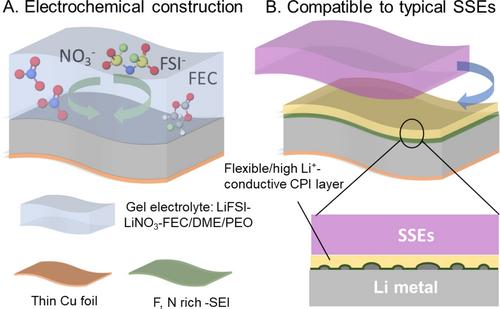
All-solid-state Li-metal battery (ASSLB) chemistry with thin solid-state electrolyte (SSE) membranes features high energy density and intrinsic safety but suffers from severe dendrite formation and poor interface contact during cycling, which hampers the practical application of rechargeable ASSLB. Here, we propose a universal design of thin Li-metal anode (LMA) via a dynamic stability strategy to address these issues. The ultra-thin LMA (20 μm) is in situ constructed with uniform highly Li-ion conductive solid-electrolyte interphase and composite-polymer interphase (CPI) via electroplating process. As a result, the passivation layer with poor Li-ion conduction on Li anode can be dissolved and small surface resistance can be achieved due to the good compatibility of CPI to SSEs. The cycling of Li symmetric cell with Li6PS5Cl thin film electrolyte (<100 μm) shows a high critical current density of >2.0 mA cm−2 with excellent cycling stability at 1.0 mA cm−2. The ASSLBs paring with Ni-rich LiNi0.6Mn0.2Co0.2O2 cathode demonstrated the feasibility of engineered LMA design by presenting good rate capability from 0.1 C to 1.0 C at room temperature, as well as long-term cycling stability (81 % retention after 100 cycles). This work represents a general pathway to make thin dendrite-free LMA available for high-energy-density ASSLBs.
采用薄固态电解质(SSE)膜的全固态锂金属电池(ASSLB)具有高能量密度和本质安全性,但在循环过程中存在严重的枝晶形成和界面接触不良,这阻碍了可充电ASSLB的实际应用。在这里,我们提出了一种通过动态稳定性策略来解决这些问题的薄锂金属阳极(LMA)的通用设计。超薄LMA (20 μm)由均匀的高锂离子导电固体电解质界面和复合聚合物界面(CPI)通过电镀工艺原位构建。因此,由于CPI与ssi的良好相容性,可以溶解Li阳极上Li离子传导较差的钝化层,并获得较小的表面电阻。锂对称电池与Li6PS5Cl薄膜电解质(<)的循环100 μm)的临界电流密度为>;2.0 mA cm-2,在1.0 mA cm-2时具有优异的循环稳定性。与富ni的LiNi0.6Mn0.2Co0.2O2阴极相匹配的asslb在室温下在0.1C至1.0 C范围内具有良好的倍率性能,并且具有长期循环稳定性(循环100次后保持81%),证明了工程LMA设计的可行性。这项工作为高能量密度asslb提供了一条无枝晶薄LMA的一般途径。
期刊介绍:
Angewandte Chemie, a journal of the German Chemical Society (GDCh), maintains a leading position among scholarly journals in general chemistry with an impressive Impact Factor of 16.6 (2022 Journal Citation Reports, Clarivate, 2023). Published weekly in a reader-friendly format, it features new articles almost every day. Established in 1887, Angewandte Chemie is a prominent chemistry journal, offering a dynamic blend of Review-type articles, Highlights, Communications, and Research Articles on a weekly basis, making it unique in the field.




 京公网安备 11010802042870号
京ICP备2023020795号-1
京公网安备 11010802042870号
京ICP备2023020795号-1

 分享
分享
 求助内容:
求助内容: 应助结果提醒方式:
 扫码关注我们
