Simone Wahnschafft, Achim Spiller, Yasemin Boztuğ, Peter von Philipsborn, Dominic Lemken
{"title":"Examining public support for comprehensive policy packages to tackle unhealthy food environments.","authors":"Simone Wahnschafft, Achim Spiller, Yasemin Boztuğ, Peter von Philipsborn, Dominic Lemken","doi":"10.1017/S1368980024002532","DOIUrl":null,"url":null,"abstract":"<p><strong>Objective: </strong>This study examines public support - and its drivers - for comprehensive policy packages (i.e. bundles of coherent policy measures introduced together) aimed at improving food environments.</p><p><strong>Design: </strong>Participants completed an online survey with a choice-based conjoint experiment, where they evaluated pairs of policy packages comprising up to seven distinct food environment measures. After choosing a preferred package or opting for a single policy, participants designed their ideal policy package. Based on their choices, respondents were categorised as resistant, inclined or supportive towards policy packaging according to their frequency of opting out for single measures and the number of policies they included in their ideal package.</p><p><strong>Setting: </strong>The study was conducted in Germany via an online survey.</p><p><strong>Participants: </strong>The sample included 1200 eligible German voters, recruited based on age, gender and income quotas.</p><p><strong>Results: </strong>Based on both opt-out frequency (44·7 %) and ideal policy packaging (72·8 %) outcomes, most respondents were inclined towards policy packages. The inclusion of fiscal incentives and school-based measures in packages enhanced support, while fiscal disincentives reduced it. Key drivers of support included beliefs about the importance of diet-related issues and the role of government in regulation, while socio-demographic factors, political leaning and personal experience with diet-related disease had minimal impact.</p><p><strong>Conclusions: </strong>The results reveal public appetite for policy packages to address unhealthy food environments, contingent on package design and beliefs about the issue's severity and legitimacy of intervention. Public health advocates should design and promote policy packages aligned with public preferences, especially given anticipated opposition from commercial interests.</p>","PeriodicalId":20951,"journal":{"name":"Public Health Nutrition","volume":" ","pages":"e7"},"PeriodicalIF":3.0000,"publicationDate":"2024-12-22","publicationTypes":"Journal Article","fieldsOfStudy":null,"isOpenAccess":false,"openAccessPdf":"https://www.ncbi.nlm.nih.gov/pmc/articles/PMC11736651/pdf/","citationCount":"0","resultStr":null,"platform":"Semanticscholar","paperid":null,"PeriodicalName":"Public Health Nutrition","FirstCategoryId":"3","ListUrlMain":"https://doi.org/10.1017/S1368980024002532","RegionNum":3,"RegionCategory":"医学","ArticlePicture":[],"TitleCN":null,"AbstractTextCN":null,"PMCID":null,"EPubDate":"","PubModel":"","JCR":"Q2","JCRName":"NUTRITION & DIETETICS","Score":null,"Total":0}
引用次数: 0
Abstract
Objective: This study examines public support - and its drivers - for comprehensive policy packages (i.e. bundles of coherent policy measures introduced together) aimed at improving food environments.
Design: Participants completed an online survey with a choice-based conjoint experiment, where they evaluated pairs of policy packages comprising up to seven distinct food environment measures. After choosing a preferred package or opting for a single policy, participants designed their ideal policy package. Based on their choices, respondents were categorised as resistant, inclined or supportive towards policy packaging according to their frequency of opting out for single measures and the number of policies they included in their ideal package.
Setting: The study was conducted in Germany via an online survey.
Participants: The sample included 1200 eligible German voters, recruited based on age, gender and income quotas.
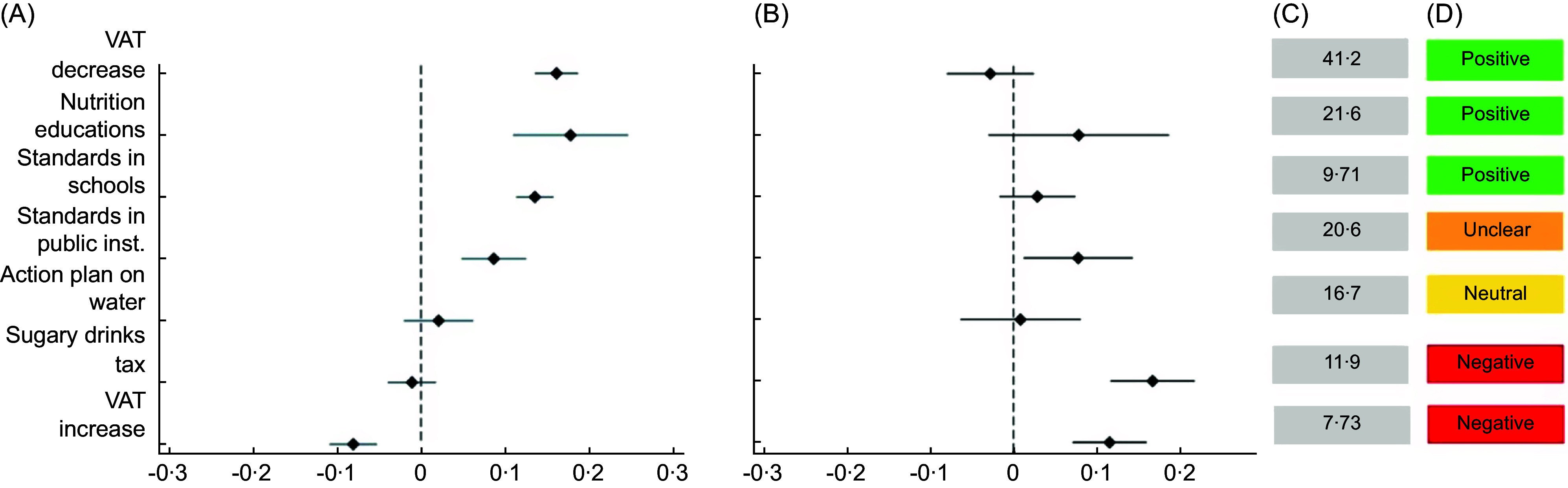
Results: Based on both opt-out frequency (44·7 %) and ideal policy packaging (72·8 %) outcomes, most respondents were inclined towards policy packages. The inclusion of fiscal incentives and school-based measures in packages enhanced support, while fiscal disincentives reduced it. Key drivers of support included beliefs about the importance of diet-related issues and the role of government in regulation, while socio-demographic factors, political leaning and personal experience with diet-related disease had minimal impact.
Conclusions: The results reveal public appetite for policy packages to address unhealthy food environments, contingent on package design and beliefs about the issue's severity and legitimacy of intervention. Public health advocates should design and promote policy packages aligned with public preferences, especially given anticipated opposition from commercial interests.
期刊介绍:
Public Health Nutrition provides an international peer-reviewed forum for the publication and dissemination of research and scholarship aimed at understanding the causes of, and approaches and solutions to nutrition-related public health achievements, situations and problems around the world. The journal publishes original and commissioned articles, commentaries and discussion papers for debate. The journal is of interest to epidemiologists and health promotion specialists interested in the role of nutrition in disease prevention; academics and those involved in fieldwork and the application of research to identify practical solutions to important public health problems.





 京公网安备 11010802042870号
京ICP备2023020795号-1
京公网安备 11010802042870号
京ICP备2023020795号-1

 分享
分享
 求助内容:
求助内容: 应助结果提醒方式:
 扫码关注我们
