Tao Ban, Yinfei Wang, Yifei Xu, Zihui Wang, Xiuling Zhu
{"title":"Constructing high-performance poly(terphenyl pyridinium) membranes through efficient acid doping and controllable crosslinking for vanadium flow batteries","authors":"Tao Ban, Yinfei Wang, Yifei Xu, Zihui Wang, Xiuling Zhu","doi":"10.1016/j.cej.2024.158925","DOIUrl":null,"url":null,"abstract":"The development of membranes is crucial for advancing vanadium flow battery (VFB), however, designing high-performance membranes to achieve high-selectivity ion transport and excellent stability remains a significant challenge. Herein, we present an innovative design of crosslinked acid-doped poly(triphenyl pyridinium) membranes centered on balancing the ratio of the two triphenylene isomers (meso and para) and incorporating efficient sulfuric acid doping and controllable crosslinking strategies. Specifically, precisely balanced rigid and flexible segments make the polymer chains more loosely packed, enhancing acid absorption of the membrane. The uniformly distributed hydrophilic regions and abundant hydrogen bond network within the membrane significantly improve the transport of charge-balanced ions. Meanwhile, the Donnan repulsion effect from the pyridinium groups and the spatial barrier effect from the densely arranged polymer chains synergistically prevent vanadium penetration. The resulting membrane exhibits high ion selectivity (18.49 × 10<sup>5</sup> S min cm<sup>−3</sup>). Furthermore, the robust ether-free backbone and non-weak-bond pyridinium in combination with the crosslinked structure achieve outstanding mechanical and chemical stability. The VFBs based on these membranes offer excellent energy efficiency (over 82 %) at high current density, and exhibit ultra-low capacity decay (0.056 % decay rate per cycle) and sustained stability (over 1600 cycles) at 120 mA cm<sup>−2</sup>. This study provides a new perspective on the design of high-performance membranes for VFBs","PeriodicalId":270,"journal":{"name":"Chemical Engineering Journal","volume":"5 1","pages":""},"PeriodicalIF":13.2000,"publicationDate":"2024-12-24","publicationTypes":"Journal Article","fieldsOfStudy":null,"isOpenAccess":false,"openAccessPdf":"","citationCount":"0","resultStr":null,"platform":"Semanticscholar","paperid":null,"PeriodicalName":"Chemical Engineering Journal","FirstCategoryId":"5","ListUrlMain":"https://doi.org/10.1016/j.cej.2024.158925","RegionNum":1,"RegionCategory":"工程技术","ArticlePicture":[],"TitleCN":null,"AbstractTextCN":null,"PMCID":null,"EPubDate":"","PubModel":"","JCR":"Q1","JCRName":"ENGINEERING, CHEMICAL","Score":null,"Total":0}
引用次数: 0
Abstract
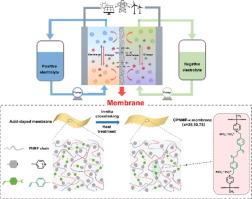
The development of membranes is crucial for advancing vanadium flow battery (VFB), however, designing high-performance membranes to achieve high-selectivity ion transport and excellent stability remains a significant challenge. Herein, we present an innovative design of crosslinked acid-doped poly(triphenyl pyridinium) membranes centered on balancing the ratio of the two triphenylene isomers (meso and para) and incorporating efficient sulfuric acid doping and controllable crosslinking strategies. Specifically, precisely balanced rigid and flexible segments make the polymer chains more loosely packed, enhancing acid absorption of the membrane. The uniformly distributed hydrophilic regions and abundant hydrogen bond network within the membrane significantly improve the transport of charge-balanced ions. Meanwhile, the Donnan repulsion effect from the pyridinium groups and the spatial barrier effect from the densely arranged polymer chains synergistically prevent vanadium penetration. The resulting membrane exhibits high ion selectivity (18.49 × 10⁵ S min cm−3). Furthermore, the robust ether-free backbone and non-weak-bond pyridinium in combination with the crosslinked structure achieve outstanding mechanical and chemical stability. The VFBs based on these membranes offer excellent energy efficiency (over 82 %) at high current density, and exhibit ultra-low capacity decay (0.056 % decay rate per cycle) and sustained stability (over 1600 cycles) at 120 mA cm−2. This study provides a new perspective on the design of high-performance membranes for VFBs
膜的发展对钒液流电池(VFB)的发展至关重要,然而,设计高性能膜以实现高选择性离子传输和优异的稳定性仍然是一个重大挑战。本文提出了一种新颖的酸掺杂聚三苯基吡啶交联膜设计,其核心是平衡两种三苯基异构体(介观和对位)的比例,并结合高效硫酸掺杂和可控交联策略。具体来说,精确平衡的刚性和柔性部分使聚合物链更松散地包装,增强膜的酸吸收。膜内均匀分布的亲水区和丰富的氢键网络显著促进了电荷平衡离子的输运。同时,吡啶基团的Donnan排斥效应和密集排列的聚合物链的空间屏障效应协同阻止了钒的渗透。所得膜具有高离子选择性(18.49 × 10⁵ S min cm−3)。此外,强健的无醚主链和无弱键的吡啶结合交联结构获得了出色的机械和化学稳定性。基于这些膜的VFBs在高电流密度下具有优异的能量效率(超过82 %),并且在120 mA cm - 2下表现出超低的容量衰减(每周期衰减率为0.056 %)和持续的稳定性(超过1600次循环)。本研究为vfb高性能膜的设计提供了新的思路
期刊介绍:
The Chemical Engineering Journal is an international research journal that invites contributions of original and novel fundamental research. It aims to provide an international platform for presenting original fundamental research, interpretative reviews, and discussions on new developments in chemical engineering. The journal welcomes papers that describe novel theory and its practical application, as well as those that demonstrate the transfer of techniques from other disciplines. It also welcomes reports on carefully conducted experimental work that is soundly interpreted. The main focus of the journal is on original and rigorous research results that have broad significance. The Catalysis section within the Chemical Engineering Journal focuses specifically on Experimental and Theoretical studies in the fields of heterogeneous catalysis, molecular catalysis, and biocatalysis. These studies have industrial impact on various sectors such as chemicals, energy, materials, foods, healthcare, and environmental protection.



 京公网安备 11010802042870号
京ICP备2023020795号-1
京公网安备 11010802042870号
京ICP备2023020795号-1

 分享
分享
 求助内容:
求助内容: 应助结果提醒方式:
 扫码关注我们
