Yaron S. Cohen , Sumesh Sadhujan , Maheshwaran Duraiyarasu , Sonal Rajput , Anchal Vashishtha , Yakov Shitrit , Olga Iliashevsky , Eran Edri
{"title":"The play of bismuth disproportionation: Formation of Bi(I) species during cluster-like electrodeposition mechanism","authors":"Yaron S. Cohen , Sumesh Sadhujan , Maheshwaran Duraiyarasu , Sonal Rajput , Anchal Vashishtha , Yakov Shitrit , Olga Iliashevsky , Eran Edri","doi":"10.1016/j.electacta.2024.145576","DOIUrl":null,"url":null,"abstract":"<div><div>The electrochemistry of main group metal complexes offers fascinating chemical opportunities due to unusual two-electron steps and various intermediate quasi-stable oxidation states. This study explored the electrochemical behaviors of bismuth and antimony halo-thiolate complexes during bias potential cycling in an organic solvent. Our findings reveal critical disproportionation reactions, leading to unique nucleation and growth pathways that enhance the density of electroactive sites for CO₂ reduction to formate—a key reaction for future energy and chemical industries. We present four pieces of evidence supporting a homogeneous disproportionation reaction, which induces a cluster-like deposition mechanism, marking a notable exception in electrodeposition processes. Including antimony complexes in the electrolyte significantly accelerates the formation of Bi(I) intermediates, supposedly via Sb-to-Bi charge transfer. This research advances our understanding of bismuth and antimony electrochemical properties and demonstrates how controlled electrodeposition can optimize electrocatalytic efficiency for applications like CO₂ reduction, contributing to developing more effective and sustainable energy technologies.</div></div>","PeriodicalId":305,"journal":{"name":"Electrochimica Acta","volume":"513 ","pages":"Article 145576"},"PeriodicalIF":5.6000,"publicationDate":"2025-02-10","publicationTypes":"Journal Article","fieldsOfStudy":null,"isOpenAccess":false,"openAccessPdf":"","citationCount":"0","resultStr":null,"platform":"Semanticscholar","paperid":null,"PeriodicalName":"Electrochimica Acta","FirstCategoryId":"88","ListUrlMain":"https://www.sciencedirect.com/science/article/pii/S0013468624018127","RegionNum":3,"RegionCategory":"材料科学","ArticlePicture":[],"TitleCN":null,"AbstractTextCN":null,"PMCID":null,"EPubDate":"2024/12/25 0:00:00","PubModel":"Epub","JCR":"Q1","JCRName":"ELECTROCHEMISTRY","Score":null,"Total":0}
引用次数: 0
Abstract
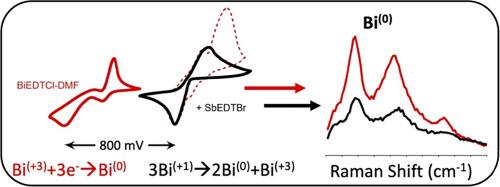
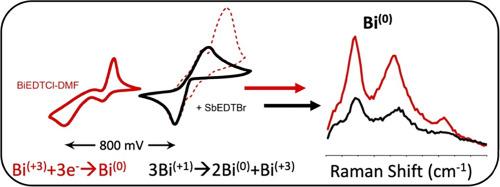
The electrochemistry of main group metal complexes offers fascinating chemical opportunities due to unusual two-electron steps and various intermediate quasi-stable oxidation states. This study explored the electrochemical behaviors of bismuth and antimony halo-thiolate complexes during bias potential cycling in an organic solvent. Our findings reveal critical disproportionation reactions, leading to unique nucleation and growth pathways that enhance the density of electroactive sites for CO₂ reduction to formate—a key reaction for future energy and chemical industries. We present four pieces of evidence supporting a homogeneous disproportionation reaction, which induces a cluster-like deposition mechanism, marking a notable exception in electrodeposition processes. Including antimony complexes in the electrolyte significantly accelerates the formation of Bi(I) intermediates, supposedly via Sb-to-Bi charge transfer. This research advances our understanding of bismuth and antimony electrochemical properties and demonstrates how controlled electrodeposition can optimize electrocatalytic efficiency for applications like CO₂ reduction, contributing to developing more effective and sustainable energy technologies.
期刊介绍:
Electrochimica Acta is an international journal. It is intended for the publication of both original work and reviews in the field of electrochemistry. Electrochemistry should be interpreted to mean any of the research fields covered by the Divisions of the International Society of Electrochemistry listed below, as well as emerging scientific domains covered by ISE New Topics Committee.



 京公网安备 11010802042870号
京ICP备2023020795号-1
京公网安备 11010802042870号
京ICP备2023020795号-1

 分享
分享
 求助内容:
求助内容: 应助结果提醒方式:
 扫码关注我们
