Distinct Gut Microbiota Profiles in Normal Weight Obesity and Their Association With Cardiometabolic Diseases: Results From Two Independent Cohort Studies
Wenjie Wang, Feijie Wang, Yihan Li, Yuwei Shi, Xiaoyan Wang, Xinyu Chen, Weifang Zheng, Julianna C. Hsing, Ying Lu, Yi-Shuan Wu, Ann W. Hsing, Juntao Kan, Wei He, Shankuan Zhu
{"title":"Distinct Gut Microbiota Profiles in Normal Weight Obesity and Their Association With Cardiometabolic Diseases: Results From Two Independent Cohort Studies","authors":"Wenjie Wang, Feijie Wang, Yihan Li, Yuwei Shi, Xiaoyan Wang, Xinyu Chen, Weifang Zheng, Julianna C. Hsing, Ying Lu, Yi-Shuan Wu, Ann W. Hsing, Juntao Kan, Wei He, Shankuan Zhu","doi":"10.1002/jcsm.13644","DOIUrl":null,"url":null,"abstract":"<div>\n \n \n <section>\n \n <h3> Background</h3>\n \n <p>Normal weight obesity (NWO) is characterized by excess body fat in individuals with normal body mass index (BMI). This study aimed to investigate gut microbiota alterations in NWO and their potential associations with cardiometabolic diseases (CMD) risk in two independent cohorts.</p>\n </section>\n \n <section>\n \n <h3> Methods</h3>\n \n <p>Our NWO-CMD mortality analysis included 168 099 adults with normal BMI from two large open-access databases, while our NWO-gut microbiota study involved 5467 adults with normal BMI from two independent cohorts: the WELL-China cohort and the Lanxi cohort. NWO was defined as having a normal BMI (18.5–23.9 kg/m<sup>2</sup>) but an excess per cent body fat (PBF, ≥ 25% in men and ≥ 35% in women). Normal weight lean was defined as having a normal BMI and normal PBF. The 16S rRNA gene sequencing method was used to analyse gut microbiota data.</p>\n </section>\n \n <section>\n \n <h3> Results</h3>\n \n <p>The study comprised 3620 (64.0% female, median age 58 years) and 1847 (64.3% female, median age 56 years) participants from the WELL-China and Lanxi cohorts. In our meta-analysis, NWO is associated with 26% (95% CI: 1.07–1.41) higher risk of CMD mortality. Gut microbial analyses indicated that the NWO group exhibited reduced levels of observed species (<i>p</i> = 0.009 and <i>p</i> = 0.013) and Chao 1 index (<i>p</i> = 0.002 and <i>p</i> = 0.002) and altered gut microbial compositions (<i>p</i> = 0.009 and <i>p</i> < 0.001) compared with the NWL group. Seven genera were consistently observed to be associated with NWO in both two cohorts (all Q < 0.25). Among them, five (<i>Fusobacterium</i>, <i>Ruminococcus gnavus group</i>, <i>Ruminococcus torques group</i>, <i>Coprococcus</i> and <i>Christensenellaceae_R7_group</i>) have been previously linked to obesity, while the other two (<i>Phascolarctobacterium</i> and <i>Clostridia_UCG-014</i>) were minimally reported. We also found statistically significant differences in the microbial composition between the NWO group and the obesity group (<i>p</i> = 0.001 and <i>p</i> = 0.001). Furthermore, the NWO-related gut microbiome was associated with an elevated risk of hypertension, dyslipidaemia and metabolic syndrome, the corresponding HR (95% CIs) were 1.11 (1.01–1.22), 1.19 (1.10–1.29) and 1.17 (1.05–1.30) in the WELL-China cohort and 1.14 (1.02–1.27), 1.15 (1.02–1.29) and 1.16 (1.02–1.32) in the Lanxi cohort.</p>\n </section>\n \n <section>\n \n <h3> Conclusions</h3>\n \n <p>These two large cohorts provided reliable evidence that gut microbiota alterations in NWO resemble those found in obesity, yet also display unique aspects. This distinct microbiota profile may contribute to heightened cardiometabolic risks in adults with normal BMI.</p>\n </section>\n </div>","PeriodicalId":48911,"journal":{"name":"Journal of Cachexia Sarcopenia and Muscle","volume":"16 1","pages":""},"PeriodicalIF":9.1000,"publicationDate":"2024-12-26","publicationTypes":"Journal Article","fieldsOfStudy":null,"isOpenAccess":false,"openAccessPdf":"https://onlinelibrary.wiley.com/doi/epdf/10.1002/jcsm.13644","citationCount":"0","resultStr":null,"platform":"Semanticscholar","paperid":null,"PeriodicalName":"Journal of Cachexia Sarcopenia and Muscle","FirstCategoryId":"3","ListUrlMain":"https://onlinelibrary.wiley.com/doi/10.1002/jcsm.13644","RegionNum":1,"RegionCategory":"医学","ArticlePicture":[],"TitleCN":null,"AbstractTextCN":null,"PMCID":null,"EPubDate":"","PubModel":"","JCR":"Q1","JCRName":"GERIATRICS & GERONTOLOGY","Score":null,"Total":0}
引用次数: 0
Abstract
Background
Normal weight obesity (NWO) is characterized by excess body fat in individuals with normal body mass index (BMI). This study aimed to investigate gut microbiota alterations in NWO and their potential associations with cardiometabolic diseases (CMD) risk in two independent cohorts.
Methods
Our NWO-CMD mortality analysis included 168 099 adults with normal BMI from two large open-access databases, while our NWO-gut microbiota study involved 5467 adults with normal BMI from two independent cohorts: the WELL-China cohort and the Lanxi cohort. NWO was defined as having a normal BMI (18.5–23.9 kg/m2) but an excess per cent body fat (PBF, ≥ 25% in men and ≥ 35% in women). Normal weight lean was defined as having a normal BMI and normal PBF. The 16S rRNA gene sequencing method was used to analyse gut microbiota data.
Results
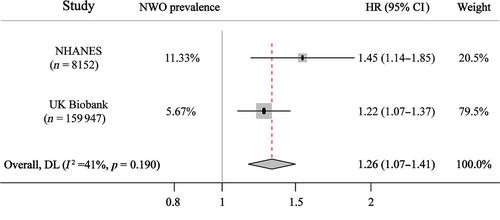
The study comprised 3620 (64.0% female, median age 58 years) and 1847 (64.3% female, median age 56 years) participants from the WELL-China and Lanxi cohorts. In our meta-analysis, NWO is associated with 26% (95% CI: 1.07–1.41) higher risk of CMD mortality. Gut microbial analyses indicated that the NWO group exhibited reduced levels of observed species (p = 0.009 and p = 0.013) and Chao 1 index (p = 0.002 and p = 0.002) and altered gut microbial compositions (p = 0.009 and p < 0.001) compared with the NWL group. Seven genera were consistently observed to be associated with NWO in both two cohorts (all Q < 0.25). Among them, five (Fusobacterium, Ruminococcus gnavus group, Ruminococcus torques group, Coprococcus and Christensenellaceae_R7_group) have been previously linked to obesity, while the other two (Phascolarctobacterium and Clostridia_UCG-014) were minimally reported. We also found statistically significant differences in the microbial composition between the NWO group and the obesity group (p = 0.001 and p = 0.001). Furthermore, the NWO-related gut microbiome was associated with an elevated risk of hypertension, dyslipidaemia and metabolic syndrome, the corresponding HR (95% CIs) were 1.11 (1.01–1.22), 1.19 (1.10–1.29) and 1.17 (1.05–1.30) in the WELL-China cohort and 1.14 (1.02–1.27), 1.15 (1.02–1.29) and 1.16 (1.02–1.32) in the Lanxi cohort.
Conclusions
These two large cohorts provided reliable evidence that gut microbiota alterations in NWO resemble those found in obesity, yet also display unique aspects. This distinct microbiota profile may contribute to heightened cardiometabolic risks in adults with normal BMI.
期刊介绍:
The Journal of Cachexia, Sarcopenia and Muscle is a peer-reviewed international journal dedicated to publishing materials related to cachexia and sarcopenia, as well as body composition and its physiological and pathophysiological changes across the lifespan and in response to various illnesses from all fields of life sciences. The journal aims to provide a reliable resource for professionals interested in related research or involved in the clinical care of affected patients, such as those suffering from AIDS, cancer, chronic heart failure, chronic lung disease, liver cirrhosis, chronic kidney failure, rheumatoid arthritis, or sepsis.



 京公网安备 11010802042870号
京ICP备2023020795号-1
京公网安备 11010802042870号
京ICP备2023020795号-1

 分享
分享
 求助内容:
求助内容: 应助结果提醒方式:
 扫码关注我们
