Santanu Ghora , Rishika Chakraborty , Saheb Bag , Mopidevi Manikanta Kumar , C. Retna Raj
{"title":"Transition metal phosphide-based oxygen electrocatalysts for aqueous zinc–air batteries†","authors":"Santanu Ghora , Rishika Chakraborty , Saheb Bag , Mopidevi Manikanta Kumar , C. Retna Raj","doi":"10.1039/d4cc05498a","DOIUrl":null,"url":null,"abstract":"<div><div>Electrically rechargeable zinc–air batteries (ZABs) are emerging as promising energy storage devices in the post-lithium era, leveraging the oxygen reduction reaction (ORR) and the oxygen evolution reaction (OER) at the air cathodes. Efficient bifunctional oxygen electrocatalysts, capable of catalyzing both the ORR and OER, are essential for the operation of rechargeable ZABs. Traditional Pt- and RuO<sub>2</sub>/IrO<sub>2</sub>-based catalysts are not ideal, as they lack sufficient bifunctional ORR and OER activity, exhibit limited long-term durability, require high overpotentials and are expensive. In contrast, non-precious metal-based catalysts, including transition metal phosphides (TMPs), have gained significant attention for their promising bifunctional catalytic properties, making them attractive candidates for ZABs. Despite encouraging lab-scale achievements, translating these advancements into market-ready applications remains challenging due to suboptimal energy performance. Rationally engineered bifunctional TMPs hold great potential for overcoming these challenges and meeting the requirements of rechargeable ZABs. This feature article reviews recent progress in the development of TMP-based catalysts for ZABs, providing a comprehensive overview of ZAB fundamentals and strategies for catalyst design, synthesis, and engineering. A particular emphasis is placed on widely studied bifunctional Fe, Co, and Ni phosphides, along with approaches to enhance their catalytic performance. Key performance metrics are critically evaluated, including the potential gap (Δ<em>E</em>) between the ORR and the OER, specific capacity, peak power density, and charge–discharge cycling stability. Finally, this feature article discusses the challenges faced in TMP-based ZABs, proposes strategies to address these issues, and explores future directions for improving their rechargeability to meet the demands of commercial-scale energy storage technologies.</div></div>","PeriodicalId":67,"journal":{"name":"Chemical Communications","volume":"61 13","pages":"Pages 2636-2657"},"PeriodicalIF":4.2000,"publicationDate":"2025-01-02","publicationTypes":"Journal Article","fieldsOfStudy":null,"isOpenAccess":false,"openAccessPdf":"","citationCount":"0","resultStr":null,"platform":"Semanticscholar","paperid":null,"PeriodicalName":"Chemical Communications","FirstCategoryId":"92","ListUrlMain":"https://www.sciencedirect.com/org/science/article/pii/S1359734524028301","RegionNum":2,"RegionCategory":"化学","ArticlePicture":[],"TitleCN":null,"AbstractTextCN":null,"PMCID":null,"EPubDate":"2024/12/26 0:00:00","PubModel":"Epub","JCR":"Q2","JCRName":"CHEMISTRY, MULTIDISCIPLINARY","Score":null,"Total":0}
引用次数: 0
Abstract
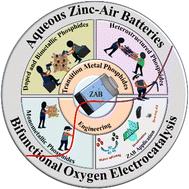
Electrically rechargeable zinc–air batteries (ZABs) are emerging as promising energy storage devices in the post-lithium era, leveraging the oxygen reduction reaction (ORR) and the oxygen evolution reaction (OER) at the air cathodes. Efficient bifunctional oxygen electrocatalysts, capable of catalyzing both the ORR and OER, are essential for the operation of rechargeable ZABs. Traditional Pt- and RuO2/IrO2-based catalysts are not ideal, as they lack sufficient bifunctional ORR and OER activity, exhibit limited long-term durability, require high overpotentials and are expensive. In contrast, non-precious metal-based catalysts, including transition metal phosphides (TMPs), have gained significant attention for their promising bifunctional catalytic properties, making them attractive candidates for ZABs. Despite encouraging lab-scale achievements, translating these advancements into market-ready applications remains challenging due to suboptimal energy performance. Rationally engineered bifunctional TMPs hold great potential for overcoming these challenges and meeting the requirements of rechargeable ZABs. This feature article reviews recent progress in the development of TMP-based catalysts for ZABs, providing a comprehensive overview of ZAB fundamentals and strategies for catalyst design, synthesis, and engineering. A particular emphasis is placed on widely studied bifunctional Fe, Co, and Ni phosphides, along with approaches to enhance their catalytic performance. Key performance metrics are critically evaluated, including the potential gap (ΔE) between the ORR and the OER, specific capacity, peak power density, and charge–discharge cycling stability. Finally, this feature article discusses the challenges faced in TMP-based ZABs, proposes strategies to address these issues, and explores future directions for improving their rechargeability to meet the demands of commercial-scale energy storage technologies.
期刊介绍:
ChemComm (Chemical Communications) is renowned as the fastest publisher of articles providing information on new avenues of research, drawn from all the world''s major areas of chemical research.



 京公网安备 11010802042870号
京ICP备2023020795号-1
京公网安备 11010802042870号
京ICP备2023020795号-1

 分享
分享
 求助内容:
求助内容: 应助结果提醒方式:
 扫码关注我们
