Manisha, Mukul Gupta, V. Raghavendra Reddy and Sevi Murugavel
{"title":"Effect of strain on the electronic structure and polaronic conductivity of LiFePO4†","authors":"Manisha, Mukul Gupta, V. Raghavendra Reddy and Sevi Murugavel","doi":"10.1039/D4CP03106G","DOIUrl":null,"url":null,"abstract":"<p >Improving the electronic properties of active cathode materials can significantly impact the design of rechargeable batteries. In this study, we investigated the influence of micro-strain on the structural and electronic properties of LiFePO<small><sub>4</sub></small> (LFP) by performing combined core-level spectroscopy analysis and electrical conductivity measurements. High-resolution X-ray diffraction measurements, followed by Rietveld refinement analysis, revealed an increase in unit cell parameters due to the enhanced micro-strain in the lattice structure. <small><sup>57</sup></small>Fe Mössbauer spectroscopy disclosed the presence of Fe<small><sup>2+</sup></small> and Fe<small><sup>3+</sup></small> in distorted octahedral environments, and their relative concentrations provided a comprehensive understanding of the electronic structure and its relationship with micro-strain in the LFP samples. The effect of micro-strain on the electronic structure of the LFP samples was investigated using X-ray absorption spectroscopy (XAS). The analysis revealed the valence state of the 3d levels in the vicinity of the Fermi level, which was sensitive to local lattice distortions. The obtained Fe L-edge and O K-edge spectral fingerprints demonstrated the influence of micro-strain, providing valuable insights into the valence state of iron, crystal field and covalent character between Fe and O. The unique structural behaviour and electronic properties of olivine LFP structure were found to be directly linked to changes in the bonding character, which varied significantly with micro-strain. We propose that the observed lattice expansion in LFP is due to the weaker hybridization of e<small><sub>g</sub></small> states with oxygen. The effect of micro-strain on the electronic properties of LFP is reflected in the observed enhancement of polaronic conductivity by an order of magnitude that is highly beneficial for improving the performance of electrode materials.</p>","PeriodicalId":99,"journal":{"name":"Physical Chemistry Chemical Physics","volume":" 5","pages":" 2692-2703"},"PeriodicalIF":2.9000,"publicationDate":"2024-12-26","publicationTypes":"Journal Article","fieldsOfStudy":null,"isOpenAccess":false,"openAccessPdf":"","citationCount":"0","resultStr":null,"platform":"Semanticscholar","paperid":null,"PeriodicalName":"Physical Chemistry Chemical Physics","FirstCategoryId":"92","ListUrlMain":"https://pubs.rsc.org/en/content/articlelanding/2025/cp/d4cp03106g","RegionNum":3,"RegionCategory":"化学","ArticlePicture":[],"TitleCN":null,"AbstractTextCN":null,"PMCID":null,"EPubDate":"","PubModel":"","JCR":"Q3","JCRName":"CHEMISTRY, PHYSICAL","Score":null,"Total":0}
引用次数: 0
Abstract
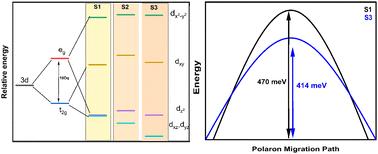
Improving the electronic properties of active cathode materials can significantly impact the design of rechargeable batteries. In this study, we investigated the influence of micro-strain on the structural and electronic properties of LiFePO4 (LFP) by performing combined core-level spectroscopy analysis and electrical conductivity measurements. High-resolution X-ray diffraction measurements, followed by Rietveld refinement analysis, revealed an increase in unit cell parameters due to the enhanced micro-strain in the lattice structure. 57Fe Mössbauer spectroscopy disclosed the presence of Fe2+ and Fe3+ in distorted octahedral environments, and their relative concentrations provided a comprehensive understanding of the electronic structure and its relationship with micro-strain in the LFP samples. The effect of micro-strain on the electronic structure of the LFP samples was investigated using X-ray absorption spectroscopy (XAS). The analysis revealed the valence state of the 3d levels in the vicinity of the Fermi level, which was sensitive to local lattice distortions. The obtained Fe L-edge and O K-edge spectral fingerprints demonstrated the influence of micro-strain, providing valuable insights into the valence state of iron, crystal field and covalent character between Fe and O. The unique structural behaviour and electronic properties of olivine LFP structure were found to be directly linked to changes in the bonding character, which varied significantly with micro-strain. We propose that the observed lattice expansion in LFP is due to the weaker hybridization of eg states with oxygen. The effect of micro-strain on the electronic properties of LFP is reflected in the observed enhancement of polaronic conductivity by an order of magnitude that is highly beneficial for improving the performance of electrode materials.
期刊介绍:
Physical Chemistry Chemical Physics (PCCP) is an international journal co-owned by 19 physical chemistry and physics societies from around the world. This journal publishes original, cutting-edge research in physical chemistry, chemical physics and biophysical chemistry. To be suitable for publication in PCCP, articles must include significant innovation and/or insight into physical chemistry; this is the most important criterion that reviewers and Editors will judge against when evaluating submissions.
The journal has a broad scope and welcomes contributions spanning experiment, theory, computation and data science. Topical coverage includes spectroscopy, dynamics, kinetics, statistical mechanics, thermodynamics, electrochemistry, catalysis, surface science, quantum mechanics, quantum computing and machine learning. Interdisciplinary research areas such as polymers and soft matter, materials, nanoscience, energy, surfaces/interfaces, and biophysical chemistry are welcomed if they demonstrate significant innovation and/or insight into physical chemistry. Joined experimental/theoretical studies are particularly appreciated when complementary and based on up-to-date approaches.




 京公网安备 11010802042870号
京ICP备2023020795号-1
京公网安备 11010802042870号
京ICP备2023020795号-1

 分享
分享
 求助内容:
求助内容: 应助结果提醒方式:
 扫码关注我们
