Disturbed Spatial WNT Activation—A Potential Driver of the Reticularized Skin Phenotype in Systemic Sclerosis

IF 10.9 1区 医学 Q1 RHEUMATOLOGY Arthritis & Rheumatology Pub Date : 2024-12-25 DOI:10.1002/art.43094
Sara Chenguiti Fakhouri, Honglin Zhu, Yi-Nan Li, Moritz Ronicke, Aleix Rius Rigau, Clara Dees, Laura Konstantinidis, Ralf Schmid, Alexandru-Emil Matei, Markus Eckstein, Carol Geppert, Ingo Ludolph, Alexander Kreuter, Michael Sticherling, Carola Berking, Raymund E. Horch, Georg Schett, Jörg H. W. Distler, Christina Bergmann
{"title":"Disturbed Spatial WNT Activation—A Potential Driver of the Reticularized Skin Phenotype in Systemic Sclerosis","authors":"Sara Chenguiti Fakhouri,&nbsp;Honglin Zhu,&nbsp;Yi-Nan Li,&nbsp;Moritz Ronicke,&nbsp;Aleix Rius Rigau,&nbsp;Clara Dees,&nbsp;Laura Konstantinidis,&nbsp;Ralf Schmid,&nbsp;Alexandru-Emil Matei,&nbsp;Markus Eckstein,&nbsp;Carol Geppert,&nbsp;Ingo Ludolph,&nbsp;Alexander Kreuter,&nbsp;Michael Sticherling,&nbsp;Carola Berking,&nbsp;Raymund E. Horch,&nbsp;Georg Schett,&nbsp;Jörg H. W. Distler,&nbsp;Christina Bergmann","doi":"10.1002/art.43094","DOIUrl":null,"url":null,"abstract":"<div>\n \n <section>\n \n <h3> Objective</h3>\n \n <p>Little is known on the mechanisms necessary to maintain the physiologic adult human skin integrity. This study aims to quantitatively describe anatomic changes in systemic sclerosis (SSc)–skin compared with controls and investigate the underlying mechanisms.</p>\n </section>\n \n <section>\n \n <h3> Methods</h3>\n \n <p>Skin morphology was histologically assessed in 23 patients with SSc, 18 controls, and 15 patients with hypertrophic scars. Spatial WNT/β-catenin-activation was analyzed by RNAscope and immunofluorescence staining. Enrichment of reticular marker genes in predefined fibroblast subpopulations was done using Gene Ontology (GO) enrichment and gene set enrichment analysis.</p>\n </section>\n \n <section>\n \n <h3> Results</h3>\n \n <p>SSc skin showed a decrease in number (<i>P</i> &lt; 0.0001/<i>P</i> = 0.0004), area (<i>P</i> &lt; 0.0001), and height (<i>P</i> &lt; 0.0001) of papillae compared with controls and hypertrophic scars, respectively. The expression of papillary/reticular marker genes shifted toward a reticular expression profile in SSc. On the level of previously defined fibroblast populations, the increase of reticular marker genes was particularly pronounced in the PI16+ and SFRP4+ populations (<i>P</i> &lt; 0.0001, respectively). Mechanistically, the expression of the WNT/β-catenin target <i>AXIN2</i> and the number of fibroblasts with nuclear β-catenin-staining-pattern increased in the papillary compared with the reticular dermis in healthy skin. This polarization was lost in SSc with a two-fold increase in β-catenin-positive fibroblasts and <i>AXIN2</i>-expressing fibroblasts throughout the dermis (<i>P</i> = 0.0095). Enrichment of genes related to WNT/β-catenin-regulation was found in the PI16+ population that also relocates from the reticular to the papillary dermis in SSc.</p>\n </section>\n \n <section>\n \n <h3> Conclusion</h3>\n \n <p>We demonstrate an association of the “reticularized” skin phenotype in SSc with a profound loss of physiologic spatial WNT/β-catenin-activation. Rescuing the spatial WNT/β-catenin-activation might help restore the physiologic skin organization in future therapeutic approaches of fibrosing disorders.</p>\n </section>\n </div>","PeriodicalId":129,"journal":{"name":"Arthritis & Rheumatology","volume":"77 6","pages":"740-749"},"PeriodicalIF":10.9000,"publicationDate":"2024-12-25","publicationTypes":"Journal Article","fieldsOfStudy":null,"isOpenAccess":false,"openAccessPdf":"https://onlinelibrary.wiley.com/doi/epdf/10.1002/art.43094","citationCount":"0","resultStr":null,"platform":"Semanticscholar","paperid":null,"PeriodicalName":"Arthritis & Rheumatology","FirstCategoryId":"3","ListUrlMain":"https://acrjournals.onlinelibrary.wiley.com/doi/10.1002/art.43094","RegionNum":1,"RegionCategory":"医学","ArticlePicture":[],"TitleCN":null,"AbstractTextCN":null,"PMCID":null,"EPubDate":"","PubModel":"","JCR":"Q1","JCRName":"RHEUMATOLOGY","Score":null,"Total":0}
引用次数: 0

Abstract

Objective

Little is known on the mechanisms necessary to maintain the physiologic adult human skin integrity. This study aims to quantitatively describe anatomic changes in systemic sclerosis (SSc)–skin compared with controls and investigate the underlying mechanisms.

Methods

Skin morphology was histologically assessed in 23 patients with SSc, 18 controls, and 15 patients with hypertrophic scars. Spatial WNT/β-catenin-activation was analyzed by RNAscope and immunofluorescence staining. Enrichment of reticular marker genes in predefined fibroblast subpopulations was done using Gene Ontology (GO) enrichment and gene set enrichment analysis.

Results

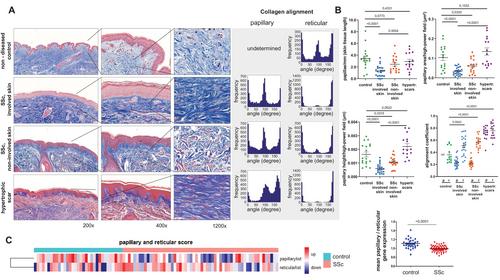
SSc skin showed a decrease in number (P < 0.0001/P = 0.0004), area (P < 0.0001), and height (P < 0.0001) of papillae compared with controls and hypertrophic scars, respectively. The expression of papillary/reticular marker genes shifted toward a reticular expression profile in SSc. On the level of previously defined fibroblast populations, the increase of reticular marker genes was particularly pronounced in the PI16+ and SFRP4+ populations (P < 0.0001, respectively). Mechanistically, the expression of the WNT/β-catenin target AXIN2 and the number of fibroblasts with nuclear β-catenin-staining-pattern increased in the papillary compared with the reticular dermis in healthy skin. This polarization was lost in SSc with a two-fold increase in β-catenin-positive fibroblasts and AXIN2-expressing fibroblasts throughout the dermis (P = 0.0095). Enrichment of genes related to WNT/β-catenin-regulation was found in the PI16+ population that also relocates from the reticular to the papillary dermis in SSc.

Conclusion

We demonstrate an association of the “reticularized” skin phenotype in SSc with a profound loss of physiologic spatial WNT/β-catenin-activation. Rescuing the spatial WNT/β-catenin-activation might help restore the physiologic skin organization in future therapeutic approaches of fibrosing disorders.
Abstract Image

Abstract Image

Abstract Image

Abstract Image

Abstract Image

Abstract Image

查看原文
分享 分享
微信好友 朋友圈 QQ好友 复制链接
本刊更多论文
WNT空间激活紊乱——系统性硬化症(SSc)网状皮肤表型的潜在驱动因素
对于维持成人皮肤完整的生理机制,我们所知甚少。本研究旨在定量描述与对照组相比,系统性硬化症(SSc)皮肤的解剖学变化,并探讨其潜在机制。
本文章由计算机程序翻译,如有差异,请以英文原文为准。
求助全文
约1分钟内获得全文 去求助
来源期刊
Arthritis & Rheumatology
Arthritis & Rheumatology RHEUMATOLOGY-
CiteScore
20.90
自引率
3.00%
发文量
371
期刊介绍: Arthritis & Rheumatology is the official journal of the American College of Rheumatology and focuses on the natural history, pathophysiology, treatment, and outcome of rheumatic diseases. It is a peer-reviewed publication that aims to provide the highest quality basic and clinical research in this field. The journal covers a wide range of investigative areas and also includes review articles, editorials, and educational material for researchers and clinicians. Being recognized as a leading research journal in rheumatology, Arthritis & Rheumatology serves the global community of rheumatology investigators and clinicians.
期刊最新文献
In synergy with interferon-gamma, interleukin-17 activates vascular stromal cells towards a pro-inflammatory profile in giant cell arteritis. First-Year IgG Dynamics in IgG4-Related Disease: A Critical Window for Predicting Long-Term Outcomes. Clinical image: Blistering targetoid skin lesions in a patient with rheumatoid arthritis. Late-Onset Rheumatoid Arthritis and Air Pollution in the Multiethnic Cohort. Rituximab versus Cyclophosphamide for IgA Vasculitis.
×
引用
GB/T 7714-2015
复制
MLA
复制
APA
复制
导出至
BibTeX EndNote RefMan NoteFirst NoteExpress
×
×
提示
您的信息不完整,为了账户安全,请先补充。
现在去补充
×
提示
您因"违规操作"
具体请查看互助需知
我知道了
×
提示
现在去查看 取消
×
提示
确定
0
微信
客服QQ
Book学术公众号 扫码关注我们
反馈
×
意见反馈
请填写您的意见或建议
请填写您的手机或邮箱
已复制链接
已复制链接
快去分享给好友吧!
我知道了
×
扫码分享
扫码分享
Book学术官方微信
Book学术文献互助
Book学术文献互助群
群 号:604180095
Book学术
文献互助 智能选刊 最新文献 互助须知 联系我们:info@booksci.cn
Book学术提供免费学术资源搜索服务,方便国内外学者检索中英文文献。致力于提供最便捷和优质的服务体验。
Copyright © 2023 Book学术 All rights reserved.
ghs 京公网安备 11010802042870号 京ICP备2023020795号-1