{"title":"Earthquake Nucleation and Slip Behavior Altered by Stochastic Normal Stress Heterogeneity","authors":"Meng Li, Andre Niemeijer, Ylona van Dinther","doi":"10.1029/2024JB029857","DOIUrl":null,"url":null,"abstract":"<p>In recent laboratory experiments, varying nucleation locations of accelerating slip with changing nucleation lengths were observed. Spatial variations in effective normal stress, due to the controlling influence on fault strength and fracture energy, play an important role. We quantitatively explain how spatially heterogeneous effective normal stresses affect earthquake nucleation and slip behavior. We simulate a meter-scale laboratory experiment in a numerical earthquake sequence model with stochastically variable normal stresses. We identify five regimes of earthquake nucleation and slip behaviors, controlled by the ratio of the heterogeneity wavelength <span></span><math>\n <semantics>\n <mrow>\n <mo>(</mo>\n <mi>λ</mi>\n <mo>)</mo>\n </mrow>\n <annotation> $(\\lambda )$</annotation>\n </semantics></math> to the nucleation length <span></span><math>\n <semantics>\n <mrow>\n <mfenced>\n <msub>\n <mi>L</mi>\n <mi>c</mi>\n </msub>\n </mfenced>\n </mrow>\n <annotation> $\\left({L}_{c}\\right)$</annotation>\n </semantics></math>. When <span></span><math>\n <semantics>\n <mrow>\n <mi>λ</mi>\n <mo>/</mo>\n <msub>\n <mi>L</mi>\n <mi>c</mi>\n </msub>\n <mo>≪</mo>\n <mn>1</mn>\n </mrow>\n <annotation> $\\lambda /{L}_{c}\\ll 1$</annotation>\n </semantics></math>, full ruptures are observed. Slip rates and recurrence intervals are similar to those on homogeneous faults with comparable averaged normal stress. When <span></span><math>\n <semantics>\n <mrow>\n <mi>λ</mi>\n <mo>/</mo>\n <msub>\n <mi>L</mi>\n <mi>c</mi>\n </msub>\n <mo>≫</mo>\n <mn>1</mn>\n </mrow>\n <annotation> $\\lambda /{L}_{c}\\gg 1$</annotation>\n </semantics></math>, slow slip events and partial ruptures occur frequently and the nucleation length of each earthquake depends on the local stress level. We find locations of nucleation and arrest in both low and high normal stress regions (LSR and HSR, respectively) when <span></span><math>\n <semantics>\n <mrow>\n <mi>λ</mi>\n </mrow>\n <annotation> $\\lambda $</annotation>\n </semantics></math> and <span></span><math>\n <semantics>\n <mrow>\n <msub>\n <mi>L</mi>\n <mi>c</mi>\n </msub>\n </mrow>\n <annotation> ${L}_{c}$</annotation>\n </semantics></math> are of the same magnitude. When <span></span><math>\n <semantics>\n <mrow>\n <mi>λ</mi>\n <mo>/</mo>\n <msub>\n <mi>L</mi>\n <mi>c</mi>\n </msub>\n <mo>≳</mo>\n <mn>1</mn>\n </mrow>\n <annotation> $\\lambda /{L}_{c}\\gtrsim 1$</annotation>\n </semantics></math>, earthquakes nucleate in LSRs, and arrest in HSRs. However, HSRs and LSRs switch these roles when <span></span><math>\n <semantics>\n <mrow>\n <mi>λ</mi>\n <mo>/</mo>\n <msub>\n <mi>L</mi>\n <mi>c</mi>\n </msub>\n <mo>≲</mo>\n <mn>1</mn>\n </mrow>\n <annotation> $\\lambda /{L}_{c}\\lesssim 1$</annotation>\n </semantics></math>. Interestingly, we observe that nucleation migrates from an LSR to its neighboring HSR in one earthquake, when <span></span><math>\n <semantics>\n <mrow>\n <mi>λ</mi>\n </mrow>\n <annotation> $\\lambda $</annotation>\n </semantics></math> is between the minimum and maximum local nucleation lengths. We observe a large amount of aseismic slip and associated stress drop in the initial LSR, which might be linked to the migration of foreshocks as documented in natural and laboratory observations. This improved understanding of earthquake nucleation is important in estimating the seismic potential of different fault patches for natural and induced seismicity.</p>","PeriodicalId":15864,"journal":{"name":"Journal of Geophysical Research: Solid Earth","volume":"130 1","pages":""},"PeriodicalIF":4.1000,"publicationDate":"2024-12-26","publicationTypes":"Journal Article","fieldsOfStudy":null,"isOpenAccess":false,"openAccessPdf":"https://onlinelibrary.wiley.com/doi/epdf/10.1029/2024JB029857","citationCount":"0","resultStr":null,"platform":"Semanticscholar","paperid":null,"PeriodicalName":"Journal of Geophysical Research: Solid Earth","FirstCategoryId":"89","ListUrlMain":"https://agupubs.onlinelibrary.wiley.com/doi/10.1029/2024JB029857","RegionNum":2,"RegionCategory":"地球科学","ArticlePicture":[],"TitleCN":null,"AbstractTextCN":null,"PMCID":null,"EPubDate":"","PubModel":"","JCR":"Q1","JCRName":"GEOCHEMISTRY & GEOPHYSICS","Score":null,"Total":0}
引用次数: 0
Abstract
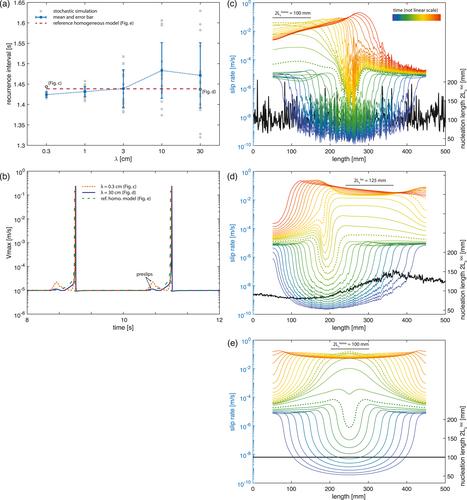
In recent laboratory experiments, varying nucleation locations of accelerating slip with changing nucleation lengths were observed. Spatial variations in effective normal stress, due to the controlling influence on fault strength and fracture energy, play an important role. We quantitatively explain how spatially heterogeneous effective normal stresses affect earthquake nucleation and slip behavior. We simulate a meter-scale laboratory experiment in a numerical earthquake sequence model with stochastically variable normal stresses. We identify five regimes of earthquake nucleation and slip behaviors, controlled by the ratio of the heterogeneity wavelength to the nucleation length . When , full ruptures are observed. Slip rates and recurrence intervals are similar to those on homogeneous faults with comparable averaged normal stress. When , slow slip events and partial ruptures occur frequently and the nucleation length of each earthquake depends on the local stress level. We find locations of nucleation and arrest in both low and high normal stress regions (LSR and HSR, respectively) when and are of the same magnitude. When , earthquakes nucleate in LSRs, and arrest in HSRs. However, HSRs and LSRs switch these roles when . Interestingly, we observe that nucleation migrates from an LSR to its neighboring HSR in one earthquake, when is between the minimum and maximum local nucleation lengths. We observe a large amount of aseismic slip and associated stress drop in the initial LSR, which might be linked to the migration of foreshocks as documented in natural and laboratory observations. This improved understanding of earthquake nucleation is important in estimating the seismic potential of different fault patches for natural and induced seismicity.
期刊介绍:
The Journal of Geophysical Research: Solid Earth serves as the premier publication for the breadth of solid Earth geophysics including (in alphabetical order): electromagnetic methods; exploration geophysics; geodesy and gravity; geodynamics, rheology, and plate kinematics; geomagnetism and paleomagnetism; hydrogeophysics; Instruments, techniques, and models; solid Earth interactions with the cryosphere, atmosphere, oceans, and climate; marine geology and geophysics; natural and anthropogenic hazards; near surface geophysics; petrology, geochemistry, and mineralogy; planet Earth physics and chemistry; rock mechanics and deformation; seismology; tectonophysics; and volcanology.
JGR: Solid Earth has long distinguished itself as the venue for publication of Research Articles backed solidly by data and as well as presenting theoretical and numerical developments with broad applications. Research Articles published in JGR: Solid Earth have had long-term impacts in their fields.
JGR: Solid Earth provides a venue for special issues and special themes based on conferences, workshops, and community initiatives. JGR: Solid Earth also publishes Commentaries on research and emerging trends in the field; these are commissioned by the editors, and suggestion are welcome.






 京公网安备 11010802042870号
京ICP备2023020795号-1
京公网安备 11010802042870号
京ICP备2023020795号-1

 分享
分享
 求助内容:
求助内容: 应助结果提醒方式:
 扫码关注我们
