{"title":"Comprehensive Spectroscopic Investigation of MoS2-Solar Cells with Exclusive Zn3P2 as HTL Having Least Lattice Mismatches for 32.55% PCE","authors":"Atish Kumar Sharma, Ankita Srivastava, Prakash Kumar Jha, Keyur Sangani, Nitesh K. Chourasia, Ritesh Kumar Chourasia","doi":"10.1002/adts.202401237","DOIUrl":null,"url":null,"abstract":"<p>In this analytical study, four-layer MoS<sub>2</sub>-based renewable energy photovoltaic cell has been first introduced using SCAPS-1d. Proposed cell has FTO as window layer, ZnSe as electron transport layer (ETL), MoS<sub>2</sub> as absorber layer, and an exclusive Zn<sub>3</sub>P<sub>2</sub> hole transport layer (HTL) with least lattice mismatch of about 1.8%. To explore highest performance through proposed novel solar cell configuration, simulation studies have been done on best possible optimized physical and electrical parameters. Simulated power conversion efficiency, short circuit current, open circuit voltage, and fill factor are 32.55%, 37.75 mA/cm<sup>2</sup>, 1038.4 mV, and 83.01% respectively. Further to investigate defect states between band levels, admittance, and impedance spectroscopic analysis has been done with an equivalent electrical circuit model obtained from EIS module. Present studies help to identify the carrier accumulation behavior at various least-lattice mismatched interfaces and in bulk of four-layer solar device. For this analysis, proposed renewable solar device is simulated for characteristics such as capacitance-voltage (C-V), capacitance-frequency (C-F), conductance-voltage (G-V), and conductance-frequency (G-F) under different suitable and practical physical conditions. In this technique, AC signal is applied to the solutions obtained from the semiconductor and continuity equations in SCAPS-1d. Further, we have done an in-depth analysis through these measurements.</p>","PeriodicalId":7219,"journal":{"name":"Advanced Theory and Simulations","volume":"8 4","pages":""},"PeriodicalIF":2.9000,"publicationDate":"2024-12-27","publicationTypes":"Journal Article","fieldsOfStudy":null,"isOpenAccess":false,"openAccessPdf":"","citationCount":"0","resultStr":null,"platform":"Semanticscholar","paperid":null,"PeriodicalName":"Advanced Theory and Simulations","FirstCategoryId":"5","ListUrlMain":"https://advanced.onlinelibrary.wiley.com/doi/10.1002/adts.202401237","RegionNum":4,"RegionCategory":"工程技术","ArticlePicture":[],"TitleCN":null,"AbstractTextCN":null,"PMCID":null,"EPubDate":"","PubModel":"","JCR":"Q1","JCRName":"MULTIDISCIPLINARY SCIENCES","Score":null,"Total":0}
引用次数: 0
Abstract
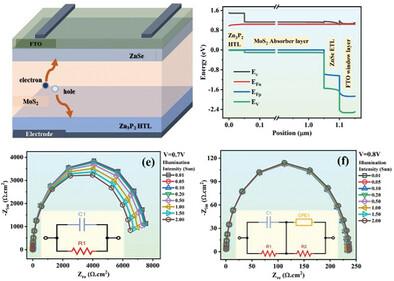
In this analytical study, four-layer MoS2-based renewable energy photovoltaic cell has been first introduced using SCAPS-1d. Proposed cell has FTO as window layer, ZnSe as electron transport layer (ETL), MoS2 as absorber layer, and an exclusive Zn3P2 hole transport layer (HTL) with least lattice mismatch of about 1.8%. To explore highest performance through proposed novel solar cell configuration, simulation studies have been done on best possible optimized physical and electrical parameters. Simulated power conversion efficiency, short circuit current, open circuit voltage, and fill factor are 32.55%, 37.75 mA/cm2, 1038.4 mV, and 83.01% respectively. Further to investigate defect states between band levels, admittance, and impedance spectroscopic analysis has been done with an equivalent electrical circuit model obtained from EIS module. Present studies help to identify the carrier accumulation behavior at various least-lattice mismatched interfaces and in bulk of four-layer solar device. For this analysis, proposed renewable solar device is simulated for characteristics such as capacitance-voltage (C-V), capacitance-frequency (C-F), conductance-voltage (G-V), and conductance-frequency (G-F) under different suitable and practical physical conditions. In this technique, AC signal is applied to the solutions obtained from the semiconductor and continuity equations in SCAPS-1d. Further, we have done an in-depth analysis through these measurements.
期刊介绍:
Advanced Theory and Simulations is an interdisciplinary, international, English-language journal that publishes high-quality scientific results focusing on the development and application of theoretical methods, modeling and simulation approaches in all natural science and medicine areas, including:
materials, chemistry, condensed matter physics
engineering, energy
life science, biology, medicine
atmospheric/environmental science, climate science
planetary science, astronomy, cosmology
method development, numerical methods, statistics








 京公网安备 11010802042870号
京ICP备2023020795号-1
京公网安备 11010802042870号
京ICP备2023020795号-1

 分享
分享
 求助内容:
求助内容: 应助结果提醒方式:
 扫码关注我们
