{"title":"FALCON: Fast Autonomous Aerial Exploration Using Coverage Path Guidance","authors":"Yichen Zhang;Xinyi Chen;Chen Feng;Boyu Zhou;Shaojie Shen","doi":"10.1109/TRO.2024.3522148","DOIUrl":null,"url":null,"abstract":"In this article, we introduce a novel <bold>F</b>ast <bold>A</b>utonomous exp<bold>L</b>oration framework using <bold>CO</b>verage path guida<bold>N</b>ce (FALCON), which aims at setting a new performance benchmark in the field of autonomous aerial exploration. Despite recent advancements in the domain, existing exploration planners often suffer from inefficiencies, such as frequent revisitations of previously explored regions. FALCON effectively harnesses the full potential of online generated coverage paths in enhancing exploration efficiency. The framework begins with an incremental connectivity-aware space decomposition and connectivity graph construction, which facilitate efficient coverage path planning. Subsequently, a hierarchical planner generates a coverage path spanning the entire unexplored space, serving as a global guidance. Then, a local planner optimizes the frontier visitation order, minimizing traversal time while consciously incorporating the intention of the global guidance. Finally, minimum-time smooth and safe trajectories are produced to visit the frontier viewpoints. For fair and comprehensive benchmark experiments, we introduce a lightweight <italic>exploration planner evaluation environment</i> that allows for comparing exploration planners across a variety of testing scenarios using an identical quadrotor simulator. In addition, an in-depth analysis and evaluation is conducted to highlight the significant performance advantages of FALCON in comparison with the state-of-the-art exploration planners based on objective criteria. Extensive ablation studies demonstrate the effectiveness of each component in the proposed framework. Real-world experiments conducted fully onboard further validate FALCON’s practical capability in complex and challenging environments. The source code of both the exploration planner FALCON and the exploration planner evaluation environment has been released to benefit the community.","PeriodicalId":50388,"journal":{"name":"IEEE Transactions on Robotics","volume":"41 ","pages":"1365-1385"},"PeriodicalIF":10.5000,"publicationDate":"2024-12-25","publicationTypes":"Journal Article","fieldsOfStudy":null,"isOpenAccess":false,"openAccessPdf":"","citationCount":"0","resultStr":null,"platform":"Semanticscholar","paperid":null,"PeriodicalName":"IEEE Transactions on Robotics","FirstCategoryId":"94","ListUrlMain":"https://ieeexplore.ieee.org/document/10816079/","RegionNum":1,"RegionCategory":"计算机科学","ArticlePicture":[],"TitleCN":null,"AbstractTextCN":null,"PMCID":null,"EPubDate":"","PubModel":"","JCR":"Q1","JCRName":"ROBOTICS","Score":null,"Total":0}
引用次数: 0
Abstract
In this article, we introduce a novel Fast Autonomous expLoration framework using COverage path guidaNce (FALCON), which aims at setting a new performance benchmark in the field of autonomous aerial exploration. Despite recent advancements in the domain, existing exploration planners often suffer from inefficiencies, such as frequent revisitations of previously explored regions. FALCON effectively harnesses the full potential of online generated coverage paths in enhancing exploration efficiency. The framework begins with an incremental connectivity-aware space decomposition and connectivity graph construction, which facilitate efficient coverage path planning. Subsequently, a hierarchical planner generates a coverage path spanning the entire unexplored space, serving as a global guidance. Then, a local planner optimizes the frontier visitation order, minimizing traversal time while consciously incorporating the intention of the global guidance. Finally, minimum-time smooth and safe trajectories are produced to visit the frontier viewpoints. For fair and comprehensive benchmark experiments, we introduce a lightweight exploration planner evaluation environment that allows for comparing exploration planners across a variety of testing scenarios using an identical quadrotor simulator. In addition, an in-depth analysis and evaluation is conducted to highlight the significant performance advantages of FALCON in comparison with the state-of-the-art exploration planners based on objective criteria. Extensive ablation studies demonstrate the effectiveness of each component in the proposed framework. Real-world experiments conducted fully onboard further validate FALCON’s practical capability in complex and challenging environments. The source code of both the exploration planner FALCON and the exploration planner evaluation environment has been released to benefit the community.
期刊介绍:
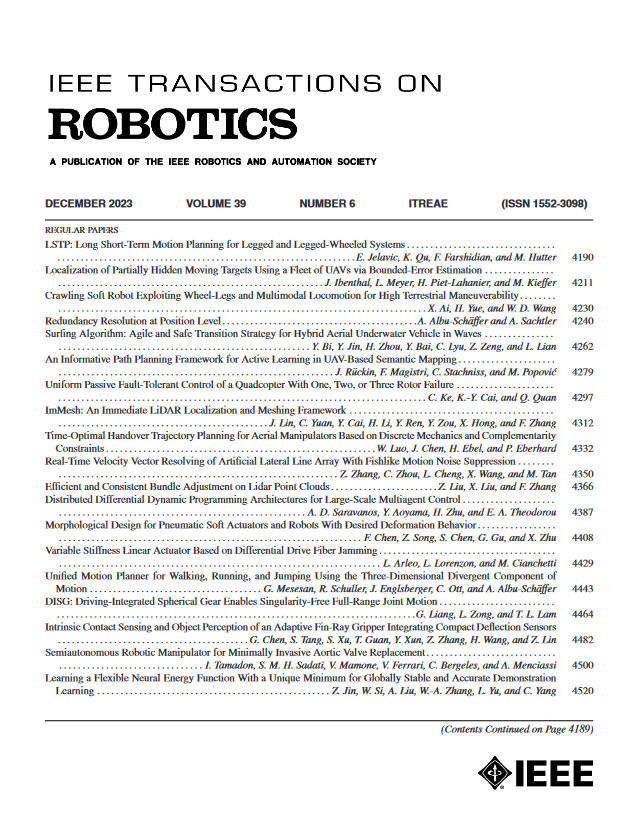
The IEEE Transactions on Robotics (T-RO) is dedicated to publishing fundamental papers covering all facets of robotics, drawing on interdisciplinary approaches from computer science, control systems, electrical engineering, mathematics, mechanical engineering, and beyond. From industrial applications to service and personal assistants, surgical operations to space, underwater, and remote exploration, robots and intelligent machines play pivotal roles across various domains, including entertainment, safety, search and rescue, military applications, agriculture, and intelligent vehicles.
Special emphasis is placed on intelligent machines and systems designed for unstructured environments, where a significant portion of the environment remains unknown and beyond direct sensing or control.



 京公网安备 11010802042870号
京ICP备2023020795号-1
京公网安备 11010802042870号
京ICP备2023020795号-1

 分享
分享
 求助内容:
求助内容: 应助结果提醒方式:
 扫码关注我们
