Shenbagam Dewar, Mary R. Janevic, John A. Batsis, Neil B. Alexander
{"title":"Older Adults With Obesity: Need for 4Ms Age-Friendly Approach to Care","authors":"Shenbagam Dewar, Mary R. Janevic, John A. Batsis, Neil B. Alexander","doi":"10.1111/jgs.19353","DOIUrl":null,"url":null,"abstract":"<p>The prevalence of older adults living with obesity is increasing (39%) [<span>1</span>] and their quality of life is diminished by multimorbidity, mobility disability, and frequent healthcare visits [<span>2</span>]. Common comorbidities include cardiometabolic, pulmonary, liver and kidney diseases, memory loss, mental health conditions, and cancers [<span>3-6</span>]. Multimorbidity leads to polypharmacy burden while necessitating care by multiple specialists. The heterogeneity of aging with cumulative disease burden due to obesity further accelerates aging by the dynamic accumulation of biological changes predisposing to geriatric syndromes [<span>7</span>]. This physiological process increases the risk of functional limitation, mobility disability, and early institutionalization. Earlier in life, older adults with obesity often have attempted intensive lifestyle intervention (ILI) including diet and physical activity changes, trialed first-generation anti-obesity medications (AOMs), and a few have undergone weight loss surgery. With aging and obesity, they are faced with multimorbidity and disability and hence have patient-priority goals for weight loss and overall health [<span>8</span>].</p><p>The National Council on Aging roundtable discussion on obesity and equitable aging has developed policy recommendations which includes the need for comprehensive assessment with tailored and personalized approach to obesity care [<span>9</span>]. Current evidence supporting weight loss in older adults remains low to moderate [<span>10</span>] and recommends geriatric principles of “start low and go slow.” This monitored approach following a comprehensive geriatric assessment (CGA) warrants emphasis as the newer generation of AOMs help achieve 12%–20% weight loss with future medications close to bariatric surgery, raising the concern for safety in older adults. This rationalizes a need for an age-friendly model of care using the 4M framework: “What <span>m</span>atters most” in terms of patient priority goals for weight loss, recognize <span>m</span>ental health disorders and cognitive impairment and <span>m</span>edications, including polypharmacy with a focus to deprescribe weight promoting medications, with consideration of individual's <span>m</span>obility impairment. This study was designed to study the 4M elements by a priori model of approach to obesity care.</p><p>This is a retrospective study of older adults (<i>n</i> = 58) with mean age 73, BMI ≥ 30 kg/m<sup>2</sup> referred to a geriatric weight-management clinic. Patient-centered obesity care was focused toward top three patient-priority goals after a CGA. Assessments include mental health disorders, obesity-related chronic conditions, polypharmacy review including weight-promoting medications, and assistive device use. Obesity interventions included behavioral, ILI (diet and physical activity), and pharmacological interventions applying geriatric principles.</p><p>Top three patient priority goals were the desire to achieve weight loss, improve mobility and function, and reduce pain. There was a high prevalence of mental health diagnoses (79%) and polypharmacy mean (SD) of 16 (6.8) medications with 2.9 obesogenic (weight-promoting) medications. (Table 1). Over 50% used an assistive device, and with BMI ≥ 50, all were walker or wheelchair/scooter dependent, i.e., used an assistive device beyond a cane (Figure 1).</p><p>This study shows that older adults with obesity have a high prevalence of mental health comorbidities, medication burden, and mobility impairment necessitating assistive device use and have individual priority goals beyond weight loss to include improvement of mobility and function, and pain. This highlights the need for a patient-centered 4M approach, aligning care toward “What Matters Most”. Mental health disorders were highly prevalent in our study cohort which needs recognition and treatment with medications which are weight-neutral or weight–loss promoting preferentially over weight-promoting medications.</p><p>Our experience suggests that an initial step in evaluation should begin with a comprehensive geriatric assessment including (1) cognitive function; (2) functional status with screening for ADL and IADL impairment; (3) Mobility testing such as the “Timed up and go”; (4) psychosocial assessment using PHQ-2 screen; and (5) SDOH screen for housing, food insecurity, and transportation. One of the key steps before dietary and physical activity recommendation is the deprescription of weight-promoting medications which is currently overlooked, predisposing to iatrogenic weight gain and resistance to weight loss. Improvement of mobility and functional impairment would be more successful following a referral to physical therapy before physical activity counseling.</p><p>In summary, weight management in older adults should follow an age-friendly approach using 4M principles with adoption of a mindful and holistic approach aligned to patient preferences and risk aversion. Recommendations for lifestyle changes should include resistance-based exercises and enhanced protein supplementation to mitigate muscle and bone loss. Treatment of obesity without considering the heterogeneity of aging has potential for unintended consequences due to the loss of muscle mass and bone density leading to worsening illness, functional impairments, frailty, impacting healthcare economics. The clinical effectiveness of the 4M approach on physical function, clinical outcomes, and quality of life in older adults will be shared in future publication.</p><p>All listed authors had full access to all the data in the study, take responsibility for the integrity of the data and the accuracy of the data analysis, and had authority over manuscript preparation, the decision to submit the manuscript for publication, and approved its current contents. All authors meet the criteria for authorship stated in the Uniform Requirements for Manuscripts Submitted to Biomedical Journals.</p><p>The authors declare no conflicts of interest.</p>","PeriodicalId":17240,"journal":{"name":"Journal of the American Geriatrics Society","volume":"73 5","pages":"1621-1623"},"PeriodicalIF":4.5000,"publicationDate":"2024-12-28","publicationTypes":"Journal Article","fieldsOfStudy":null,"isOpenAccess":false,"openAccessPdf":"https://onlinelibrary.wiley.com/doi/epdf/10.1111/jgs.19353","citationCount":"0","resultStr":null,"platform":"Semanticscholar","paperid":null,"PeriodicalName":"Journal of the American Geriatrics Society","FirstCategoryId":"3","ListUrlMain":"https://agsjournals.onlinelibrary.wiley.com/doi/10.1111/jgs.19353","RegionNum":2,"RegionCategory":"医学","ArticlePicture":[],"TitleCN":null,"AbstractTextCN":null,"PMCID":null,"EPubDate":"","PubModel":"","JCR":"Q1","JCRName":"GERIATRICS & GERONTOLOGY","Score":null,"Total":0}
引用次数: 0
Abstract
The prevalence of older adults living with obesity is increasing (39%) [1] and their quality of life is diminished by multimorbidity, mobility disability, and frequent healthcare visits [2]. Common comorbidities include cardiometabolic, pulmonary, liver and kidney diseases, memory loss, mental health conditions, and cancers [3-6]. Multimorbidity leads to polypharmacy burden while necessitating care by multiple specialists. The heterogeneity of aging with cumulative disease burden due to obesity further accelerates aging by the dynamic accumulation of biological changes predisposing to geriatric syndromes [7]. This physiological process increases the risk of functional limitation, mobility disability, and early institutionalization. Earlier in life, older adults with obesity often have attempted intensive lifestyle intervention (ILI) including diet and physical activity changes, trialed first-generation anti-obesity medications (AOMs), and a few have undergone weight loss surgery. With aging and obesity, they are faced with multimorbidity and disability and hence have patient-priority goals for weight loss and overall health [8].
The National Council on Aging roundtable discussion on obesity and equitable aging has developed policy recommendations which includes the need for comprehensive assessment with tailored and personalized approach to obesity care [9]. Current evidence supporting weight loss in older adults remains low to moderate [10] and recommends geriatric principles of “start low and go slow.” This monitored approach following a comprehensive geriatric assessment (CGA) warrants emphasis as the newer generation of AOMs help achieve 12%–20% weight loss with future medications close to bariatric surgery, raising the concern for safety in older adults. This rationalizes a need for an age-friendly model of care using the 4M framework: “What matters most” in terms of patient priority goals for weight loss, recognize mental health disorders and cognitive impairment and medications, including polypharmacy with a focus to deprescribe weight promoting medications, with consideration of individual's mobility impairment. This study was designed to study the 4M elements by a priori model of approach to obesity care.
This is a retrospective study of older adults (n = 58) with mean age 73, BMI ≥ 30 kg/m2 referred to a geriatric weight-management clinic. Patient-centered obesity care was focused toward top three patient-priority goals after a CGA. Assessments include mental health disorders, obesity-related chronic conditions, polypharmacy review including weight-promoting medications, and assistive device use. Obesity interventions included behavioral, ILI (diet and physical activity), and pharmacological interventions applying geriatric principles.
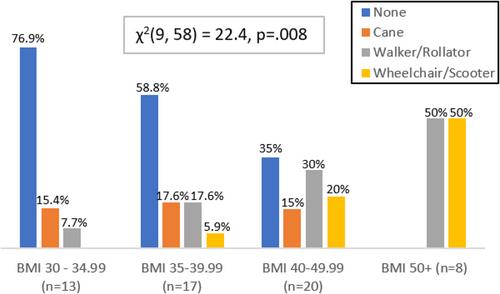
Top three patient priority goals were the desire to achieve weight loss, improve mobility and function, and reduce pain. There was a high prevalence of mental health diagnoses (79%) and polypharmacy mean (SD) of 16 (6.8) medications with 2.9 obesogenic (weight-promoting) medications. (Table 1). Over 50% used an assistive device, and with BMI ≥ 50, all were walker or wheelchair/scooter dependent, i.e., used an assistive device beyond a cane (Figure 1).
This study shows that older adults with obesity have a high prevalence of mental health comorbidities, medication burden, and mobility impairment necessitating assistive device use and have individual priority goals beyond weight loss to include improvement of mobility and function, and pain. This highlights the need for a patient-centered 4M approach, aligning care toward “What Matters Most”. Mental health disorders were highly prevalent in our study cohort which needs recognition and treatment with medications which are weight-neutral or weight–loss promoting preferentially over weight-promoting medications.
Our experience suggests that an initial step in evaluation should begin with a comprehensive geriatric assessment including (1) cognitive function; (2) functional status with screening for ADL and IADL impairment; (3) Mobility testing such as the “Timed up and go”; (4) psychosocial assessment using PHQ-2 screen; and (5) SDOH screen for housing, food insecurity, and transportation. One of the key steps before dietary and physical activity recommendation is the deprescription of weight-promoting medications which is currently overlooked, predisposing to iatrogenic weight gain and resistance to weight loss. Improvement of mobility and functional impairment would be more successful following a referral to physical therapy before physical activity counseling.
In summary, weight management in older adults should follow an age-friendly approach using 4M principles with adoption of a mindful and holistic approach aligned to patient preferences and risk aversion. Recommendations for lifestyle changes should include resistance-based exercises and enhanced protein supplementation to mitigate muscle and bone loss. Treatment of obesity without considering the heterogeneity of aging has potential for unintended consequences due to the loss of muscle mass and bone density leading to worsening illness, functional impairments, frailty, impacting healthcare economics. The clinical effectiveness of the 4M approach on physical function, clinical outcomes, and quality of life in older adults will be shared in future publication.
All listed authors had full access to all the data in the study, take responsibility for the integrity of the data and the accuracy of the data analysis, and had authority over manuscript preparation, the decision to submit the manuscript for publication, and approved its current contents. All authors meet the criteria for authorship stated in the Uniform Requirements for Manuscripts Submitted to Biomedical Journals.
老年肥胖人群的患病率正在上升(39%),他们的生活质量因多种疾病、行动不便和频繁就医而下降。常见的合并症包括心代谢、肺部、肝脏和肾脏疾病、记忆丧失、精神健康状况和癌症[3-6]。多种疾病导致多种药物负担,同时需要多个专家的护理。肥胖引起的累积疾病负担与衰老的异质性通过易患老年综合征的生物学变化的动态积累进一步加速了衰老。这一生理过程增加了功能限制、行动障碍和早期住院的风险。在生命早期,患有肥胖的老年人经常尝试强化生活方式干预(ILI),包括改变饮食和身体活动,试用第一代抗肥胖药物(AOMs),少数人接受过减肥手术。随着年龄的增长和肥胖,他们面临着多种疾病和残疾,因此患者优先考虑的目标是减肥和整体健康。全国老龄化委员会关于肥胖和公平老龄化的圆桌讨论制定了政策建议,其中包括对肥胖护理采取量身定制和个性化方法进行全面评估的必要性[10]。目前支持老年人减肥的证据仍然是低到中等体重,并建议老年人遵循“低起点,慢节奏”的原则。这种综合老年评估(CGA)后的监测方法值得强调,因为新一代的AOMs可以帮助实现12%-20%的体重减轻,未来的药物治疗接近减肥手术,这引起了对老年人安全性的关注。这使得使用4M框架的老年人友好型护理模式的需求合理化:就患者减肥的优先目标而言,“最重要的是什么”,认识到精神健康障碍和认知障碍以及药物,包括以减少体重促进药物为重点的综合用药,并考虑到个人的行动障碍。本研究旨在通过肥胖症护理方法的先验模型研究4M要素。这是一项回顾性研究,研究对象为平均年龄73岁、BMI≥30 kg/m2的老年人(n = 58),就诊于老年体重管理诊所。以患者为中心的肥胖护理是针对CGA后患者优先考虑的前三个目标。评估包括精神健康障碍、肥胖相关的慢性疾病、包括促进体重的药物和辅助装置使用在内的多种药物审查。肥胖干预包括行为、ILI(饮食和身体活动)和应用老年病学原则的药物干预。患者最优先考虑的三个目标是减肥、改善活动能力和功能以及减轻疼痛。精神健康诊断的患病率很高(79%),16种(6.8种)药物的多药平均(SD)和2.9种致胖(促进体重)药物。(表1)。超过50%的患者使用辅助装置,BMI≥50的患者均依赖助行器或轮椅/滑板车,即使用手杖以外的辅助装置(图1)。这项研究表明,老年肥胖患者有很高的精神健康合并症、药物负担和需要使用辅助装置的行动障碍,并且有个人优先目标,而不是减肥,包括改善行动和功能,以及疼痛。这突出了以患者为中心的4M方法的必要性,使护理与“最重要的”保持一致。在我们的研究队列中,精神健康障碍非常普遍,需要使用中性或促进减肥的药物来识别和治疗,而不是促进体重的药物。我们的经验表明,评估的第一步应该从全面的老年评估开始,包括:(1)认知功能;(2)功能状态与ADL和IADL障碍筛查;(3)“time up and go”等机动性测试;(4)使用PHQ-2筛查进行心理社会评估;(5) SDOH筛选住房、粮食不安全和交通。在饮食和体育活动推荐之前的关键步骤之一是取消目前被忽视的促进体重的药物处方,这容易导致医源性体重增加和减肥抵抗。在进行体育活动咨询之前进行物理治疗,可以更成功地改善活动能力和功能障碍。总之,老年人的体重管理应遵循年龄友好的方法,使用4M原则,采用与患者偏好和风险厌恶相一致的注意和整体方法。改变生活方式的建议应包括以阻力为基础的锻炼和加强蛋白质补充,以减轻肌肉和骨质流失。 不考虑衰老异质性的肥胖治疗可能会产生意想不到的后果,因为肌肉质量和骨密度的减少会导致疾病恶化、功能障碍、虚弱,影响医疗经济学。4M方法在老年人身体功能、临床结果和生活质量方面的临床有效性将在未来的出版物中分享。所有列出的作者都可以完全访问研究中的所有数据,对数据的完整性和数据分析的准确性负责,并有权准备稿件,决定是否提交发表稿件,并批准其当前内容。所有作者均符合《生物医学期刊投稿统一要求》中规定的作者资格标准。作者声明无利益冲突。
期刊介绍:
Journal of the American Geriatrics Society (JAGS) is the go-to journal for clinical aging research. We provide a diverse, interprofessional community of healthcare professionals with the latest insights on geriatrics education, clinical practice, and public policy—all supporting the high-quality, person-centered care essential to our well-being as we age. Since the publication of our first edition in 1953, JAGS has remained one of the oldest and most impactful journals dedicated exclusively to gerontology and geriatrics.





 京公网安备 11010802042870号
京ICP备2023020795号-1
京公网安备 11010802042870号
京ICP备2023020795号-1

 分享
分享
 求助内容:
求助内容: 应助结果提醒方式:
 扫码关注我们
