Dr. Yang Feng, Dr. Yanpeng Fan, Dr. Lingfei Zhao, Dr. Jiangtao Yu, Dr. Yaqi Liao, Dr. Tongrui Zhang, Ruochen Zhang, Dr. Haitao Zhu, Dr. Xingwei Sun, Prof. Zhe Hu, Prof. Kai Zhang, Prof. Jun Chen
{"title":"Enhancing Microdomain Consistency in Polymer Electrolytes towards Sustainable Lithium Batteries","authors":"Dr. Yang Feng, Dr. Yanpeng Fan, Dr. Lingfei Zhao, Dr. Jiangtao Yu, Dr. Yaqi Liao, Dr. Tongrui Zhang, Ruochen Zhang, Dr. Haitao Zhu, Dr. Xingwei Sun, Prof. Zhe Hu, Prof. Kai Zhang, Prof. Jun Chen","doi":"10.1002/anie.202417105","DOIUrl":null,"url":null,"abstract":"<p>Polymer electrolytes incorporated with fillers possess immense potential for constructing the fast and selective Li<sup>+</sup> conduction. However, the inhomogeneous distribution of the fillers usually deteriorates the microdomain consistency of the electrolytes, resulting in uneven Li<sup>+</sup> flux, and unstable electrode-electrolyte interfaces. Herein, we formulate a solution-process chemistry to in situ construct gel polymer electrolytes (GPEs) with well-dispersed metal–organic frameworks (MOFs), leading to a uniform microdomain structure. Through the integration of X-ray computed tomography analyses and theoretical simulations, our research identifies that the improvement of microdomain consistency in GPEs is beneficial for enhancing its mechanical strength, homogenizing ionic/electronic field distribution and upgrading the interface stability with the elctrodes. Moreover, consistently spread MOFs bind effectively with Lewis-base anions of Li salts, enhancing Li<sup>+</sup> kinetics. Owing to these advantages, the developed GPEs achieve a high conductivity of 1.51 mS cm<sup>−1</sup> and a Li<sup>+</sup> transference number of 0.66, resulting in exceptional cyclability of lithium metal electrodes (over 1800 hours). Additionally, the solid-state NCM811//Li pouch batteries exhibit an impressive capacity retention of 94.2 % over 200 cycles with an N/P ratio of 1.69. This study emphasizes the significant impact of microdomain structural chemistry on the advancement of solid-state batteries.</p>","PeriodicalId":125,"journal":{"name":"Angewandte Chemie International Edition","volume":"64 5","pages":""},"PeriodicalIF":16.9000,"publicationDate":"2024-12-29","publicationTypes":"Journal Article","fieldsOfStudy":null,"isOpenAccess":false,"openAccessPdf":"","citationCount":"0","resultStr":null,"platform":"Semanticscholar","paperid":null,"PeriodicalName":"Angewandte Chemie International Edition","FirstCategoryId":"92","ListUrlMain":"https://onlinelibrary.wiley.com/doi/10.1002/anie.202417105","RegionNum":1,"RegionCategory":"化学","ArticlePicture":[],"TitleCN":null,"AbstractTextCN":null,"PMCID":null,"EPubDate":"","PubModel":"","JCR":"Q1","JCRName":"CHEMISTRY, MULTIDISCIPLINARY","Score":null,"Total":0}
引用次数: 0
Abstract
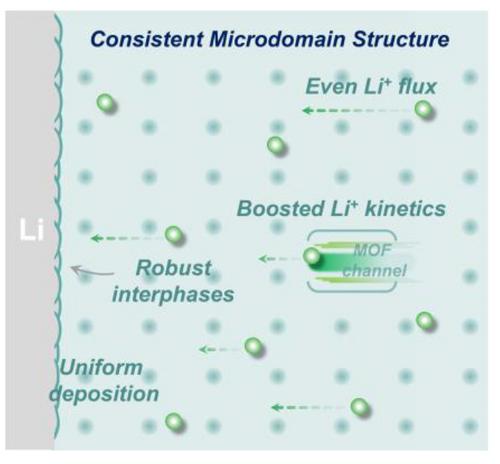
Polymer electrolytes incorporated with fillers possess immense potential for constructing the fast and selective Li+ conduction. However, the inhomogeneous distribution of the fillers usually deteriorates the microdomain consistency of the electrolytes, resulting in uneven Li+ flux, and unstable electrode-electrolyte interfaces. Herein, we formulate a solution-process chemistry to in situ construct gel polymer electrolytes (GPEs) with well-dispersed metal–organic frameworks (MOFs), leading to a uniform microdomain structure. Through the integration of X-ray computed tomography analyses and theoretical simulations, our research identifies that the improvement of microdomain consistency in GPEs is beneficial for enhancing its mechanical strength, homogenizing ionic/electronic field distribution and upgrading the interface stability with the elctrodes. Moreover, consistently spread MOFs bind effectively with Lewis-base anions of Li salts, enhancing Li+ kinetics. Owing to these advantages, the developed GPEs achieve a high conductivity of 1.51 mS cm−1 and a Li+ transference number of 0.66, resulting in exceptional cyclability of lithium metal electrodes (over 1800 hours). Additionally, the solid-state NCM811//Li pouch batteries exhibit an impressive capacity retention of 94.2 % over 200 cycles with an N/P ratio of 1.69. This study emphasizes the significant impact of microdomain structural chemistry on the advancement of solid-state batteries.
聚合物电解质与填料结合,在构建快速和选择性的锂离子传导方面具有巨大的潜力。然而,填料的不均匀分布通常会破坏电解质的微畴一致性,导致Li+通量不均匀,电极-电解质界面不稳定。在此,我们制定了一种溶液过程化学来原位构建具有分散良好的金属有机框架(mof)的凝胶聚合物电解质(gpe),从而获得均匀的微畴结构。通过x射线计算机断层扫描分析和理论模拟相结合,我们的研究发现,提高gpe的微畴一致性有利于提高其机械强度,均匀离子/电场分布,提高与电极的界面稳定性。此外,持续扩散的mof与Li盐的lewis碱阴离子有效结合,增强了Li+动力学。由于这些优点,开发的gpe实现了1.51 mS cm−1的高电导率和0.66的Li+转移数,从而实现了锂金属电极的卓越循环性(超过1800小时)。此外,固态NCM811//Li袋电池在200次循环中表现出令人印象深刻的94.2%的容量保持率,N/P比为1.69。本研究强调了微畴结构化学对固态电池发展的重要影响。
期刊介绍:
Angewandte Chemie, a journal of the German Chemical Society (GDCh), maintains a leading position among scholarly journals in general chemistry with an impressive Impact Factor of 16.6 (2022 Journal Citation Reports, Clarivate, 2023). Published weekly in a reader-friendly format, it features new articles almost every day. Established in 1887, Angewandte Chemie is a prominent chemistry journal, offering a dynamic blend of Review-type articles, Highlights, Communications, and Research Articles on a weekly basis, making it unique in the field.




 京公网安备 11010802042870号
京ICP备2023020795号-1
京公网安备 11010802042870号
京ICP备2023020795号-1

 分享
分享
 求助内容:
求助内容: 应助结果提醒方式:
 扫码关注我们
