{"title":"Covalent Organic Frameworks and Their Derivatives for Applications in High-Performance Lithium–Sulfur Batteries","authors":"Xiudong Chen, Huixiong Jiang, Jin-Hang Liu, Hang Zhang, Changchao Zhan, Yun Gao, Xiaoduo Jiang, Yawei Wang, Xiaohua Cao, Shu-Lei Chou","doi":"10.1002/adfm.202421697","DOIUrl":null,"url":null,"abstract":"<p>Lithium–Sulfur batteries (LSBs) are widely regarded as one of the most promising energy storage systems due to their ultra-high theoretical energy density and environmental friendliness. However, practical applications of LSBs face significant challenges, including the shuttle effect of soluble polysulfides and the formation of lithium dendrites. Covalent organic frameworks (COFs) have emerged as potential materials for inhibiting the polysulfide shuttle effect and buffering lithium dendrites. This review provides an overview of the latest advancements in the use of COF and its derivative materials as sulfur host materials, modified commercial separators, and electrolytes in LBSs, and makes some brief conclusions and predictions. Pure COFs, COF derivatives, and COF composites are discussed as sulfur hosts, along with novel strategies intended to enhance LSB cycling stability and reversibility. Strategies for enhancing LSBs performance are summarized through the modification of separators using COFs, with the ultimate goal of achieving high energy density. It also discusses the strategies for designing COF-based electrolytes, which include structural design, use of ionic COFs, and introduction of lithium salt molecules or flexible oligo(ethylene oxide) chains into COF skeletons. Additionally, the review discusses some future prospects for the use of COFs and their derivatives in LSBs.</p>","PeriodicalId":112,"journal":{"name":"Advanced Functional Materials","volume":"35 17","pages":""},"PeriodicalIF":19.0000,"publicationDate":"2024-12-30","publicationTypes":"Journal Article","fieldsOfStudy":null,"isOpenAccess":false,"openAccessPdf":"","citationCount":"0","resultStr":null,"platform":"Semanticscholar","paperid":null,"PeriodicalName":"Advanced Functional Materials","FirstCategoryId":"88","ListUrlMain":"https://advanced.onlinelibrary.wiley.com/doi/10.1002/adfm.202421697","RegionNum":1,"RegionCategory":"材料科学","ArticlePicture":[],"TitleCN":null,"AbstractTextCN":null,"PMCID":null,"EPubDate":"","PubModel":"","JCR":"Q1","JCRName":"CHEMISTRY, MULTIDISCIPLINARY","Score":null,"Total":0}
引用次数: 0
Abstract
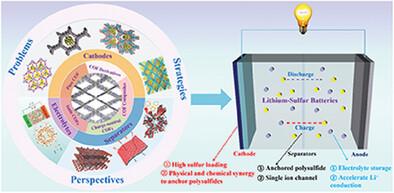
Lithium–Sulfur batteries (LSBs) are widely regarded as one of the most promising energy storage systems due to their ultra-high theoretical energy density and environmental friendliness. However, practical applications of LSBs face significant challenges, including the shuttle effect of soluble polysulfides and the formation of lithium dendrites. Covalent organic frameworks (COFs) have emerged as potential materials for inhibiting the polysulfide shuttle effect and buffering lithium dendrites. This review provides an overview of the latest advancements in the use of COF and its derivative materials as sulfur host materials, modified commercial separators, and electrolytes in LBSs, and makes some brief conclusions and predictions. Pure COFs, COF derivatives, and COF composites are discussed as sulfur hosts, along with novel strategies intended to enhance LSB cycling stability and reversibility. Strategies for enhancing LSBs performance are summarized through the modification of separators using COFs, with the ultimate goal of achieving high energy density. It also discusses the strategies for designing COF-based electrolytes, which include structural design, use of ionic COFs, and introduction of lithium salt molecules or flexible oligo(ethylene oxide) chains into COF skeletons. Additionally, the review discusses some future prospects for the use of COFs and their derivatives in LSBs.
期刊介绍:
Firmly established as a top-tier materials science journal, Advanced Functional Materials reports breakthrough research in all aspects of materials science, including nanotechnology, chemistry, physics, and biology every week.
Advanced Functional Materials is known for its rapid and fair peer review, quality content, and high impact, making it the first choice of the international materials science community.



 京公网安备 11010802042870号
京ICP备2023020795号-1
京公网安备 11010802042870号
京ICP备2023020795号-1

 分享
分享
 求助内容:
求助内容: 应助结果提醒方式:
 扫码关注我们
