Kyle D. Dougherty, Justin A. Dellinger, Bogdan Cristescu, Daniel J. Gammons, David K. Garcelon, J. Mark Higley, Quinton E. Martins, Seth P. D. Riley, Jeff A. Sikich, Thomas R. Stephenson, T. Winston Vickers, Greta M. Wengert, Christopher C. Wilmers, Heiko U. Wittmer, John F. Benson
{"title":"A Functional Response in Resource Selection Links Multiscale Responses of a Large Carnivore to Human Mortality Risk","authors":"Kyle D. Dougherty, Justin A. Dellinger, Bogdan Cristescu, Daniel J. Gammons, David K. Garcelon, J. Mark Higley, Quinton E. Martins, Seth P. D. Riley, Jeff A. Sikich, Thomas R. Stephenson, T. Winston Vickers, Greta M. Wengert, Christopher C. Wilmers, Heiko U. Wittmer, John F. Benson","doi":"10.1111/ele.70035","DOIUrl":null,"url":null,"abstract":"<p>Theory suggests that animals make hierarchical, multiscale resource selection decisions to address the hierarchy of factors limiting their fitness. Ecologists have developed tools to link population-level resource selection across scales; yet, theoretical expectations about the relationship between coarse- and fine-scale selection decisions at the individual level remain elusive despite their importance to fitness. With GPS-telemetry data collected across California, USA, we evaluated resource selection of mountain lions (<i>Puma concolor</i>; <i>n</i> = 244) relative to spatial variation in human-caused mortality risk. With hierarchical resource selection, coarse-scale selection determines availability at finer scales. This simple relationship allowed us to demonstrate that functional responses in resource selection explicitly link individual-level resource selection decisions across scales. We show that individuals proactively avoiding risk when selecting home ranges are freed to relax this avoidance when making decisions within home ranges. However, individuals also exhibit reactive avoidance of risk at the finest scales along movement paths.</p>","PeriodicalId":161,"journal":{"name":"Ecology Letters","volume":"28 1","pages":""},"PeriodicalIF":7.9000,"publicationDate":"2024-12-31","publicationTypes":"Journal Article","fieldsOfStudy":null,"isOpenAccess":false,"openAccessPdf":"https://onlinelibrary.wiley.com/doi/epdf/10.1111/ele.70035","citationCount":"0","resultStr":null,"platform":"Semanticscholar","paperid":null,"PeriodicalName":"Ecology Letters","FirstCategoryId":"93","ListUrlMain":"https://onlinelibrary.wiley.com/doi/10.1111/ele.70035","RegionNum":1,"RegionCategory":"环境科学与生态学","ArticlePicture":[],"TitleCN":null,"AbstractTextCN":null,"PMCID":null,"EPubDate":"","PubModel":"","JCR":"Q1","JCRName":"ECOLOGY","Score":null,"Total":0}
引用次数: 0
Abstract
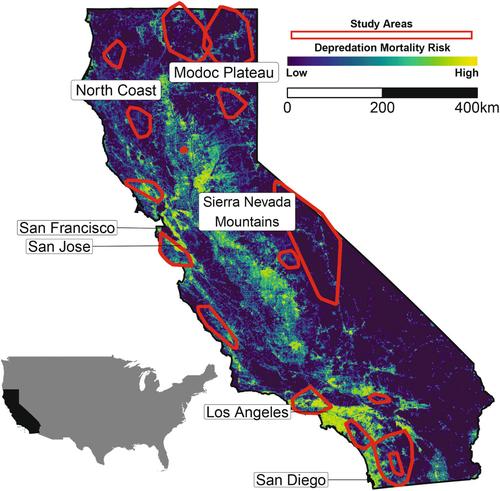
Theory suggests that animals make hierarchical, multiscale resource selection decisions to address the hierarchy of factors limiting their fitness. Ecologists have developed tools to link population-level resource selection across scales; yet, theoretical expectations about the relationship between coarse- and fine-scale selection decisions at the individual level remain elusive despite their importance to fitness. With GPS-telemetry data collected across California, USA, we evaluated resource selection of mountain lions (Puma concolor; n = 244) relative to spatial variation in human-caused mortality risk. With hierarchical resource selection, coarse-scale selection determines availability at finer scales. This simple relationship allowed us to demonstrate that functional responses in resource selection explicitly link individual-level resource selection decisions across scales. We show that individuals proactively avoiding risk when selecting home ranges are freed to relax this avoidance when making decisions within home ranges. However, individuals also exhibit reactive avoidance of risk at the finest scales along movement paths.
期刊介绍:
Ecology Letters serves as a platform for the rapid publication of innovative research in ecology. It considers manuscripts across all taxa, biomes, and geographic regions, prioritizing papers that investigate clearly stated hypotheses. The journal publishes concise papers of high originality and general interest, contributing to new developments in ecology. Purely descriptive papers and those that only confirm or extend previous results are discouraged.





 京公网安备 11010802042870号
京ICP备2023020795号-1
京公网安备 11010802042870号
京ICP备2023020795号-1

 分享
分享
 求助内容:
求助内容: 应助结果提醒方式:
 扫码关注我们
