{"title":"Torsional Structural Relaxation Caused by Pt–Pt Bond Formation in the Photoexcited Dimer of Pt(II) N ̂ C ̂ N Complex in Solution","authors":"Honoka Watanabe, Munetaka Iwamura, Koichi Nozaki, Tsukasa Takanashi, Hikaru Kuramochi, Tahei Tahara","doi":"10.1021/acs.jpclett.4c03170","DOIUrl":null,"url":null,"abstract":"[Pt(NCN)MeCN]<sup>+</sup> (NCN = 1,3-di(2-pyridyl)benzene, MeCN = acetonitrile) forms oligomers in the ground state due to metallophilic interactions, and a Pt–Pt bond is formed with photoexcitation. Ultrafast excited-state dynamics of the [Pt(NCN)MeCN]<sup>+</sup> dimer in acetonitrile is investigated by femtosecond time-resolved absorption (TA) and picosecond emission spectroscopy. The femtosecond TA signals exhibit 60 cm<sup>–1</sup> oscillations arising from the Pt–Pt stretching motion in the S<sub>1</sub> dimer. The excited-state absorption in the 500–700 nm region increases with time constants of 0.3, 1.4, and 9.4 ps, which are assigned to contraction of the Pt–Pt distance, structural change in the S<sub>1</sub> dimer, and S<sub>1</sub> → T<sub>1</sub> intersystem crossing, respectively. The 1.4 ps structural change is attributed to torsional structural relaxation proceeding in the S<sub>1</sub> dimer based on the computation, which indicates that a torsional angle around the Pt–Pt bond in the S<sub>0</sub> dimer is widely distributed around two potential minima, whereas that of the S<sub>1</sub> dimer has much narrower distributions around noticeably different torsional angles.","PeriodicalId":62,"journal":{"name":"The Journal of Physical Chemistry Letters","volume":"9 1","pages":""},"PeriodicalIF":4.6000,"publicationDate":"2024-12-31","publicationTypes":"Journal Article","fieldsOfStudy":null,"isOpenAccess":false,"openAccessPdf":"","citationCount":"0","resultStr":null,"platform":"Semanticscholar","paperid":null,"PeriodicalName":"The Journal of Physical Chemistry Letters","FirstCategoryId":"1","ListUrlMain":"https://doi.org/10.1021/acs.jpclett.4c03170","RegionNum":2,"RegionCategory":"化学","ArticlePicture":[],"TitleCN":null,"AbstractTextCN":null,"PMCID":null,"EPubDate":"","PubModel":"","JCR":"Q2","JCRName":"CHEMISTRY, PHYSICAL","Score":null,"Total":0}
引用次数: 0
Abstract
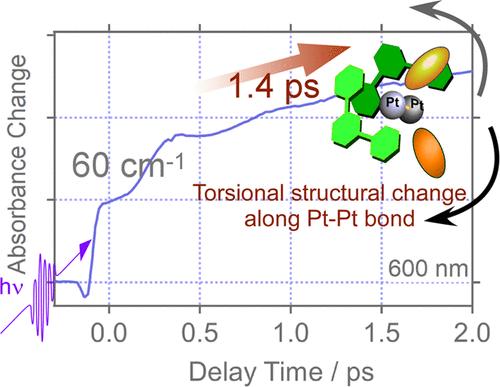
[Pt(NCN)MeCN]+ (NCN = 1,3-di(2-pyridyl)benzene, MeCN = acetonitrile) forms oligomers in the ground state due to metallophilic interactions, and a Pt–Pt bond is formed with photoexcitation. Ultrafast excited-state dynamics of the [Pt(NCN)MeCN]+ dimer in acetonitrile is investigated by femtosecond time-resolved absorption (TA) and picosecond emission spectroscopy. The femtosecond TA signals exhibit 60 cm–1 oscillations arising from the Pt–Pt stretching motion in the S1 dimer. The excited-state absorption in the 500–700 nm region increases with time constants of 0.3, 1.4, and 9.4 ps, which are assigned to contraction of the Pt–Pt distance, structural change in the S1 dimer, and S1 → T1 intersystem crossing, respectively. The 1.4 ps structural change is attributed to torsional structural relaxation proceeding in the S1 dimer based on the computation, which indicates that a torsional angle around the Pt–Pt bond in the S0 dimer is widely distributed around two potential minima, whereas that of the S1 dimer has much narrower distributions around noticeably different torsional angles.
期刊介绍:
The Journal of Physical Chemistry (JPC) Letters is devoted to reporting new and original experimental and theoretical basic research of interest to physical chemists, biophysical chemists, chemical physicists, physicists, material scientists, and engineers. An important criterion for acceptance is that the paper reports a significant scientific advance and/or physical insight such that rapid publication is essential. Two issues of JPC Letters are published each month.



 京公网安备 11010802042870号
京ICP备2023020795号-1
京公网安备 11010802042870号
京ICP备2023020795号-1

 分享
分享
 求助内容:
求助内容: 应助结果提醒方式:
 扫码关注我们
