Yuying Pan , Qingxia Xu , Weiguo Qian , Jinsheng Yang , Yiming Wang , Xiaoping Chai , Wenjuan Wang , Yufang Zhou , Haichun Zhang , Yonggang Jia , Jun Qian , Chaoyu Xia
{"title":"The accumulation, elimination characteristics, and toxic effects of intertidal sediment crude oil contamination in Sinonvacula constricta","authors":"Yuying Pan , Qingxia Xu , Weiguo Qian , Jinsheng Yang , Yiming Wang , Xiaoping Chai , Wenjuan Wang , Yufang Zhou , Haichun Zhang , Yonggang Jia , Jun Qian , Chaoyu Xia","doi":"10.1016/j.marenvres.2024.106938","DOIUrl":null,"url":null,"abstract":"<div><div>Marine oil spills lead to intertidal sediment pollution, causing benthic bioaccumulation and toxicity. However, relatively few studies have been conducted on the effects of crude oil sediment pollution on benthos. In this study, <em>Sinonovacula constricta</em> was used as the research object in a sediment environment to study the accumulation and elimination effects of <em>S. constricta</em> on long-term exposure to crude oil pollution as well as the toxicity effects at the biochemical and tissue levels through laboratory exposure tests. The objective of this study was to provide theoretical support for monitoring the biological toxicity of intertidal crude oil pollution. The results showed that <em>S. constricta</em> accumulated petroleum hydrocarbons in the sediment, which were positively correlated with pollution concentration and time. The fitting results of the two-compartment kinetic model were good and could be applied to the accumulation and elimination of sediment crude oil pollution. The activity of antioxidant enzymes and the content of malondialdehyde in the gills were mainly induced, and there was a dose- and time-dependent relationship. Crude oil pollution can cause digestive tube ablation, lumen swelling, and blood cell infiltration in the viscera of <em>S. constricta</em>. <em>S. constricta</em> can be used as an indicator organism for oil pollution in the intertidal zone, and its gills and visceral mass can be used as target tissues.</div></div>","PeriodicalId":18204,"journal":{"name":"Marine environmental research","volume":"204 ","pages":"Article 106938"},"PeriodicalIF":3.2000,"publicationDate":"2025-02-01","publicationTypes":"Journal Article","fieldsOfStudy":null,"isOpenAccess":false,"openAccessPdf":"","citationCount":"0","resultStr":null,"platform":"Semanticscholar","paperid":null,"PeriodicalName":"Marine environmental research","FirstCategoryId":"93","ListUrlMain":"https://www.sciencedirect.com/science/article/pii/S0141113624005993","RegionNum":3,"RegionCategory":"环境科学与生态学","ArticlePicture":[],"TitleCN":null,"AbstractTextCN":null,"PMCID":null,"EPubDate":"","PubModel":"","JCR":"Q2","JCRName":"ENVIRONMENTAL SCIENCES","Score":null,"Total":0}
引用次数: 0
Abstract
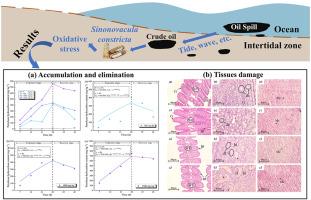
Marine oil spills lead to intertidal sediment pollution, causing benthic bioaccumulation and toxicity. However, relatively few studies have been conducted on the effects of crude oil sediment pollution on benthos. In this study, Sinonovacula constricta was used as the research object in a sediment environment to study the accumulation and elimination effects of S. constricta on long-term exposure to crude oil pollution as well as the toxicity effects at the biochemical and tissue levels through laboratory exposure tests. The objective of this study was to provide theoretical support for monitoring the biological toxicity of intertidal crude oil pollution. The results showed that S. constricta accumulated petroleum hydrocarbons in the sediment, which were positively correlated with pollution concentration and time. The fitting results of the two-compartment kinetic model were good and could be applied to the accumulation and elimination of sediment crude oil pollution. The activity of antioxidant enzymes and the content of malondialdehyde in the gills were mainly induced, and there was a dose- and time-dependent relationship. Crude oil pollution can cause digestive tube ablation, lumen swelling, and blood cell infiltration in the viscera of S. constricta. S. constricta can be used as an indicator organism for oil pollution in the intertidal zone, and its gills and visceral mass can be used as target tissues.
期刊介绍:
Marine Environmental Research publishes original research papers on chemical, physical, and biological interactions in the oceans and coastal waters. The journal serves as a forum for new information on biology, chemistry, and toxicology and syntheses that advance understanding of marine environmental processes.
Submission of multidisciplinary studies is encouraged. Studies that utilize experimental approaches to clarify the roles of anthropogenic and natural causes of changes in marine ecosystems are especially welcome, as are those studies that represent new developments of a theoretical or conceptual aspect of marine science. All papers published in this journal are reviewed by qualified peers prior to acceptance and publication. Examples of topics considered to be appropriate for the journal include, but are not limited to, the following:
– The extent, persistence, and consequences of change and the recovery from such change in natural marine systems
– The biochemical, physiological, and ecological consequences of contaminants to marine organisms and ecosystems
– The biogeochemistry of naturally occurring and anthropogenic substances
– Models that describe and predict the above processes
– Monitoring studies, to the extent that their results provide new information on functional processes
– Methodological papers describing improved quantitative techniques for the marine sciences.



 京公网安备 11010802042870号
京ICP备2023020795号-1
京公网安备 11010802042870号
京ICP备2023020795号-1

 分享
分享
 求助内容:
求助内容: 应助结果提醒方式:
 扫码关注我们
