Arjun Bhatta, Bernhard Kuhle, Ryan D. Yu, Lucas Spanaus, Katja Ditter, Katherine E. Bohnsack, Hauke S. Hillen
{"title":"Molecular basis of human nuclear and mitochondrial tRNA 3′ processing","authors":"Arjun Bhatta, Bernhard Kuhle, Ryan D. Yu, Lucas Spanaus, Katja Ditter, Katherine E. Bohnsack, Hauke S. Hillen","doi":"10.1038/s41594-024-01445-w","DOIUrl":null,"url":null,"abstract":"Eukaryotic transfer RNA (tRNA) precursors undergo sequential processing steps to become mature tRNAs. In humans, ELAC2 carries out 3′ end processing of both nucleus-encoded (nu-tRNAs) and mitochondria-encoded (mt-tRNAs) tRNAs. ELAC2 is self-sufficient for processing of nu-tRNAs but requires TRMT10C and SDR5C1 to process most mt-tRNAs. Here we show that TRMT10C and SDR5C1 specifically facilitate processing of structurally degenerate mt-tRNAs lacking the canonical elbow. Structures of ELAC2 in complex with TRMT10C, SDR5C1 and two divergent mt-tRNA substrates reveal two distinct mechanisms of pre-tRNA recognition. While canonical nu-tRNAs and mt-tRNAs are recognized by direct ELAC2–RNA interactions, processing of noncanonical mt-tRNAs depends on protein–protein interactions between ELAC2 and TRMT10C. These results provide the molecular basis for tRNA 3′ processing in both the nucleus and the mitochondria and explain the organelle-specific requirement for additional factors. Moreover, they suggest that TRMT10C–SDR5C1 evolved as a mitochondrial tRNA maturation platform to compensate for the structural erosion of mt-tRNAs in bilaterian animals. Bhatta et al. use biochemistry and cryogenic electron microscopy to elucidate the mechanism of human tRNA 3′ processing. Their results show how mitochondria-specific subunits of RNase Z compensate for the structural degeneracy of organellar tRNAs.","PeriodicalId":49141,"journal":{"name":"Nature Structural & Molecular Biology","volume":"32 4","pages":"613-624"},"PeriodicalIF":10.1000,"publicationDate":"2025-01-02","publicationTypes":"Journal Article","fieldsOfStudy":null,"isOpenAccess":false,"openAccessPdf":"https://www.nature.comhttps://www.nature.com/articles/s41594-024-01445-w.pdf","citationCount":"0","resultStr":null,"platform":"Semanticscholar","paperid":null,"PeriodicalName":"Nature Structural & Molecular Biology","FirstCategoryId":"99","ListUrlMain":"https://www.nature.com/articles/s41594-024-01445-w","RegionNum":1,"RegionCategory":"生物学","ArticlePicture":[],"TitleCN":null,"AbstractTextCN":null,"PMCID":null,"EPubDate":"","PubModel":"","JCR":"Q1","JCRName":"BIOCHEMISTRY & MOLECULAR BIOLOGY","Score":null,"Total":0}
引用次数: 0
Abstract
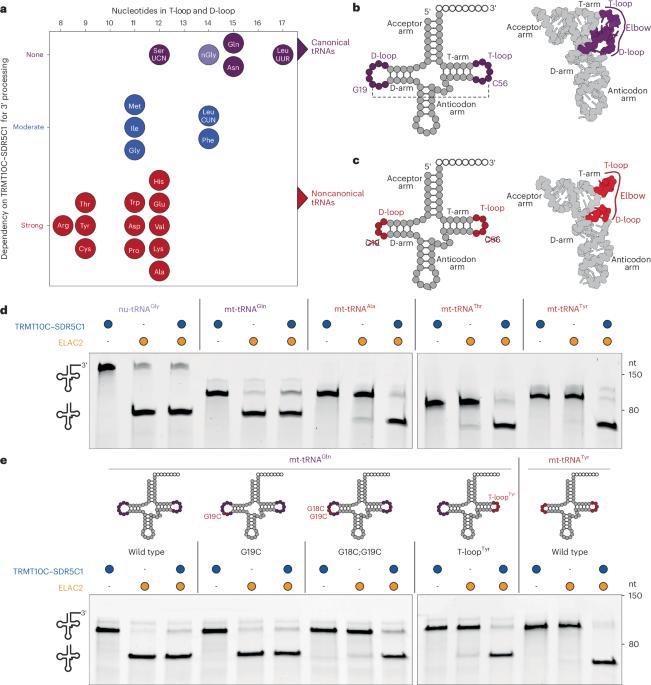
Eukaryotic transfer RNA (tRNA) precursors undergo sequential processing steps to become mature tRNAs. In humans, ELAC2 carries out 3′ end processing of both nucleus-encoded (nu-tRNAs) and mitochondria-encoded (mt-tRNAs) tRNAs. ELAC2 is self-sufficient for processing of nu-tRNAs but requires TRMT10C and SDR5C1 to process most mt-tRNAs. Here we show that TRMT10C and SDR5C1 specifically facilitate processing of structurally degenerate mt-tRNAs lacking the canonical elbow. Structures of ELAC2 in complex with TRMT10C, SDR5C1 and two divergent mt-tRNA substrates reveal two distinct mechanisms of pre-tRNA recognition. While canonical nu-tRNAs and mt-tRNAs are recognized by direct ELAC2–RNA interactions, processing of noncanonical mt-tRNAs depends on protein–protein interactions between ELAC2 and TRMT10C. These results provide the molecular basis for tRNA 3′ processing in both the nucleus and the mitochondria and explain the organelle-specific requirement for additional factors. Moreover, they suggest that TRMT10C–SDR5C1 evolved as a mitochondrial tRNA maturation platform to compensate for the structural erosion of mt-tRNAs in bilaterian animals. Bhatta et al. use biochemistry and cryogenic electron microscopy to elucidate the mechanism of human tRNA 3′ processing. Their results show how mitochondria-specific subunits of RNase Z compensate for the structural degeneracy of organellar tRNAs.
期刊介绍:
Nature Structural & Molecular Biology is a comprehensive platform that combines structural and molecular research. Our journal focuses on exploring the functional and mechanistic aspects of biological processes, emphasizing how molecular components collaborate to achieve a particular function. While structural data can shed light on these insights, our publication does not require them as a prerequisite.




 京公网安备 11010802042870号
京ICP备2023020795号-1
京公网安备 11010802042870号
京ICP备2023020795号-1

 分享
分享
 求助内容:
求助内容: 应助结果提醒方式:
 扫码关注我们
