{"title":"High-performance p-n Thermocells by Interface Optimization Based on Liquid Metal for Powering Wearable Devices","authors":"Yuqing Tian, Wei Wei, Zhouquan Sun, Yunhao Hu, Kerui Li, Qinghong Zhang, Yaogang Li, Chengyi Hou, Hongzhi Wang","doi":"10.1002/adfm.202417740","DOIUrl":null,"url":null,"abstract":"<p>Using body heat as a sustainable energy source through the thermoelectric effect to power wearable electronics is promising. Ionic thermoelectric materials based on the thermogalvanic effect can generate stable voltage under low-temperature differences, but their low thermopower and poor contact interface with electrodes hinder practical use. In this study, strong chaotropic salts are utilized to modify the solvation shells of ions, increasing the thermopower of the p-type redox couple [Fe(CN)₆]<sup>3</sup>⁻/[Fe(CN)₆]⁴⁻ to 3.98 mV K<sup>−1</sup>. Additionally, Arrhenius acid is introduced to inhibit the deprotonation of the n-type redox couple Fe<sup>3</sup>⁺/Fe<sup>2</sup>⁺, enhancing the thermopower to −2.29 mV K<sup>−1</sup>. Liquid metal electrodes, with excellent deformability and hydrogen bonding with hydrogel surfaces, effectively reduce the resistance of thermocells. Thus, a pair of p-n thermocells achieve a voltage output of 118 mV and a current density of 4.5 A m<sup>−</sup><sup>2</sup>, with a maximum power density of 0.11 W m<sup>−</sup><sup>2</sup> (Δ<i>T</i> = 5 K). A wearable device integrated with 18 p-n pairs can generate a voltage of 2.2 V from body heat and continuously power portable electronic devices. This work demonstrates the promising potential of wearable self-powered devices for practical daily applications.</p>","PeriodicalId":112,"journal":{"name":"Advanced Functional Materials","volume":"35 13","pages":""},"PeriodicalIF":19.0000,"publicationDate":"2025-01-02","publicationTypes":"Journal Article","fieldsOfStudy":null,"isOpenAccess":false,"openAccessPdf":"","citationCount":"0","resultStr":null,"platform":"Semanticscholar","paperid":null,"PeriodicalName":"Advanced Functional Materials","FirstCategoryId":"88","ListUrlMain":"https://advanced.onlinelibrary.wiley.com/doi/10.1002/adfm.202417740","RegionNum":1,"RegionCategory":"材料科学","ArticlePicture":[],"TitleCN":null,"AbstractTextCN":null,"PMCID":null,"EPubDate":"","PubModel":"","JCR":"Q1","JCRName":"CHEMISTRY, MULTIDISCIPLINARY","Score":null,"Total":0}
引用次数: 0
Abstract
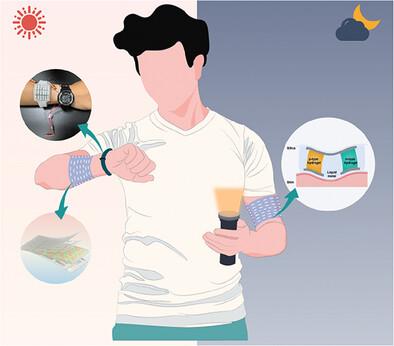
Using body heat as a sustainable energy source through the thermoelectric effect to power wearable electronics is promising. Ionic thermoelectric materials based on the thermogalvanic effect can generate stable voltage under low-temperature differences, but their low thermopower and poor contact interface with electrodes hinder practical use. In this study, strong chaotropic salts are utilized to modify the solvation shells of ions, increasing the thermopower of the p-type redox couple [Fe(CN)₆]3⁻/[Fe(CN)₆]⁴⁻ to 3.98 mV K−1. Additionally, Arrhenius acid is introduced to inhibit the deprotonation of the n-type redox couple Fe3⁺/Fe2⁺, enhancing the thermopower to −2.29 mV K−1. Liquid metal electrodes, with excellent deformability and hydrogen bonding with hydrogel surfaces, effectively reduce the resistance of thermocells. Thus, a pair of p-n thermocells achieve a voltage output of 118 mV and a current density of 4.5 A m−2, with a maximum power density of 0.11 W m−2 (ΔT = 5 K). A wearable device integrated with 18 p-n pairs can generate a voltage of 2.2 V from body heat and continuously power portable electronic devices. This work demonstrates the promising potential of wearable self-powered devices for practical daily applications.
期刊介绍:
Firmly established as a top-tier materials science journal, Advanced Functional Materials reports breakthrough research in all aspects of materials science, including nanotechnology, chemistry, physics, and biology every week.
Advanced Functional Materials is known for its rapid and fair peer review, quality content, and high impact, making it the first choice of the international materials science community.






 京公网安备 11010802042870号
京ICP备2023020795号-1
京公网安备 11010802042870号
京ICP备2023020795号-1

 分享
分享
 求助内容:
求助内容: 应助结果提醒方式:
 扫码关注我们
