Shreyash Hadke, Min-A Kang, Vinod K. Sangwan, Mark C. Hersam
{"title":"Two-Dimensional Materials for Brain-Inspired Computing Hardware","authors":"Shreyash Hadke, Min-A Kang, Vinod K. Sangwan, Mark C. Hersam","doi":"10.1021/acs.chemrev.4c00631","DOIUrl":null,"url":null,"abstract":"Recent breakthroughs in brain-inspired computing promise to address a wide range of problems from security to healthcare. However, the current strategy of implementing artificial intelligence algorithms using conventional silicon hardware is leading to unsustainable energy consumption. Neuromorphic hardware based on electronic devices mimicking biological systems is emerging as a low-energy alternative, although further progress requires materials that can mimic biological function while maintaining scalability and speed. As a result of their diverse unique properties, atomically thin two-dimensional (2D) materials are promising building blocks for next-generation electronics including nonvolatile memory, in-memory and neuromorphic computing, and flexible edge-computing systems. Furthermore, 2D materials achieve biorealistic synaptic and neuronal responses that extend beyond conventional logic and memory systems. Here, we provide a comprehensive review of the growth, fabrication, and integration of 2D materials and van der Waals heterojunctions for neuromorphic electronic and optoelectronic devices, circuits, and systems. For each case, the relationship between physical properties and device responses is emphasized followed by a critical comparison of technologies for different applications. We conclude with a forward-looking perspective on the key remaining challenges and opportunities for neuromorphic applications that leverage the fundamental properties of 2D materials and heterojunctions.","PeriodicalId":32,"journal":{"name":"Chemical Reviews","volume":"34 1","pages":""},"PeriodicalIF":55.8000,"publicationDate":"2025-01-02","publicationTypes":"Journal Article","fieldsOfStudy":null,"isOpenAccess":false,"openAccessPdf":"","citationCount":"0","resultStr":null,"platform":"Semanticscholar","paperid":null,"PeriodicalName":"Chemical Reviews","FirstCategoryId":"92","ListUrlMain":"https://doi.org/10.1021/acs.chemrev.4c00631","RegionNum":1,"RegionCategory":"化学","ArticlePicture":[],"TitleCN":null,"AbstractTextCN":null,"PMCID":null,"EPubDate":"","PubModel":"","JCR":"Q1","JCRName":"CHEMISTRY, MULTIDISCIPLINARY","Score":null,"Total":0}
引用次数: 0
Abstract
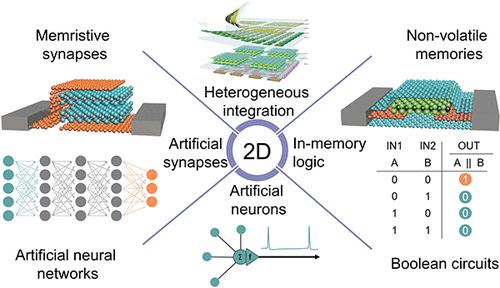
Recent breakthroughs in brain-inspired computing promise to address a wide range of problems from security to healthcare. However, the current strategy of implementing artificial intelligence algorithms using conventional silicon hardware is leading to unsustainable energy consumption. Neuromorphic hardware based on electronic devices mimicking biological systems is emerging as a low-energy alternative, although further progress requires materials that can mimic biological function while maintaining scalability and speed. As a result of their diverse unique properties, atomically thin two-dimensional (2D) materials are promising building blocks for next-generation electronics including nonvolatile memory, in-memory and neuromorphic computing, and flexible edge-computing systems. Furthermore, 2D materials achieve biorealistic synaptic and neuronal responses that extend beyond conventional logic and memory systems. Here, we provide a comprehensive review of the growth, fabrication, and integration of 2D materials and van der Waals heterojunctions for neuromorphic electronic and optoelectronic devices, circuits, and systems. For each case, the relationship between physical properties and device responses is emphasized followed by a critical comparison of technologies for different applications. We conclude with a forward-looking perspective on the key remaining challenges and opportunities for neuromorphic applications that leverage the fundamental properties of 2D materials and heterojunctions.
期刊介绍:
Chemical Reviews is a highly regarded and highest-ranked journal covering the general topic of chemistry. Its mission is to provide comprehensive, authoritative, critical, and readable reviews of important recent research in organic, inorganic, physical, analytical, theoretical, and biological chemistry.
Since 1985, Chemical Reviews has also published periodic thematic issues that focus on a single theme or direction of emerging research.



 京公网安备 11010802042870号
京ICP备2023020795号-1
京公网安备 11010802042870号
京ICP备2023020795号-1

 分享
分享
 求助内容:
求助内容: 应助结果提醒方式:
 扫码关注我们
