Jiangtao Zhu, Quan Zhang, Caiyun Wang, Yanhong Feng, Yuanyuan Zhang, Gaocan Qi, Lian Kang, Jun Luo and Xijun Liu
{"title":"Improved performances toward electrochemical carbon dioxide and oxygen reductions by iron-doped stannum nanoparticles†","authors":"Jiangtao Zhu, Quan Zhang, Caiyun Wang, Yanhong Feng, Yuanyuan Zhang, Gaocan Qi, Lian Kang, Jun Luo and Xijun Liu","doi":"10.1039/D4NR04843A","DOIUrl":null,"url":null,"abstract":"<p >The CO<small><sub>2</sub></small> reduction reaction (CO<small><sub>2</sub></small>RR) and oxygen reduction reaction (ORR) show great promise for expanding the use of renewable energy sources and fostering carbon neutrality. Sn-based catalysts show CO<small><sub>2</sub></small>RR activity; however, they have been rarely reported in the ORR. Herein, we prepared a nitrogen–carbon structure loaded with Fe-doped Sn nanoparticles (Fe–Sn/NC), which has good ORR and CO<small><sub>2</sub></small>RR activity. The results reveal that the Fe–Sn/NC catalysts deliver a high FE<small><sub>CO</sub></small> of 99.0% at a low overpotential of –0.47 V in an H-type cell for over 100 h. Notably, a peak power density of 1.36 mW cm<small><sup>−2</sup></small> is achieved in the Zn–CO<small><sub>2</sub></small> battery with the Fe–Sn/NC cathode at discharge current densities varying from 2.0 to 4.0 mA cm<small><sup>−2</sup></small>, and the FE<small><sub>CO</sub></small> remains above 99.0%. Due to efficient oxygen reduction reaction (ORR) performance and Zn–air battery (ZAB) characteristics, the ZAB-driven CO<small><sub>2</sub></small>RR has strong catalytic stability. This work proves that Fe–Sn/NC enhances the performance of the CO<small><sub>2</sub></small>RR and ORR, and the study of Zn-based batteries provides a new research direction for energy conversion.</p>","PeriodicalId":92,"journal":{"name":"Nanoscale","volume":" 5","pages":" 2709-2717"},"PeriodicalIF":5.1000,"publicationDate":"2025-01-02","publicationTypes":"Journal Article","fieldsOfStudy":null,"isOpenAccess":false,"openAccessPdf":"","citationCount":"0","resultStr":null,"platform":"Semanticscholar","paperid":null,"PeriodicalName":"Nanoscale","FirstCategoryId":"88","ListUrlMain":"https://pubs.rsc.org/en/content/articlelanding/2025/nr/d4nr04843a","RegionNum":3,"RegionCategory":"材料科学","ArticlePicture":[],"TitleCN":null,"AbstractTextCN":null,"PMCID":null,"EPubDate":"","PubModel":"","JCR":"Q1","JCRName":"CHEMISTRY, MULTIDISCIPLINARY","Score":null,"Total":0}
引用次数: 0
Abstract
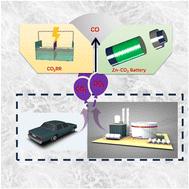
The CO2 reduction reaction (CO2RR) and oxygen reduction reaction (ORR) show great promise for expanding the use of renewable energy sources and fostering carbon neutrality. Sn-based catalysts show CO2RR activity; however, they have been rarely reported in the ORR. Herein, we prepared a nitrogen–carbon structure loaded with Fe-doped Sn nanoparticles (Fe–Sn/NC), which has good ORR and CO2RR activity. The results reveal that the Fe–Sn/NC catalysts deliver a high FECO of 99.0% at a low overpotential of –0.47 V in an H-type cell for over 100 h. Notably, a peak power density of 1.36 mW cm−2 is achieved in the Zn–CO2 battery with the Fe–Sn/NC cathode at discharge current densities varying from 2.0 to 4.0 mA cm−2, and the FECO remains above 99.0%. Due to efficient oxygen reduction reaction (ORR) performance and Zn–air battery (ZAB) characteristics, the ZAB-driven CO2RR has strong catalytic stability. This work proves that Fe–Sn/NC enhances the performance of the CO2RR and ORR, and the study of Zn-based batteries provides a new research direction for energy conversion.
期刊介绍:
Nanoscale is a high-impact international journal, publishing high-quality research across nanoscience and nanotechnology. Nanoscale publishes a full mix of research articles on experimental and theoretical work, including reviews, communications, and full papers.Highly interdisciplinary, this journal appeals to scientists, researchers and professionals interested in nanoscience and nanotechnology, quantum materials and quantum technology, including the areas of physics, chemistry, biology, medicine, materials, energy/environment, information technology, detection science, healthcare and drug discovery, and electronics.



 京公网安备 11010802042870号
京ICP备2023020795号-1
京公网安备 11010802042870号
京ICP备2023020795号-1

 分享
分享
 求助内容:
求助内容: 应助结果提醒方式:
 扫码关注我们
