Dongming Qu, Bohao Su, Zhongshu Bai, Biye Liu, Xueying Jin, Guanyu Chen, Yuting Fu, Tingwen Gu, Guang Yang and Qingkai Li
{"title":"A Gaussian spot overlap ablation model for prediction of aluminium alloy spectral peak intensity in high pulse repetition frequency LIBS","authors":"Dongming Qu, Bohao Su, Zhongshu Bai, Biye Liu, Xueying Jin, Guanyu Chen, Yuting Fu, Tingwen Gu, Guang Yang and Qingkai Li","doi":"10.1039/D4JA00298A","DOIUrl":null,"url":null,"abstract":"<p >The use of microjoule high pulse repetition frequency (PRF) lasers as excitation sources is an important direction in the miniaturisation of laser-induced breakdown spectroscopy (LIBS) instruments. However, high PRF LIBS is sensitive to experimental parameters, and the relationship between the experimental parameters and the spectral intensity of high PRF LIBS is less studied. In this work, we present a model based on Gaussian spot overlapping ablation with aluminium alloys as samples. After the index values have been collected in the non-motion state, the model derivation formula can be used to calculate the intensity of the spectral peaks under any proposed experimental parameters in the motion state. The experimental results show that the mean relative error (MRE) between the measured and predicted values of spectral peak intensity is ≤0.15 under different experimental parameters, and this result proves the validity of the model in predicting the spectral peak intensity. Meanwhile, we used 5 standard aluminium alloy samples to construct the standard curves of measured and predicted values under different experimental parameters. The experimental results show that the MRE between the measured and predicted values is ≤0.15, and the two standard curves fitted with the measured and predicted values have a high similarity with an average <em>R</em><small><sup>2</sup></small> ≥ 0.85. This study is expected to provide a universally applicable and efficient method for the quantitative analysis of high PRF LIBS in different application scenarios.</p>","PeriodicalId":81,"journal":{"name":"Journal of Analytical Atomic Spectrometry","volume":" 1","pages":" 162-172"},"PeriodicalIF":3.1000,"publicationDate":"2024-11-07","publicationTypes":"Journal Article","fieldsOfStudy":null,"isOpenAccess":false,"openAccessPdf":"","citationCount":"0","resultStr":null,"platform":"Semanticscholar","paperid":null,"PeriodicalName":"Journal of Analytical Atomic Spectrometry","FirstCategoryId":"92","ListUrlMain":"https://pubs.rsc.org/en/content/articlelanding/2025/ja/d4ja00298a","RegionNum":2,"RegionCategory":"化学","ArticlePicture":[],"TitleCN":null,"AbstractTextCN":null,"PMCID":null,"EPubDate":"","PubModel":"","JCR":"Q2","JCRName":"CHEMISTRY, ANALYTICAL","Score":null,"Total":0}
引用次数: 0
Abstract
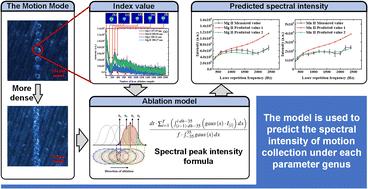
The use of microjoule high pulse repetition frequency (PRF) lasers as excitation sources is an important direction in the miniaturisation of laser-induced breakdown spectroscopy (LIBS) instruments. However, high PRF LIBS is sensitive to experimental parameters, and the relationship between the experimental parameters and the spectral intensity of high PRF LIBS is less studied. In this work, we present a model based on Gaussian spot overlapping ablation with aluminium alloys as samples. After the index values have been collected in the non-motion state, the model derivation formula can be used to calculate the intensity of the spectral peaks under any proposed experimental parameters in the motion state. The experimental results show that the mean relative error (MRE) between the measured and predicted values of spectral peak intensity is ≤0.15 under different experimental parameters, and this result proves the validity of the model in predicting the spectral peak intensity. Meanwhile, we used 5 standard aluminium alloy samples to construct the standard curves of measured and predicted values under different experimental parameters. The experimental results show that the MRE between the measured and predicted values is ≤0.15, and the two standard curves fitted with the measured and predicted values have a high similarity with an average R2 ≥ 0.85. This study is expected to provide a universally applicable and efficient method for the quantitative analysis of high PRF LIBS in different application scenarios.



 京公网安备 11010802042870号
京ICP备2023020795号-1
京公网安备 11010802042870号
京ICP备2023020795号-1

 分享
分享
 求助内容:
求助内容: 应助结果提醒方式:
 扫码关注我们
