{"title":"Responses of biogenic trace gases to atmospheric deposition and acid-processed atmospheric deposition in the oligotrophic western Pacific Ocean","authors":"Xu-Xu Gao , Qian-Qian Qi , Gui-Peng Yang","doi":"10.1016/j.marenvres.2024.106934","DOIUrl":null,"url":null,"abstract":"<div><div>Dimethylsulfide (DMS) and very short-lived bromocarbons (VSL<sup>Br</sup>) are important biogenic trace gases emitted from oceans that can affect the global climate. Atmospheric deposition (AD) can provide nutrients and trace metals to the ocean, which can enhance primary productivity, but the complex effects of AD on DMS and VSL<sup>Br</sup> are still largely unexplored. A deck incubation experiment with aerosol additions was conducted to simulate the effects of acid-processed AD on the production of trace gases, including DMS and four VSL<sup>Br</sup> such as bromoform (CHBr<sub>3</sub>), dibromomethane (CH<sub>2</sub>Br<sub>2</sub>), dibromochloromethane (CHBr<sub>2</sub>Cl), and bromodichloromethane (CHBrCl<sub>2</sub>), in the oligotrophic western Pacific Ocean (WPO). During the incubation, the average concentrations of inorganic nitrates, DMS and VSL<sup>Br</sup> were significantly higher in the two aerosol treatments, indicating significant increases due to AD. Furthermore, the introduction of aerosols led to increases in the abundances of high DMS producers, specifically dinoflagellates, which contributed to the production of DMS. The acidified aerosol additions had a more pronounced influence on chlorophyll <em>a</em> and DMS, than non-acidified aerosol additions. However, the responses of VSL<sup>Br</sup> to the acidified aerosol treatment were more complex. The average CHBr<sub>3</sub> and CH<sub>2</sub>Br<sub>2</sub> values showed no significant differences between these two aerosol treatments, while the values of CHBr<sub>2</sub>Cl and CHBrCl<sub>2</sub> were significantly lower in the acidified aerosol treatment. These results illustrated that aerosol additions promoted the production of DMS and the four VSL<sup>Br</sup>. Nevertheless, the concentrations of CHBr<sub>2</sub>Cl and CHBrCl<sub>2</sub> were suppressed in the acidified aerosol treatment relative to the non-acidified aerosol addition.</div></div>","PeriodicalId":18204,"journal":{"name":"Marine environmental research","volume":"204 ","pages":"Article 106934"},"PeriodicalIF":3.2000,"publicationDate":"2025-02-01","publicationTypes":"Journal Article","fieldsOfStudy":null,"isOpenAccess":false,"openAccessPdf":"","citationCount":"0","resultStr":null,"platform":"Semanticscholar","paperid":null,"PeriodicalName":"Marine environmental research","FirstCategoryId":"93","ListUrlMain":"https://www.sciencedirect.com/science/article/pii/S0141113624005956","RegionNum":3,"RegionCategory":"环境科学与生态学","ArticlePicture":[],"TitleCN":null,"AbstractTextCN":null,"PMCID":null,"EPubDate":"","PubModel":"","JCR":"Q2","JCRName":"ENVIRONMENTAL SCIENCES","Score":null,"Total":0}
引用次数: 0
Abstract
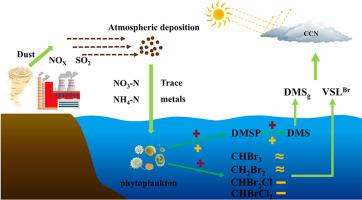
Dimethylsulfide (DMS) and very short-lived bromocarbons (VSLBr) are important biogenic trace gases emitted from oceans that can affect the global climate. Atmospheric deposition (AD) can provide nutrients and trace metals to the ocean, which can enhance primary productivity, but the complex effects of AD on DMS and VSLBr are still largely unexplored. A deck incubation experiment with aerosol additions was conducted to simulate the effects of acid-processed AD on the production of trace gases, including DMS and four VSLBr such as bromoform (CHBr3), dibromomethane (CH2Br2), dibromochloromethane (CHBr2Cl), and bromodichloromethane (CHBrCl2), in the oligotrophic western Pacific Ocean (WPO). During the incubation, the average concentrations of inorganic nitrates, DMS and VSLBr were significantly higher in the two aerosol treatments, indicating significant increases due to AD. Furthermore, the introduction of aerosols led to increases in the abundances of high DMS producers, specifically dinoflagellates, which contributed to the production of DMS. The acidified aerosol additions had a more pronounced influence on chlorophyll a and DMS, than non-acidified aerosol additions. However, the responses of VSLBr to the acidified aerosol treatment were more complex. The average CHBr3 and CH2Br2 values showed no significant differences between these two aerosol treatments, while the values of CHBr2Cl and CHBrCl2 were significantly lower in the acidified aerosol treatment. These results illustrated that aerosol additions promoted the production of DMS and the four VSLBr. Nevertheless, the concentrations of CHBr2Cl and CHBrCl2 were suppressed in the acidified aerosol treatment relative to the non-acidified aerosol addition.
期刊介绍:
Marine Environmental Research publishes original research papers on chemical, physical, and biological interactions in the oceans and coastal waters. The journal serves as a forum for new information on biology, chemistry, and toxicology and syntheses that advance understanding of marine environmental processes.
Submission of multidisciplinary studies is encouraged. Studies that utilize experimental approaches to clarify the roles of anthropogenic and natural causes of changes in marine ecosystems are especially welcome, as are those studies that represent new developments of a theoretical or conceptual aspect of marine science. All papers published in this journal are reviewed by qualified peers prior to acceptance and publication. Examples of topics considered to be appropriate for the journal include, but are not limited to, the following:
– The extent, persistence, and consequences of change and the recovery from such change in natural marine systems
– The biochemical, physiological, and ecological consequences of contaminants to marine organisms and ecosystems
– The biogeochemistry of naturally occurring and anthropogenic substances
– Models that describe and predict the above processes
– Monitoring studies, to the extent that their results provide new information on functional processes
– Methodological papers describing improved quantitative techniques for the marine sciences.



 京公网安备 11010802042870号
京ICP备2023020795号-1
京公网安备 11010802042870号
京ICP备2023020795号-1

 分享
分享
 求助内容:
求助内容: 应助结果提醒方式:
 扫码关注我们
