Shipeng Li, Xuanhao Zhang, Haodong Huang, Mou Yin, Matthew A. Jenks, Dylan K. Kosma, Pingfang Yang, Xianpeng Yang, Huayan Zhao, Shiyou Lü
{"title":"Deciphering the core shunt mechanism in Arabidopsis cuticular wax biosynthesis and its role in plant environmental adaptation","authors":"Shipeng Li, Xuanhao Zhang, Haodong Huang, Mou Yin, Matthew A. Jenks, Dylan K. Kosma, Pingfang Yang, Xianpeng Yang, Huayan Zhao, Shiyou Lü","doi":"10.1038/s41477-024-01892-9","DOIUrl":null,"url":null,"abstract":"Plant cuticular waxes serve as highly responsive adaptations to variable environments1–7. Aliphatic waxes consist of very-long-chain (VLC) compounds produced from 1-alcohol- or alkane-forming pathways5,8. The existing variation in 1-alcohols and alkanes across Arabidopsis accessions revealed that 1-alcohol amounts are negatively correlated with aridity factors, whereas alkanes display the opposite behaviour. How carbon resources are allocated between the 1-alcohol and alkane pathways responding to environmental stimuli is still largely unknown. Here, in Arabidopsis, we report a novel 1-alcohol biosynthesis pathway in which VLC acyl-CoAs are first reduced to aldehydes by CER3 and then converted into 1-alcohols via a newly identified putative aldehyde reductase SOH1. CER3, previously shown to interact with CER1 in alkane synthesis, is identified to interact with SOH1 as well, channelling wax precursors into either alcohol- or alkane-forming pathways, and the directional shunting of these precursors is tightly regulated by the SOH1–CER3–CER1 module in response to environmental conditions. The study uncovered a novel wax alcohol-forming pathway involving a two-step reduction process and further elucidated the carbon relocation mechanism between the alcohol- and alkane-forming pathway in response to environmental cues.","PeriodicalId":18904,"journal":{"name":"Nature Plants","volume":"11 2","pages":"165-175"},"PeriodicalIF":13.6000,"publicationDate":"2025-01-03","publicationTypes":"Journal Article","fieldsOfStudy":null,"isOpenAccess":false,"openAccessPdf":"","citationCount":"0","resultStr":null,"platform":"Semanticscholar","paperid":null,"PeriodicalName":"Nature Plants","FirstCategoryId":"99","ListUrlMain":"https://www.nature.com/articles/s41477-024-01892-9","RegionNum":1,"RegionCategory":"生物学","ArticlePicture":[],"TitleCN":null,"AbstractTextCN":null,"PMCID":null,"EPubDate":"","PubModel":"","JCR":"Q1","JCRName":"PLANT SCIENCES","Score":null,"Total":0}
引用次数: 0
Abstract
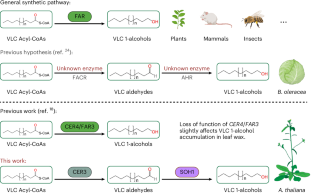
Plant cuticular waxes serve as highly responsive adaptations to variable environments1–7. Aliphatic waxes consist of very-long-chain (VLC) compounds produced from 1-alcohol- or alkane-forming pathways5,8. The existing variation in 1-alcohols and alkanes across Arabidopsis accessions revealed that 1-alcohol amounts are negatively correlated with aridity factors, whereas alkanes display the opposite behaviour. How carbon resources are allocated between the 1-alcohol and alkane pathways responding to environmental stimuli is still largely unknown. Here, in Arabidopsis, we report a novel 1-alcohol biosynthesis pathway in which VLC acyl-CoAs are first reduced to aldehydes by CER3 and then converted into 1-alcohols via a newly identified putative aldehyde reductase SOH1. CER3, previously shown to interact with CER1 in alkane synthesis, is identified to interact with SOH1 as well, channelling wax precursors into either alcohol- or alkane-forming pathways, and the directional shunting of these precursors is tightly regulated by the SOH1–CER3–CER1 module in response to environmental conditions. The study uncovered a novel wax alcohol-forming pathway involving a two-step reduction process and further elucidated the carbon relocation mechanism between the alcohol- and alkane-forming pathway in response to environmental cues.
期刊介绍:
Nature Plants is an online-only, monthly journal publishing the best research on plants — from their evolution, development, metabolism and environmental interactions to their societal significance.




 京公网安备 11010802042870号
京ICP备2023020795号-1
京公网安备 11010802042870号
京ICP备2023020795号-1

 分享
分享
 求助内容:
求助内容: 应助结果提醒方式:
 扫码关注我们
