{"title":"Chemical precipitation processes valorizing two waste streams amalgamating Fe-rich welding wastewater and P-rich swine slurry leachate into FePO4","authors":"Thi-Hanh Ha , Yao-Hui Huang , Ming-Chun Lu","doi":"10.1016/j.jclepro.2024.144632","DOIUrl":null,"url":null,"abstract":"<div><div>Phosphorus (P) is a finite resource, necessitating regulated extraction. This study recovered P from solid swine slurry (SSS) as FePO<sub>4</sub> through acid leaching and precipitation. Two systems—conventional batch stirred reactor (CBR) and fluidized-bed reactor (FBR)—were used to recover phosphorus as iron phosphate from SSS. Optimal P leaching was achieved with 0.16 mol/L HCl and an L/S ratio of 60 mL/g, reaching 99% leaching efficiency. FePO<sub>4</sub> was precipitated by adding Fe(III)-rich industrial wastewater at a 1.6:1 molar ratio (MR) and controlling the mixing solution pH to 4.5. The CBR system achieved 95.3% P removal, while the FBR reached 52.4% crystallization and 96.2% total P removal. Analyses confirmed the FePO<sub>4</sub> purity, with FBR products having lower water content (7.1%) compared to the batch system (91.8%). This study demonstrates the potential for P recovery by converting Fe-rich industrial wastewater and SSS-derived P into FePO<sub>4</sub>.</div></div>","PeriodicalId":349,"journal":{"name":"Journal of Cleaner Production","volume":"488 ","pages":"Article 144632"},"PeriodicalIF":10.0000,"publicationDate":"2025-01-10","publicationTypes":"Journal Article","fieldsOfStudy":null,"isOpenAccess":false,"openAccessPdf":"","citationCount":"0","resultStr":null,"platform":"Semanticscholar","paperid":null,"PeriodicalName":"Journal of Cleaner Production","FirstCategoryId":"93","ListUrlMain":"https://www.sciencedirect.com/science/article/pii/S0959652624040812","RegionNum":1,"RegionCategory":"环境科学与生态学","ArticlePicture":[],"TitleCN":null,"AbstractTextCN":null,"PMCID":null,"EPubDate":"2025/1/3 0:00:00","PubModel":"Epub","JCR":"Q1","JCRName":"ENGINEERING, ENVIRONMENTAL","Score":null,"Total":0}
引用次数: 0
Abstract
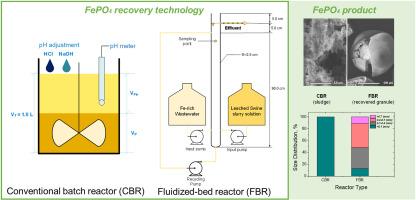
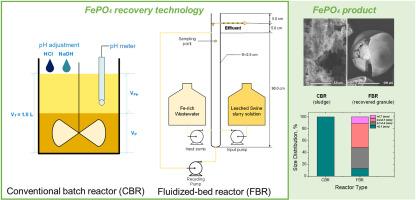
Phosphorus (P) is a finite resource, necessitating regulated extraction. This study recovered P from solid swine slurry (SSS) as FePO4 through acid leaching and precipitation. Two systems—conventional batch stirred reactor (CBR) and fluidized-bed reactor (FBR)—were used to recover phosphorus as iron phosphate from SSS. Optimal P leaching was achieved with 0.16 mol/L HCl and an L/S ratio of 60 mL/g, reaching 99% leaching efficiency. FePO4 was precipitated by adding Fe(III)-rich industrial wastewater at a 1.6:1 molar ratio (MR) and controlling the mixing solution pH to 4.5. The CBR system achieved 95.3% P removal, while the FBR reached 52.4% crystallization and 96.2% total P removal. Analyses confirmed the FePO4 purity, with FBR products having lower water content (7.1%) compared to the batch system (91.8%). This study demonstrates the potential for P recovery by converting Fe-rich industrial wastewater and SSS-derived P into FePO4.
期刊介绍:
The Journal of Cleaner Production is an international, transdisciplinary journal that addresses and discusses theoretical and practical Cleaner Production, Environmental, and Sustainability issues. It aims to help societies become more sustainable by focusing on the concept of 'Cleaner Production', which aims at preventing waste production and increasing efficiencies in energy, water, resources, and human capital use. The journal serves as a platform for corporations, governments, education institutions, regions, and societies to engage in discussions and research related to Cleaner Production, environmental, and sustainability practices.



 京公网安备 11010802042870号
京ICP备2023020795号-1
京公网安备 11010802042870号
京ICP备2023020795号-1

 分享
分享
 求助内容:
求助内容: 应助结果提醒方式:
 扫码关注我们
