Enhanced butanol tolerance and production from puerariae slag hydrolysate by Clostridium beijerinckii through metabolic engineering and process regulation strategies
Zhiyou Zhou , Huanhuan Ding , Chaoyue Shi , Shuaiyin Peng , Biao Zhu , Xuejiao An , Hanguang Li
{"title":"Enhanced butanol tolerance and production from puerariae slag hydrolysate by Clostridium beijerinckii through metabolic engineering and process regulation strategies","authors":"Zhiyou Zhou , Huanhuan Ding , Chaoyue Shi , Shuaiyin Peng , Biao Zhu , Xuejiao An , Hanguang Li","doi":"10.1016/j.biortech.2025.132035","DOIUrl":null,"url":null,"abstract":"<div><div>Butanol is a more desirable second-generation biomass energy source. Acetone-butanol-ethanol (ABE) fermentation using <em>Clostridium</em> spp. is a promising method for butanol production. However, the toxicity of butanol to the producing strains leading to its low yield and the high cost of feedstock are the main obstacles limiting the ABE fermentation industry. In this study, to enhance the butanol tolerance and production in <em>Clostridium beijerinckii</em> D9, the strategies of metabolic engineering and process regulation were employed. With this effort, a recombinant strain D9/<em>pykA</em> was successfully developed. Furthermore, the effect of exogenous fermentation waste streams and their two-stage addition strategy on ABE fermentation was also investigated. Under the optimal condition, the highest butanol and total solvent production of 11.20 ± 0.58 g/L and 13.65 ± 0.51 g/L was achieved in <em>C. beijerinckii</em> D9/<em>pykA</em>, representing increases of 40.70 % and 37.05 %, respectively, compared to the original strain D9. Additionally, the results of the physiological mechanism revealed that the two-stage fermentation waste stream addition improved NADH synthesis and upregulated key genes involved in butanol biosynthesis, and thus enhancing the production. These insights could provide a foundation for further optimization of ABE fermentation processes and offer promising avenues for improving other similar research.</div></div>","PeriodicalId":258,"journal":{"name":"Bioresource Technology","volume":"419 ","pages":"Article 132035"},"PeriodicalIF":9.0000,"publicationDate":"2025-01-02","publicationTypes":"Journal Article","fieldsOfStudy":null,"isOpenAccess":false,"openAccessPdf":"","citationCount":"0","resultStr":null,"platform":"Semanticscholar","paperid":null,"PeriodicalName":"Bioresource Technology","FirstCategoryId":"5","ListUrlMain":"https://www.sciencedirect.com/science/article/pii/S096085242500001X","RegionNum":1,"RegionCategory":"环境科学与生态学","ArticlePicture":[],"TitleCN":null,"AbstractTextCN":null,"PMCID":null,"EPubDate":"","PubModel":"","JCR":"Q1","JCRName":"AGRICULTURAL ENGINEERING","Score":null,"Total":0}
引用次数: 0
Abstract
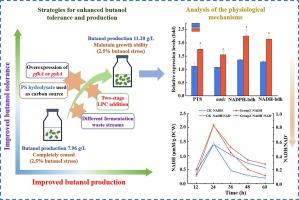
Butanol is a more desirable second-generation biomass energy source. Acetone-butanol-ethanol (ABE) fermentation using Clostridium spp. is a promising method for butanol production. However, the toxicity of butanol to the producing strains leading to its low yield and the high cost of feedstock are the main obstacles limiting the ABE fermentation industry. In this study, to enhance the butanol tolerance and production in Clostridium beijerinckii D9, the strategies of metabolic engineering and process regulation were employed. With this effort, a recombinant strain D9/pykA was successfully developed. Furthermore, the effect of exogenous fermentation waste streams and their two-stage addition strategy on ABE fermentation was also investigated. Under the optimal condition, the highest butanol and total solvent production of 11.20 ± 0.58 g/L and 13.65 ± 0.51 g/L was achieved in C. beijerinckii D9/pykA, representing increases of 40.70 % and 37.05 %, respectively, compared to the original strain D9. Additionally, the results of the physiological mechanism revealed that the two-stage fermentation waste stream addition improved NADH synthesis and upregulated key genes involved in butanol biosynthesis, and thus enhancing the production. These insights could provide a foundation for further optimization of ABE fermentation processes and offer promising avenues for improving other similar research.
期刊介绍:
Bioresource Technology publishes original articles, review articles, case studies, and short communications covering the fundamentals, applications, and management of bioresource technology. The journal seeks to advance and disseminate knowledge across various areas related to biomass, biological waste treatment, bioenergy, biotransformations, bioresource systems analysis, and associated conversion or production technologies.
Topics include:
• Biofuels: liquid and gaseous biofuels production, modeling and economics
• Bioprocesses and bioproducts: biocatalysis and fermentations
• Biomass and feedstocks utilization: bioconversion of agro-industrial residues
• Environmental protection: biological waste treatment
• Thermochemical conversion of biomass: combustion, pyrolysis, gasification, catalysis.



 京公网安备 11010802042870号
京ICP备2023020795号-1
京公网安备 11010802042870号
京ICP备2023020795号-1

 分享
分享
 求助内容:
求助内容: 应助结果提醒方式:
 扫码关注我们
