Christian Ritschel, Lena J. Daumann and Claus Feldmann
{"title":"Inorganic–organic hybrid nanoparticles with carbonate-triggered emission-colour-shift†","authors":"Christian Ritschel, Lena J. Daumann and Claus Feldmann","doi":"10.1039/D4DT02344G","DOIUrl":null,"url":null,"abstract":"<p >(Eu<small><sup>3+</sup></small><small><sub>4</sub></small>[PTC]<small><sup>4–</sup></small><small><sub>3</sub></small>)<small><sub>0.78</sub></small>(Eu<small><sup>3+</sup></small>[TREN-1,2-HOPO]<small><sup>3−</sup></small>)<small><sub>0.22</sub></small> inorganic–organic hybrid nanoparticles (IOH-NPs) contain Eu<small><sup>3+</sup></small>, tris[(1-hydroxy-2-oxo-1,2-dihydropyridine-6-carboxamido)ethyl]amine (TREN-1,2-HOPO) and perylene-3,4,9,10-tetracarboxylate (PTC). The IOH-NPs are prepared in water and exhibit a rod-type shape, with a length of 60 nm and a diameter of 5 nm. Particle size and chemical composition are examined by different methods (SEM, DLS, FT-IR, TG, C/H/N analysis). With TREN-1,2-HOPO as antenna, the IOH-NPs show Eu<small><sup>3+</sup></small>-based red emission, whereas the PTC emission is totally quenched due to π-stacking in the solid nanoparticles. After addition of carbonate, PTC is released from the IOH-NPs into solution, resulting in an increasing green emission of free PTC. The resulting carbonate-driven shift of the emission colour from red to green surprisingly allows to determine the carbonate concentration qualitatively and quantitatively in a concentration range of 1 μM to 2 mM and was tested for tap water as a specific example.</p>","PeriodicalId":71,"journal":{"name":"Dalton Transactions","volume":" 4","pages":" 1348-1353"},"PeriodicalIF":3.3000,"publicationDate":"2025-01-06","publicationTypes":"Journal Article","fieldsOfStudy":null,"isOpenAccess":false,"openAccessPdf":"https://pubs.rsc.org/en/content/articlepdf/2025/dt/d4dt02344g?page=search","citationCount":"0","resultStr":null,"platform":"Semanticscholar","paperid":null,"PeriodicalName":"Dalton Transactions","FirstCategoryId":"92","ListUrlMain":"https://pubs.rsc.org/en/content/articlelanding/2025/dt/d4dt02344g","RegionNum":3,"RegionCategory":"化学","ArticlePicture":[],"TitleCN":null,"AbstractTextCN":null,"PMCID":null,"EPubDate":"","PubModel":"","JCR":"Q2","JCRName":"CHEMISTRY, INORGANIC & NUCLEAR","Score":null,"Total":0}
引用次数: 0
Abstract
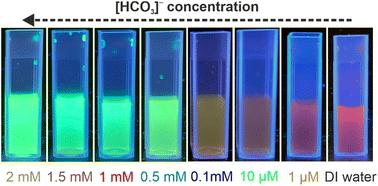
(Eu3+4[PTC]4–3)0.78(Eu3+[TREN-1,2-HOPO]3−)0.22 inorganic–organic hybrid nanoparticles (IOH-NPs) contain Eu3+, tris[(1-hydroxy-2-oxo-1,2-dihydropyridine-6-carboxamido)ethyl]amine (TREN-1,2-HOPO) and perylene-3,4,9,10-tetracarboxylate (PTC). The IOH-NPs are prepared in water and exhibit a rod-type shape, with a length of 60 nm and a diameter of 5 nm. Particle size and chemical composition are examined by different methods (SEM, DLS, FT-IR, TG, C/H/N analysis). With TREN-1,2-HOPO as antenna, the IOH-NPs show Eu3+-based red emission, whereas the PTC emission is totally quenched due to π-stacking in the solid nanoparticles. After addition of carbonate, PTC is released from the IOH-NPs into solution, resulting in an increasing green emission of free PTC. The resulting carbonate-driven shift of the emission colour from red to green surprisingly allows to determine the carbonate concentration qualitatively and quantitatively in a concentration range of 1 μM to 2 mM and was tested for tap water as a specific example.
期刊介绍:
Dalton Transactions is a journal for all areas of inorganic chemistry, which encompasses the organometallic, bioinorganic and materials chemistry of the elements, with applications including synthesis, catalysis, energy conversion/storage, electrical devices and medicine. Dalton Transactions welcomes high-quality, original submissions in all of these areas and more, where the advancement of knowledge in inorganic chemistry is significant.



 京公网安备 11010802042870号
京ICP备2023020795号-1
京公网安备 11010802042870号
京ICP备2023020795号-1

 分享
分享
 求助内容:
求助内容: 应助结果提醒方式:
 扫码关注我们
