{"title":"Structural-morphological insights into optimization of hydrothermally synthesized MoSe2 nanoflowers for improving supercapacitor applications†","authors":"Poonam Yadav, Rohit Yadav, Jitesh Pani, Ram Mehar Singh, Davender Singh, Kusum Kumari, Hitesh Borkar and Jitendra Gangwar","doi":"10.1039/D4DT02993C","DOIUrl":null,"url":null,"abstract":"<p >The present work reports a clear and improved hydrothermal methodology for the synthesis of MoSe<small><sub>2</sub></small> nanoflowers (MNFs) at 210 °C. To observe the effect of temperature on the fascinating properties, the process temperature was modified by ±10 °C. The as-prepared MNFs were found to consist of 2D nanosheets, which assembled into a 3D flower-like hierarchical morphology <em>via</em> van der Waals forces. The elemental composition and mapping of the MNFs reveal that the constituents are uniformly distributed throughout the material. Crystallographic and structural analyses confirmed that the as-synthesized MNFs were of a highly crystalline nature with a two-layer hexagonal (2H) phase of MoSe<small><sub>2</sub></small> (2H-MoSe<small><sub>2</sub></small>). Additionally, the microstructure and lattice-scale features of the MNFs studied using HRTEM disclosed ultrathin nanosheets of thickness ∼3 nm, which were a few atomic layers thick. A plausible formation and growth mechanism of the as-prepared MNFs is also proposed. For the purpose of developing supercapacitors, the electrochemical energy storage characteristics of the synthesized MNFs were examined. Maximum specific capacitance of 284.8 F g<small><sup>−1</sup></small> at 5 mV s<small><sup>−1</sup></small> scan rate was demonstrated by the three-electrode setup, and the capacitance retention was about 88%, even after 10 000 cycles. As an electrode material for supercapacitors, MNFs have great potential due to their high specific capacitance and exceptional cycling stability.</p>","PeriodicalId":71,"journal":{"name":"Dalton Transactions","volume":" 8","pages":" 3277-3286"},"PeriodicalIF":3.3000,"publicationDate":"2025-01-06","publicationTypes":"Journal Article","fieldsOfStudy":null,"isOpenAccess":false,"openAccessPdf":"","citationCount":"0","resultStr":null,"platform":"Semanticscholar","paperid":null,"PeriodicalName":"Dalton Transactions","FirstCategoryId":"92","ListUrlMain":"https://pubs.rsc.org/en/content/articlelanding/2025/dt/d4dt02993c","RegionNum":3,"RegionCategory":"化学","ArticlePicture":[],"TitleCN":null,"AbstractTextCN":null,"PMCID":null,"EPubDate":"","PubModel":"","JCR":"Q2","JCRName":"CHEMISTRY, INORGANIC & NUCLEAR","Score":null,"Total":0}
引用次数: 0
Abstract
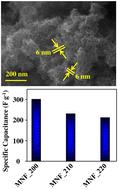
The present work reports a clear and improved hydrothermal methodology for the synthesis of MoSe2 nanoflowers (MNFs) at 210 °C. To observe the effect of temperature on the fascinating properties, the process temperature was modified by ±10 °C. The as-prepared MNFs were found to consist of 2D nanosheets, which assembled into a 3D flower-like hierarchical morphology via van der Waals forces. The elemental composition and mapping of the MNFs reveal that the constituents are uniformly distributed throughout the material. Crystallographic and structural analyses confirmed that the as-synthesized MNFs were of a highly crystalline nature with a two-layer hexagonal (2H) phase of MoSe2 (2H-MoSe2). Additionally, the microstructure and lattice-scale features of the MNFs studied using HRTEM disclosed ultrathin nanosheets of thickness ∼3 nm, which were a few atomic layers thick. A plausible formation and growth mechanism of the as-prepared MNFs is also proposed. For the purpose of developing supercapacitors, the electrochemical energy storage characteristics of the synthesized MNFs were examined. Maximum specific capacitance of 284.8 F g−1 at 5 mV s−1 scan rate was demonstrated by the three-electrode setup, and the capacitance retention was about 88%, even after 10 000 cycles. As an electrode material for supercapacitors, MNFs have great potential due to their high specific capacitance and exceptional cycling stability.
期刊介绍:
Dalton Transactions is a journal for all areas of inorganic chemistry, which encompasses the organometallic, bioinorganic and materials chemistry of the elements, with applications including synthesis, catalysis, energy conversion/storage, electrical devices and medicine. Dalton Transactions welcomes high-quality, original submissions in all of these areas and more, where the advancement of knowledge in inorganic chemistry is significant.



 京公网安备 11010802042870号
京ICP备2023020795号-1
京公网安备 11010802042870号
京ICP备2023020795号-1

 分享
分享
 求助内容:
求助内容: 应助结果提醒方式:
 扫码关注我们
