Jiayao Shan, Rong Gu, Jinting Xu, Shuaiqi Gong, Shuainan Guo, Qunjie Xu, Penghui Shi, YuLin Min
{"title":"Heterojunction Ferroelectric Materials Enhance Ion Transport and Fast Charging of Polymer Solid Electrolytes for Lithium Metal Batteries","authors":"Jiayao Shan, Rong Gu, Jinting Xu, Shuaiqi Gong, Shuainan Guo, Qunjie Xu, Penghui Shi, YuLin Min","doi":"10.1002/aenm.202405220","DOIUrl":null,"url":null,"abstract":"<p>Solid polymer electrolytes offer great promise for all-solid-state batteries, but their advancement is constrained due to the low ionic conductivity at ambient temperature and non-uniform ion transport, which hampers fast-charging capabilities. In this study, a ferroelectric heterojunction composite is incorporated into poly(vinylidene difluoride) (PVDF) based solid electrolytes to establish an interfacial electric field that enhances lithium salt dissociation and promotes uniform ion deposition. Electrospun 1D BaTiO<sub>3</sub> nanofibers serve as a long-range organic/inorganic (polymer/filler) interface for ion transport, while MoSe<sub>2</sub> hydrothermally grown on BaTiO<sub>3</sub> forms Li<sub>2</sub>Se-rich high-speed ion conductors. The piezoelectric effect of the ferroelectric material helps suppress lithium dendrite growth by reversing internal charges and reducing local overpotentials. Consequently, the PVBM electrolyte achieves a substantia ionic conductivity of 6.5 × 10<sup>−4</sup> S cm<sup>−1</sup> and a Li-ion transference number of 0.61 at 25 °C. The LiFePO<sub>4</sub>/PVBM/Li solid-state batteries demonstrate an initial discharge capacity of 146 mAh g<sup>−1</sup> at 1 C, with a capacity preservation of 80.2% upon completion of 1200 cycles, and an initial discharge capacity of 110.7 mAh g<sup>−1</sup> at 5 C. These findings highlight the prospect of ferroelectric ceramic fillers to significantly improve ion transport and fast-charging performance in polymer electrolytes.</p>","PeriodicalId":111,"journal":{"name":"Advanced Energy Materials","volume":"15 18","pages":""},"PeriodicalIF":26.0000,"publicationDate":"2025-01-05","publicationTypes":"Journal Article","fieldsOfStudy":null,"isOpenAccess":false,"openAccessPdf":"","citationCount":"0","resultStr":null,"platform":"Semanticscholar","paperid":null,"PeriodicalName":"Advanced Energy Materials","FirstCategoryId":"88","ListUrlMain":"https://advanced.onlinelibrary.wiley.com/doi/10.1002/aenm.202405220","RegionNum":1,"RegionCategory":"材料科学","ArticlePicture":[],"TitleCN":null,"AbstractTextCN":null,"PMCID":null,"EPubDate":"","PubModel":"","JCR":"Q1","JCRName":"CHEMISTRY, PHYSICAL","Score":null,"Total":0}
引用次数: 0
Abstract
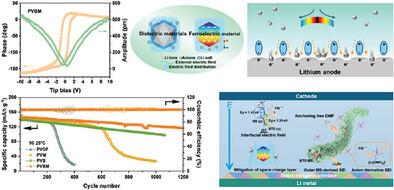
Solid polymer electrolytes offer great promise for all-solid-state batteries, but their advancement is constrained due to the low ionic conductivity at ambient temperature and non-uniform ion transport, which hampers fast-charging capabilities. In this study, a ferroelectric heterojunction composite is incorporated into poly(vinylidene difluoride) (PVDF) based solid electrolytes to establish an interfacial electric field that enhances lithium salt dissociation and promotes uniform ion deposition. Electrospun 1D BaTiO3 nanofibers serve as a long-range organic/inorganic (polymer/filler) interface for ion transport, while MoSe2 hydrothermally grown on BaTiO3 forms Li2Se-rich high-speed ion conductors. The piezoelectric effect of the ferroelectric material helps suppress lithium dendrite growth by reversing internal charges and reducing local overpotentials. Consequently, the PVBM electrolyte achieves a substantia ionic conductivity of 6.5 × 10⁻⁴ S cm−1 and a Li-ion transference number of 0.61 at 25 °C. The LiFePO4/PVBM/Li solid-state batteries demonstrate an initial discharge capacity of 146 mAh g−1 at 1 C, with a capacity preservation of 80.2% upon completion of 1200 cycles, and an initial discharge capacity of 110.7 mAh g−1 at 5 C. These findings highlight the prospect of ferroelectric ceramic fillers to significantly improve ion transport and fast-charging performance in polymer electrolytes.
固体聚合物电解质为全固态电池提供了巨大的前景,但由于环境温度下离子电导率低,离子传输不均匀,阻碍了快速充电能力,因此它们的发展受到限制。在本研究中,将铁电异质结复合材料加入聚偏氟乙烯(PVDF)基固体电解质中,建立界面电场,增强锂盐解离,促进均匀离子沉积。电纺丝1D BaTiO3纳米纤维作为离子传输的远程有机/无机(聚合物/填料)界面,而在BaTiO3上水热生长的MoSe2形成了富li2se的高速离子导体。铁电材料的压电效应有助于通过反转内部电荷和降低局部过电位来抑制锂枝晶的生长。因此,在25°C时,PVBM电解质的离子电导率为6.5 × 10−4 S cm−1,锂离子转移数为0.61。LiFePO4/PVBM/Li固态电池在1℃时的初始放电容量为146 mAh g−1,在完成1200次循环时的容量保留率为80.2%,在5℃时的初始放电容量为110.7 mAh g−1。这些研究结果突出了铁电陶瓷填料在显著改善聚合物电解质离子传输和快速充电性能方面的前景。
期刊介绍:
Established in 2011, Advanced Energy Materials is an international, interdisciplinary, English-language journal that focuses on materials used in energy harvesting, conversion, and storage. It is regarded as a top-quality journal alongside Advanced Materials, Advanced Functional Materials, and Small.
With a 2022 Impact Factor of 27.8, Advanced Energy Materials is considered a prime source for the best energy-related research. The journal covers a wide range of topics in energy-related research, including organic and inorganic photovoltaics, batteries and supercapacitors, fuel cells, hydrogen generation and storage, thermoelectrics, water splitting and photocatalysis, solar fuels and thermosolar power, magnetocalorics, and piezoelectronics.
The readership of Advanced Energy Materials includes materials scientists, chemists, physicists, and engineers in both academia and industry. The journal is indexed in various databases and collections, such as Advanced Technologies & Aerospace Database, FIZ Karlsruhe, INSPEC (IET), Science Citation Index Expanded, Technology Collection, and Web of Science, among others.



 京公网安备 11010802042870号
京ICP备2023020795号-1
京公网安备 11010802042870号
京ICP备2023020795号-1

 分享
分享
 求助内容:
求助内容: 应助结果提醒方式:
 扫码关注我们
