Guanshui Ma, Anfeng Zhang, Zhenyu Wang, Kaihang Wang, Jiayue Zhang, Kaixuan Xu, Yuxi Xu, Shenghao Zhou and Aiying Wang
{"title":"MAX phase coatings: synthesis, protective performance, and functional characteristics","authors":"Guanshui Ma, Anfeng Zhang, Zhenyu Wang, Kaihang Wang, Jiayue Zhang, Kaixuan Xu, Yuxi Xu, Shenghao Zhou and Aiying Wang","doi":"10.1039/D4MH01001A","DOIUrl":null,"url":null,"abstract":"<p >M<small><sub><em>n</em>+1</sub></small>AX<small><sub><em>n</em></sub></small> (MAX) phases are a novel class of materials with a closely packed hexagonal structure that bridge the gap between metals and ceramics, garnering tremendous research interest worldwide in recent years. Benefiting from their unique layered structure and mixed covalent–ionic–metallic bonding characteristics, MAX phase coatings possess excellent oxidation resistance, and exceptional electrical and thermal conductivities, making them highly promising for applications in advanced nuclear materials, battery plate protection materials, and aero-engine functional materials. This review aims to provide a comprehensive understanding of MAX phase coatings. It presents an overview of their compositions and microstructure, highlighting well-established structures like 211, 312, and 413. Furthermore, it delves into the various synthesis methods employed in fabricating MAX phase coatings, including physical vapor deposition, chemical vapor deposition, spraying methods, and laser cladding, among others. The potential applications of MAX phase coatings, high-temperature oxidation resistance, mechanical protection, salt spray corrosion resistance, <em>etc.</em>, are also investigated. Finally, this review discusses the future potential of MAX phase coatings and proposes areas for further research and improvement. The primary goal is to offer theoretical guidance and innovative ideas for the synthesis and development of superior MAX phase coatings for commercial applications.</p>","PeriodicalId":87,"journal":{"name":"Materials Horizons","volume":" 6","pages":" 1689-1710"},"PeriodicalIF":10.7000,"publicationDate":"2024-12-18","publicationTypes":"Journal Article","fieldsOfStudy":null,"isOpenAccess":false,"openAccessPdf":"","citationCount":"0","resultStr":null,"platform":"Semanticscholar","paperid":null,"PeriodicalName":"Materials Horizons","FirstCategoryId":"88","ListUrlMain":"https://pubs.rsc.org/en/content/articlelanding/2025/mh/d4mh01001a","RegionNum":2,"RegionCategory":"材料科学","ArticlePicture":[],"TitleCN":null,"AbstractTextCN":null,"PMCID":null,"EPubDate":"","PubModel":"","JCR":"Q1","JCRName":"CHEMISTRY, MULTIDISCIPLINARY","Score":null,"Total":0}
引用次数: 0
Abstract
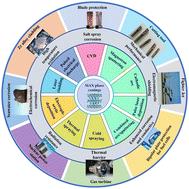
Mn+1AXn (MAX) phases are a novel class of materials with a closely packed hexagonal structure that bridge the gap between metals and ceramics, garnering tremendous research interest worldwide in recent years. Benefiting from their unique layered structure and mixed covalent–ionic–metallic bonding characteristics, MAX phase coatings possess excellent oxidation resistance, and exceptional electrical and thermal conductivities, making them highly promising for applications in advanced nuclear materials, battery plate protection materials, and aero-engine functional materials. This review aims to provide a comprehensive understanding of MAX phase coatings. It presents an overview of their compositions and microstructure, highlighting well-established structures like 211, 312, and 413. Furthermore, it delves into the various synthesis methods employed in fabricating MAX phase coatings, including physical vapor deposition, chemical vapor deposition, spraying methods, and laser cladding, among others. The potential applications of MAX phase coatings, high-temperature oxidation resistance, mechanical protection, salt spray corrosion resistance, etc., are also investigated. Finally, this review discusses the future potential of MAX phase coatings and proposes areas for further research and improvement. The primary goal is to offer theoretical guidance and innovative ideas for the synthesis and development of superior MAX phase coatings for commercial applications.



 京公网安备 11010802042870号
京ICP备2023020795号-1
京公网安备 11010802042870号
京ICP备2023020795号-1

 分享
分享
 求助内容:
求助内容: 应助结果提醒方式:
 扫码关注我们
