Social jetlag and sleep habits in children and adolescents: Associations with autonomy (bedtime setting and electronics curfew) and electronic media use before sleep.
Gaby Illingworth, Tanya Manchanda, Simona Skripkauskaite, Mina Fazel, Felicity Waite
{"title":"Social jetlag and sleep habits in children and adolescents: Associations with autonomy (bedtime setting and electronics curfew) and electronic media use before sleep.","authors":"Gaby Illingworth, Tanya Manchanda, Simona Skripkauskaite, Mina Fazel, Felicity Waite","doi":"10.1080/07420528.2024.2444675","DOIUrl":null,"url":null,"abstract":"<p><p>For young people attending school, social jetlag (SJL) refers to discrepancy in sleep/wake timing between school days and weekends. This study investigated SJL in school-aged children and adolescents in England and whether this is associated with age, gender, and sleep habits including bedtimes and electronic media use. Students (school y 5-13; typical age 9-18 y) completed the 2021 OxWell Student Survey. In total 19,760 participants (55% female) reported on sleep/wake timing, rules concerning bedtime setting on school night/weekend, electronic media curfew, and frequency of social media use and video gaming before sleep intention. The mean SJL was 1 h 53 min (<i>SD</i> = 1 h 7 min) and peaked at 2 h 7 min at age 15. Multiple regression analysis revealed SJL was positively associated with age and being male was associated with slightly lower SJL than being female. After controlling for age and gender, weekend bedtime setting (β = 0.21), frequency of social media use before sleep (β = 0.16) and video gaming before sleep (β = 0.12) were the strongest predictors of SJL. Findings suggest that household rules regarding weekend bedtimes and less electronic media use before sleep may be connected with lower SJL as well as more regular sleep timing across the whole week.</p>","PeriodicalId":10294,"journal":{"name":"Chronobiology International","volume":" ","pages":"46-57"},"PeriodicalIF":1.7000,"publicationDate":"2025-01-01","publicationTypes":"Journal Article","fieldsOfStudy":null,"isOpenAccess":false,"openAccessPdf":"https://www.ncbi.nlm.nih.gov/pmc/articles/PMC11854036/pdf/","citationCount":"0","resultStr":null,"platform":"Semanticscholar","paperid":null,"PeriodicalName":"Chronobiology International","FirstCategoryId":"3","ListUrlMain":"https://doi.org/10.1080/07420528.2024.2444675","RegionNum":4,"RegionCategory":"医学","ArticlePicture":[],"TitleCN":null,"AbstractTextCN":null,"PMCID":null,"EPubDate":"2025/1/6 0:00:00","PubModel":"Epub","JCR":"Q2","JCRName":"BIOLOGY","Score":null,"Total":0}
引用次数: 0
Abstract
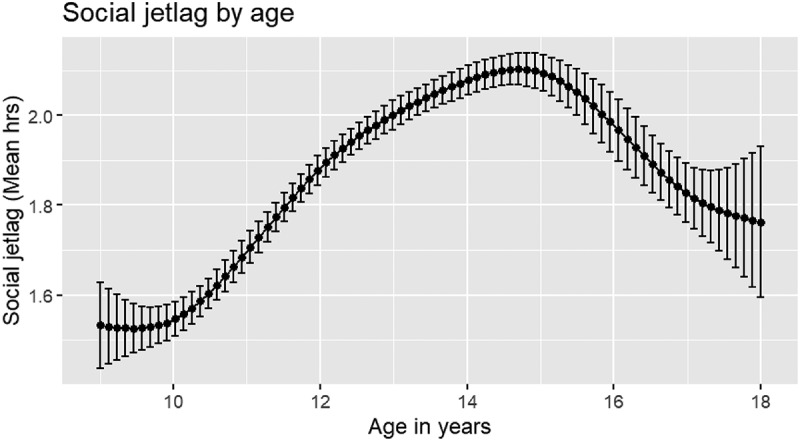
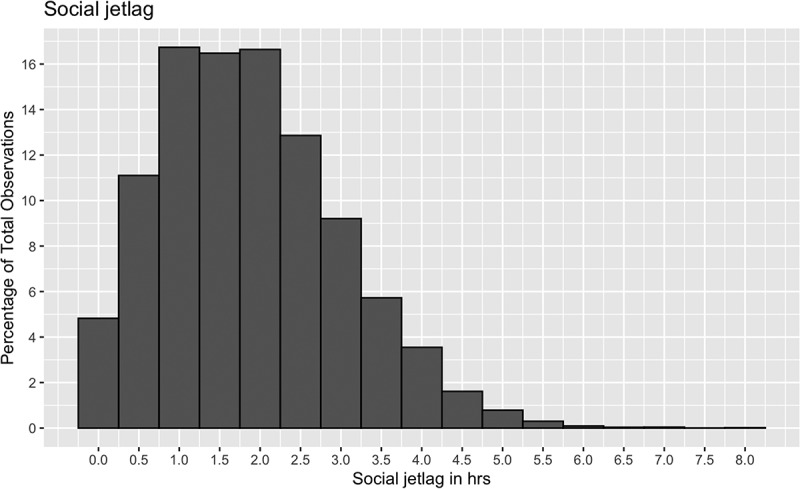
For young people attending school, social jetlag (SJL) refers to discrepancy in sleep/wake timing between school days and weekends. This study investigated SJL in school-aged children and adolescents in England and whether this is associated with age, gender, and sleep habits including bedtimes and electronic media use. Students (school y 5-13; typical age 9-18 y) completed the 2021 OxWell Student Survey. In total 19,760 participants (55% female) reported on sleep/wake timing, rules concerning bedtime setting on school night/weekend, electronic media curfew, and frequency of social media use and video gaming before sleep intention. The mean SJL was 1 h 53 min (SD = 1 h 7 min) and peaked at 2 h 7 min at age 15. Multiple regression analysis revealed SJL was positively associated with age and being male was associated with slightly lower SJL than being female. After controlling for age and gender, weekend bedtime setting (β = 0.21), frequency of social media use before sleep (β = 0.16) and video gaming before sleep (β = 0.12) were the strongest predictors of SJL. Findings suggest that household rules regarding weekend bedtimes and less electronic media use before sleep may be connected with lower SJL as well as more regular sleep timing across the whole week.
期刊介绍:
Chronobiology International is the journal of biological and medical rhythm research. It is a transdisciplinary journal focusing on biological rhythm phenomena of all life forms. The journal publishes groundbreaking articles plus authoritative review papers, short communications of work in progress, case studies, and letters to the editor, for example, on genetic and molecular mechanisms of insect, animal and human biological timekeeping, including melatonin and pineal gland rhythms. It also publishes applied topics, for example, shiftwork, chronotypes, and associated personality traits; chronobiology and chronotherapy of sleep, cardiovascular, pulmonary, psychiatric, and other medical conditions. Articles in the journal pertain to basic and applied chronobiology, and to methods, statistics, and instrumentation for biological rhythm study.
Read More: http://informahealthcare.com/page/cbi/Description



 京公网安备 11010802042870号
京ICP备2023020795号-1
京公网安备 11010802042870号
京ICP备2023020795号-1

 分享
分享
 求助内容:
求助内容: 应助结果提醒方式:
 扫码关注我们
