Helena Nti , Seth Adu-Afarwuah , Brietta M Oaks , Elizabeth L Prado , Charles D Arnold , Paul D. Hastings , Amanda E Guyer , Kathryn G Dewey , Benjamin Amponsah , Helena J Bentil , Mavis Osipi Mensah , Ebenezer Adjetey , Xiuping Tan , Lois Maame Donkor Aryee , Fatimah Bintu Ayete Labi , Adom Manu
{"title":"Impact of Small-Quantity Lipid-Based Nutrient Supplements on Pubertal Status of 9–13-Year Olds: A Follow-Up Study of the iLiNS-DYAD-Ghana Trial","authors":"Helena Nti , Seth Adu-Afarwuah , Brietta M Oaks , Elizabeth L Prado , Charles D Arnold , Paul D. Hastings , Amanda E Guyer , Kathryn G Dewey , Benjamin Amponsah , Helena J Bentil , Mavis Osipi Mensah , Ebenezer Adjetey , Xiuping Tan , Lois Maame Donkor Aryee , Fatimah Bintu Ayete Labi , Adom Manu","doi":"10.1016/j.cdnut.2024.104458","DOIUrl":null,"url":null,"abstract":"<div><h3>Background</h3><div>Early and delayed puberty are both associated with adverse health and psychosocial outcomes.</div></div><div><h3>Objectives</h3><div>We assessed the impact of provision of small-quantity lipid-based nutrient supplement (SQ-LNS) to mothers during pregnancy and 6 mo postpartum and to their children aged 6–18 mo, on pubertal status.</div></div><div><h3>Methods</h3><div>This study was a follow-up to a partially double-blind randomized controlled trial. At ≤20 wk, 1320 females were randomly assigned to receive daily: iron and folic acid during pregnancy and placebo 0–6 mo postpartum; or multiple micronutrients during pregnancy and 0–6 mo postpartum; or SQ-LNS during pregnancy and 0–6 mo postpartum and to their children from 6 to 18 mo. We re-enrolled 966 and 919 children at 9–11 y and 11–13 y, respectively. We calculated a total pubertal status score based on the Petersen Pubertal Development Scale (PDS) to assess growth spurt, skin changes, body hair, facial hair, voice break, breast development, and menstruation. Pubertal status was regressed on child’s age to generate age-adjusted PDS z-scores (aPDSZ); we performed interaction and mediation analyses.</div></div><div><h3>Results</h3><div>Mean ± standard deviation aPDSZ did not differ between the SQ-LNS and non-LNS groups at 9–11 y (0.01 ± 0.95 compared with –0.01 ± 0.98; <em>P</em> = 0.958) but was more advanced in the SQ-LNS group at 11–13 y (0.07 ± 1.04 compared with –0.04 ± 0.98; <em>P</em> = 0.049) in the adjusted model. The effect of SQ-LNS varied by sex (<em>P</em>-interaction = 0.003) and household asset index z-score (<em>P</em>-interaction = 0.002): Puberty was more advanced in the SQ-LNS compared with non-LNS group among females (<em>P</em> = 0.007) but not males (<em>P</em> = 0.877), and within lower (<em>P</em> = 0.002) than average (<em>P</em> = 0.436) and higher (<em>P</em> = 0.332) socioeconomic households.</div></div><div><h3>Conclusion</h3><div>Provision of SQ-LNS during the first 1000 d of life advanced pubertal status among females.</div></div><div><h3>Trial registration number</h3><div>This trial was registered at <span><span>clinicaltrials.gov</span><svg><path></path></svg></span> as NCT00970866 (<span><span>https://clinicaltrials.gov/ct2/show/record/NCT00970866</span><svg><path></path></svg></span>).</div></div>","PeriodicalId":10756,"journal":{"name":"Current Developments in Nutrition","volume":"8 12","pages":"Article 104458"},"PeriodicalIF":3.2000,"publicationDate":"2024-12-01","publicationTypes":"Journal Article","fieldsOfStudy":null,"isOpenAccess":false,"openAccessPdf":"https://www.ncbi.nlm.nih.gov/pmc/articles/PMC11697765/pdf/","citationCount":"0","resultStr":null,"platform":"Semanticscholar","paperid":null,"PeriodicalName":"Current Developments in Nutrition","FirstCategoryId":"1085","ListUrlMain":"https://www.sciencedirect.com/science/article/pii/S2475299124023928","RegionNum":0,"RegionCategory":null,"ArticlePicture":[],"TitleCN":null,"AbstractTextCN":null,"PMCID":null,"EPubDate":"","PubModel":"","JCR":"Q2","JCRName":"NUTRITION & DIETETICS","Score":null,"Total":0}
引用次数: 0
Abstract
Background
Early and delayed puberty are both associated with adverse health and psychosocial outcomes.
Objectives
We assessed the impact of provision of small-quantity lipid-based nutrient supplement (SQ-LNS) to mothers during pregnancy and 6 mo postpartum and to their children aged 6–18 mo, on pubertal status.
Methods
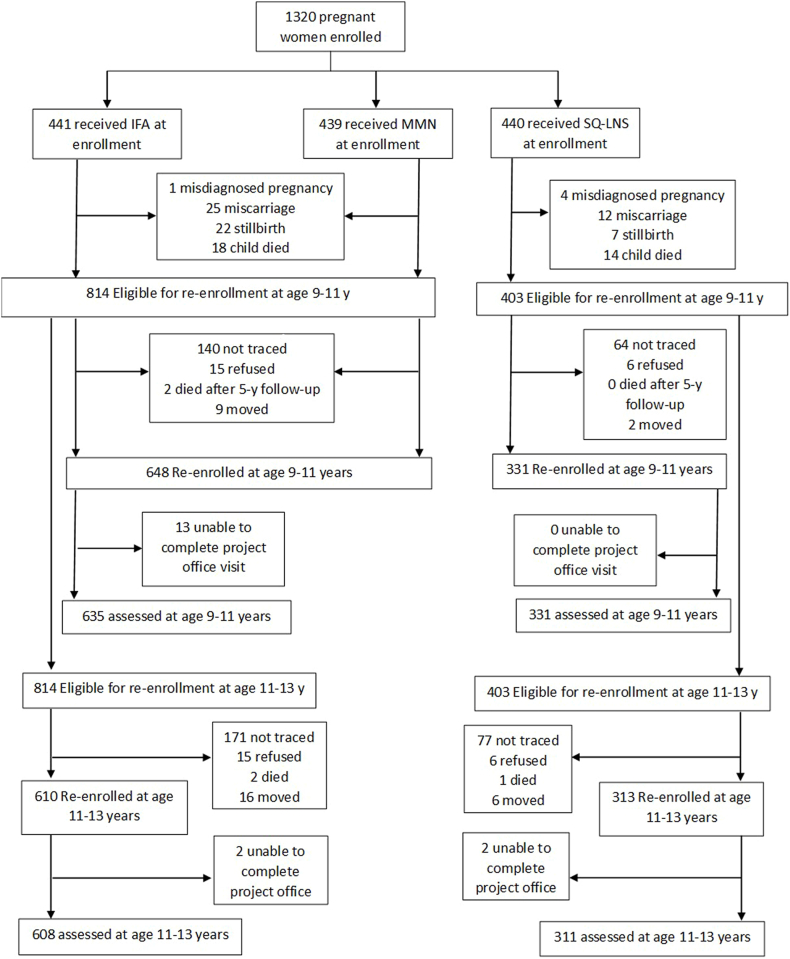
This study was a follow-up to a partially double-blind randomized controlled trial. At ≤20 wk, 1320 females were randomly assigned to receive daily: iron and folic acid during pregnancy and placebo 0–6 mo postpartum; or multiple micronutrients during pregnancy and 0–6 mo postpartum; or SQ-LNS during pregnancy and 0–6 mo postpartum and to their children from 6 to 18 mo. We re-enrolled 966 and 919 children at 9–11 y and 11–13 y, respectively. We calculated a total pubertal status score based on the Petersen Pubertal Development Scale (PDS) to assess growth spurt, skin changes, body hair, facial hair, voice break, breast development, and menstruation. Pubertal status was regressed on child’s age to generate age-adjusted PDS z-scores (aPDSZ); we performed interaction and mediation analyses.
Results
Mean ± standard deviation aPDSZ did not differ between the SQ-LNS and non-LNS groups at 9–11 y (0.01 ± 0.95 compared with –0.01 ± 0.98; P = 0.958) but was more advanced in the SQ-LNS group at 11–13 y (0.07 ± 1.04 compared with –0.04 ± 0.98; P = 0.049) in the adjusted model. The effect of SQ-LNS varied by sex (P-interaction = 0.003) and household asset index z-score (P-interaction = 0.002): Puberty was more advanced in the SQ-LNS compared with non-LNS group among females (P = 0.007) but not males (P = 0.877), and within lower (P = 0.002) than average (P = 0.436) and higher (P = 0.332) socioeconomic households.
Conclusion
Provision of SQ-LNS during the first 1000 d of life advanced pubertal status among females.
Trial registration number
This trial was registered at clinicaltrials.gov as NCT00970866 (https://clinicaltrials.gov/ct2/show/record/NCT00970866).






 京公网安备 11010802042870号
京ICP备2023020795号-1
京公网安备 11010802042870号
京ICP备2023020795号-1

 分享
分享
 求助内容:
求助内容: 应助结果提醒方式:
 扫码关注我们
